Resources

Tax Knowledge Centre

Curated articles, insights and visual guides on South African tax — written by practitioners, for practitioners.

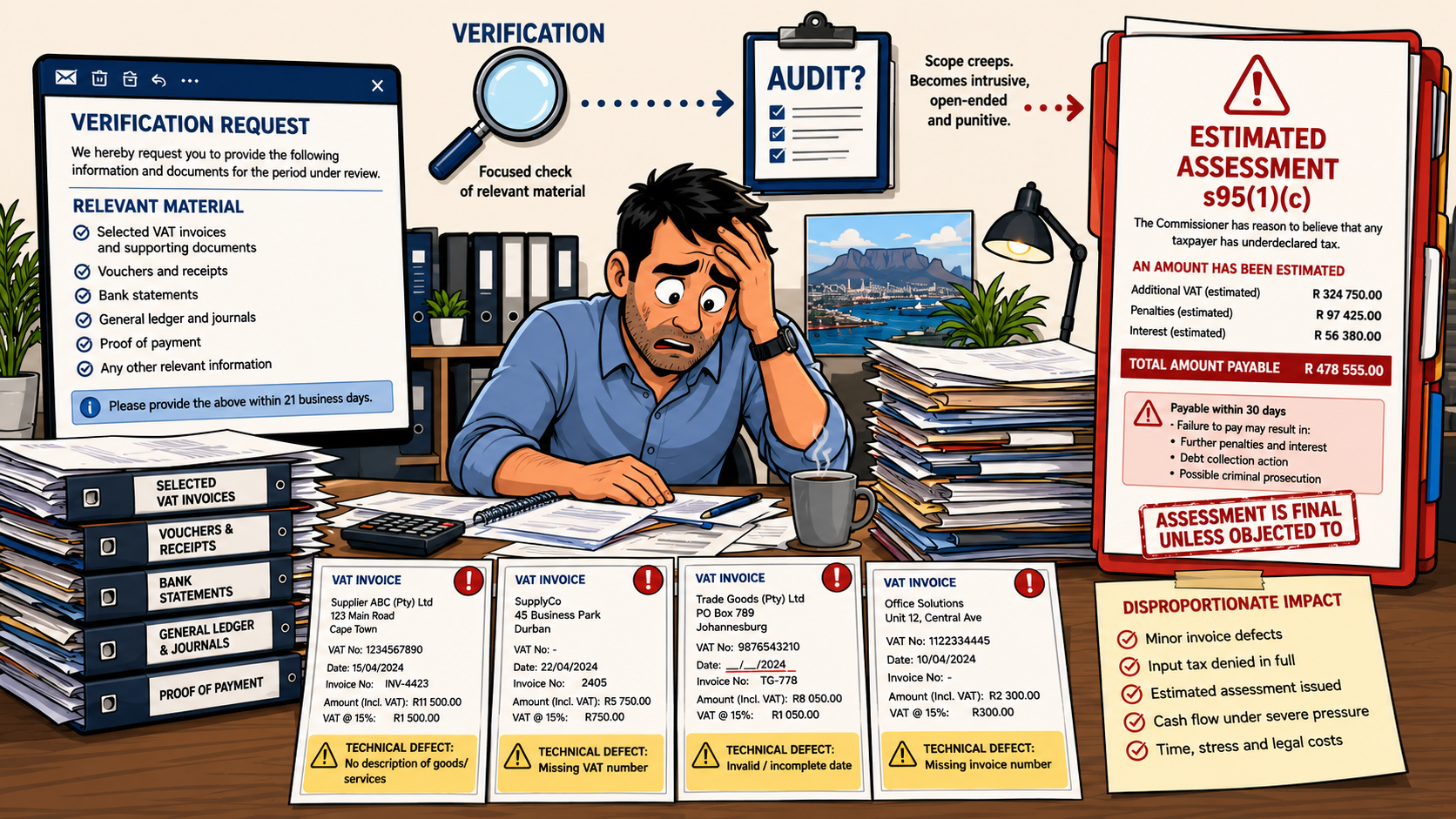
Infographic showing the SARS verification-to-audit escalation, estimated assessment breakdown and disproportionate impact on taxpayers

SARS section 95(1)(c) estimated assessments: when verification goes too far

When SARS verification letters become excessive, vague or punitive — and how taxpayers can respond before an estimated assessment is raised.

Introduction

SARS is increasingly issuing verification letters requesting "relevant material" and warning taxpayers that, if the material is not submitted, SARS may raise an estimated assessment under section 95(1)(c) of the Tax Administration Act.

This warning is serious. In VAT matters, SARS may reverse input tax. In income tax matters, SARS may disallow deductions or estimate taxable income. The result can be a substantial assessment, even where the underlying transaction is genuine and the taxpayer can ultimately prove the claim.

The issue is not whether SARS may request documents. SARS clearly has that power. The issue is whether SARS may rely on section 95(1)(c) where the request is vague, excessive, impractical, not properly received, or where SARS treats a minor defect as a basis for reversing the claim.

In my view, this is where the process may become procedurally unfair and, in appropriate cases, unlawful.

What section 95(1)(c) does

Section 95(1)(c) permits SARS to raise an assessment based on an estimate where the taxpayer does not respond to a request for relevant material under section 46 after more than one request has been delivered.

This power must be used carefully. Section 95(1)(c) is not a penalty provision. It is an estimating mechanism. SARS may use it where it cannot finalise the assessment because the taxpayer has failed to provide material that SARS properly required.

That does not mean SARS can make any request, however wide, and then raise an estimated assessment if the taxpayer does not comply perfectly. SARS must still act lawfully, reasonably and procedurally fairly. The estimate must also be rational and based on information available to SARS.

The purpose of relevant material in a verification

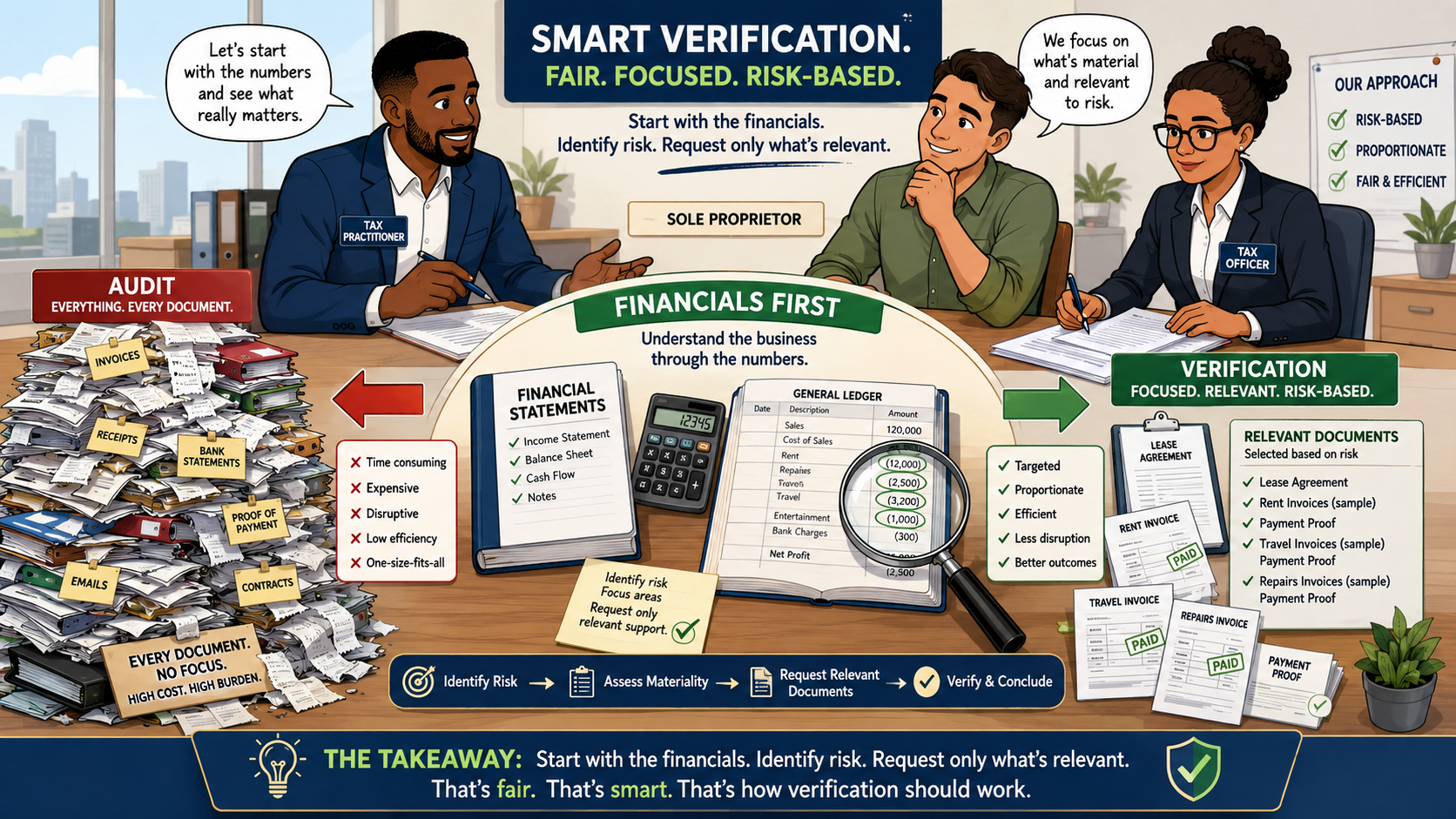
The key phrase is "relevant material". In a verification, SARS should be checking a specific item, claim, amount or risk in the return. Relevant material is material that helps SARS verify that specific issue.

A verification is not supposed to be an open-ended inspection of the taxpayer's entire accounting system. If SARS wants to verify VAT inputs, it may ask for selected invoices and proof of payment. If SARS wants to verify expenses, it should identify the expense category or claim. If SARS wants to verify turnover, it should identify the information needed to test turnover.

A proper request should therefore identify: what SARS is verifying; which documents are required; why those documents are relevant; how they must be submitted; and a reasonable time for compliance. If the taxpayer is left guessing what SARS wants, the request is defective.

VAT, sole proprietors and professional practices

The practical problem differs depending on the tax type and the taxpayer.

In VAT verifications, SARS does not necessarily request all input tax invoices. It often asks for a selection of the larger or higher-risk input invoices, together with proof of payment and supporting documents. That can be a legitimate verification process if the request is targeted and proportionate.

The problem arises where SARS reverses input tax mechanically because a selected invoice was not uploaded in time, was only partially provided, or contains a minor or curable defect. A vendor may have made a genuine taxable supply, paid the supplier, and hold records proving the transaction. In those circumstances, SARS should not treat a late upload, partial response or technical invoice defect as automatic proof that the input tax does not exist.

SARS should identify the defect, explain why it is material, and allow the taxpayer a fair opportunity to correct or explain it where possible.

In the case of sole proprietors and professional practices, the verification can be even more burdensome. SARS may request extensive documents relating to income, expenses, bank deposits, vouchers, proof of payment and supporting schedules. Depending on the wording and scope of the request, SARS may effectively be asking for the full accounting record of the practice.

That may no longer be a simple verification. It may be an audit in substance. A professional practice may have hundreds or thousands of transactions, client deposits, recoveries, disbursements, mixed business and personal payments, and several expense categories. A request for substantially all vouchers and supporting documents can therefore be extremely onerous.

The key point is that SARS must identify what it is verifying. A targeted request for selected VAT invoices may remain a verification. A broad request for substantially all records of a sole proprietor or professional practice may cross the line into audit. SARS should not use section 95(1)(c) to punish a taxpayer for failing to comply with a request that is unclear, excessive or impractical.

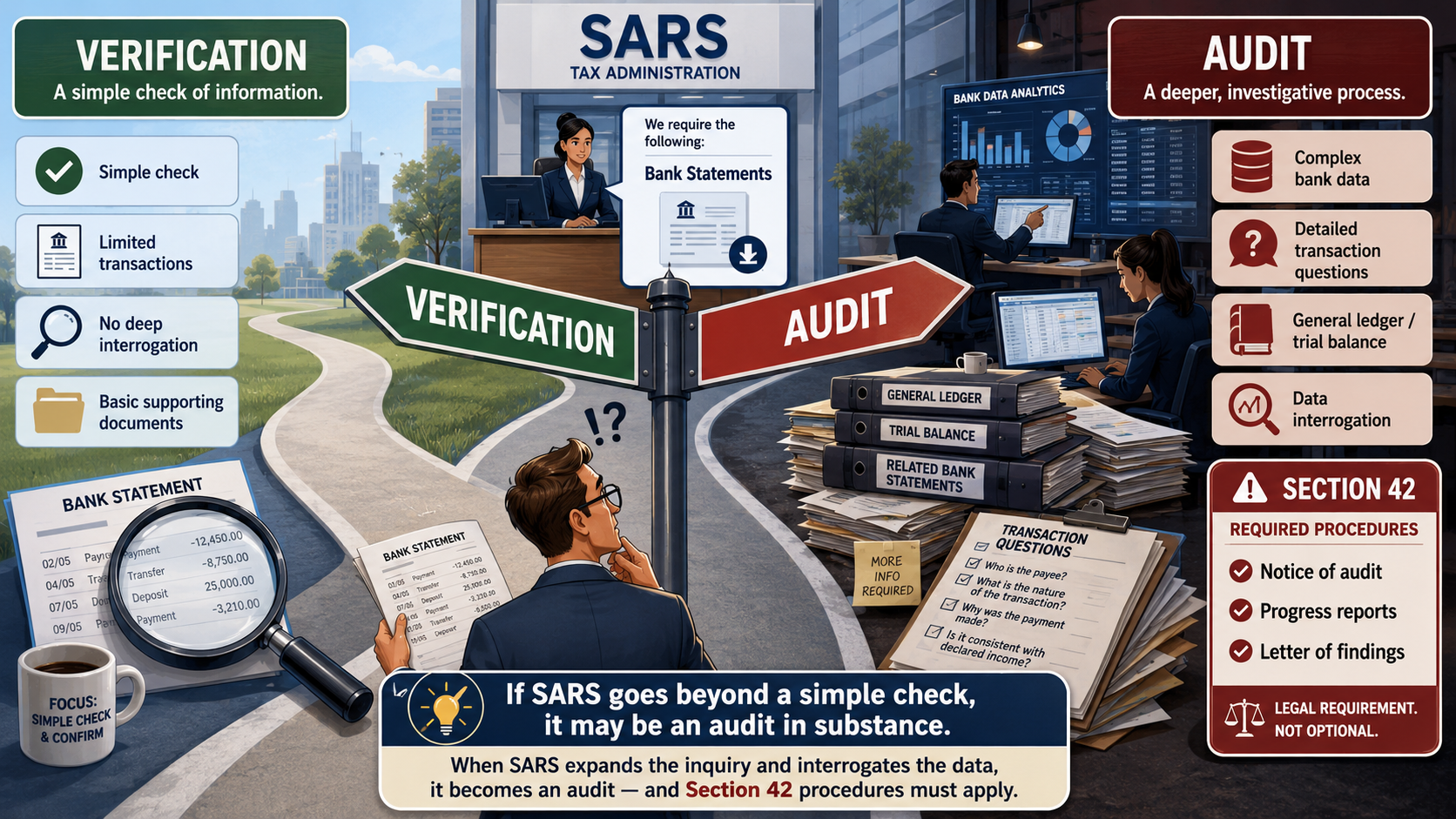
Verification versus audit

The label used by SARS is not decisive. The substance of the process matters.

A verification is a limited check. An audit is a wider examination of the taxpayer's records, accounting treatment and tax position. If SARS requests selected VAT invoices, that may remain a verification. But if SARS requests substantially all records, all vouchers, all bank statements and all supporting documents, the process may have moved into audit territory.

This matters because an audit carries procedural safeguards. SARS should provide proper notice, communicate the basis of the audit, and give the taxpayer a fair opportunity to respond to proposed adjustments. SARS should not avoid those safeguards simply by calling the process a verification.

The section 95(1)(c) warning: notice or threat?

SARS verification letters often include a warning that failure to submit the requested material may result in an estimated assessment under section 95(1)(c).

SARS may say this is merely a statutory warning. In principle, taxpayers should be told the consequences of non-compliance. However, the warning becomes problematic where it is attached to a request that is vague, excessive or impossible to satisfy in the time allowed. In that context, the warning operates as a threat: comply with an unreasonable request or face an estimated assessment.

That is not fair administration. SARS should only rely on section 95(1)(c) where the underlying request was clear, relevant, proportionate and capable of being complied with.

Non-receipt and practical difficulties

Another common problem is that taxpayers do not always receive SARS notices. A request may be placed on eFiling, sent to the wrong profile, missed by the taxpayer, or not brought to the attention of the person responsible for compliance.

Section 95(1)(c) refers to delivery of more than one request. But delivery is not always the same as actual knowledge. Where the taxpayer genuinely did not receive the request, SARS should be slow to impose the severe consequence of an estimated assessment. The real question is whether the taxpayer was given a fair opportunity to comply.

The same applies where the taxpayer receives the request but cannot comply because of the volume of documents, system limitations or the need to obtain records from third parties.

What the taxpayer should do

The taxpayer should not ignore the request.

If the SARS request is unclear, too wide or impossible to comply with in the time allowed, the taxpayer should respond before the deadline. The response should state that the taxpayer is willing to comply, but that SARS must identify the specific issue being verified, narrow the request if necessary, grant an extension, or accept documents in batches.

If SARS has already raised an estimated assessment, the taxpayer should act immediately. The taxpayer should submit the outstanding material and request a reduced or additional assessment under section 95(6). In VAT estimated-assessment cases, this must be done urgently, as SARS refers to a 40-business-day period from the VAT217 notice.

The taxpayer should also consider a suspension of payment request under section 164 where the estimated assessment creates an immediate debt.

Conclusion

SARS may verify. SARS may request relevant material. SARS may estimate in proper cases. But SARS must act fairly.

Relevant material must be relevant to a specific verification purpose. A verification should not become an open-ended demand for everything. If SARS is effectively examining the taxpayer's full accounting records, the process may be an audit, and the audit safeguards should apply.

In VAT cases, SARS should not mechanically reverse input tax for late submission, partial submission or minor invoice defects where the underlying transaction is genuine and can be proved.

The warning of section 95(1)(c) should also not be used as a threat to force compliance with an unreasonable request. Section 95(1)(c) should be used as an estimating mechanism where SARS genuinely cannot assess because relevant material has not been provided. It should not be used as a punitive shortcut where the taxpayer was not given a fair, clear and reasonable opportunity to comply.

Financial documents and calculator

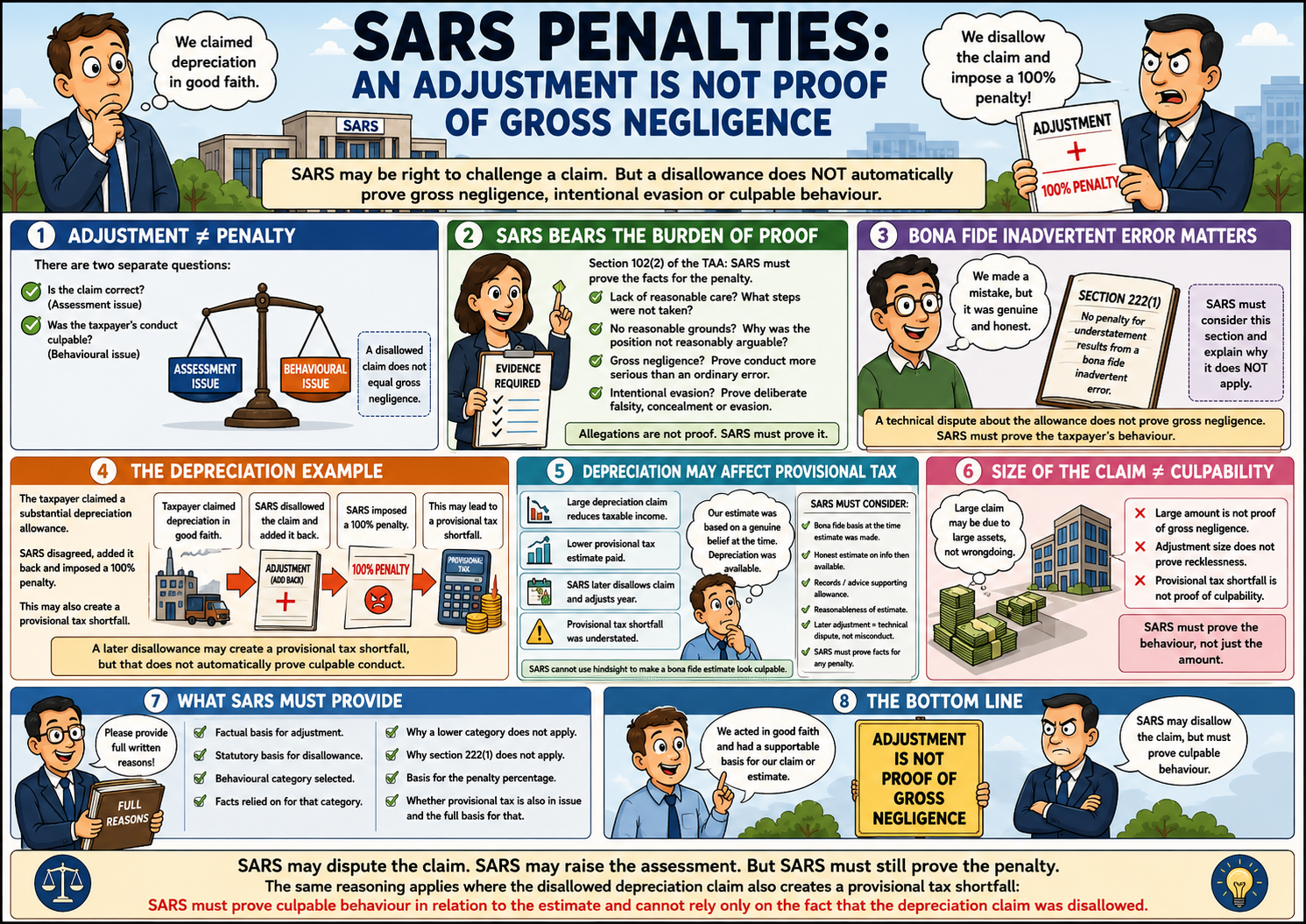
Provisional tax: where the danger lies

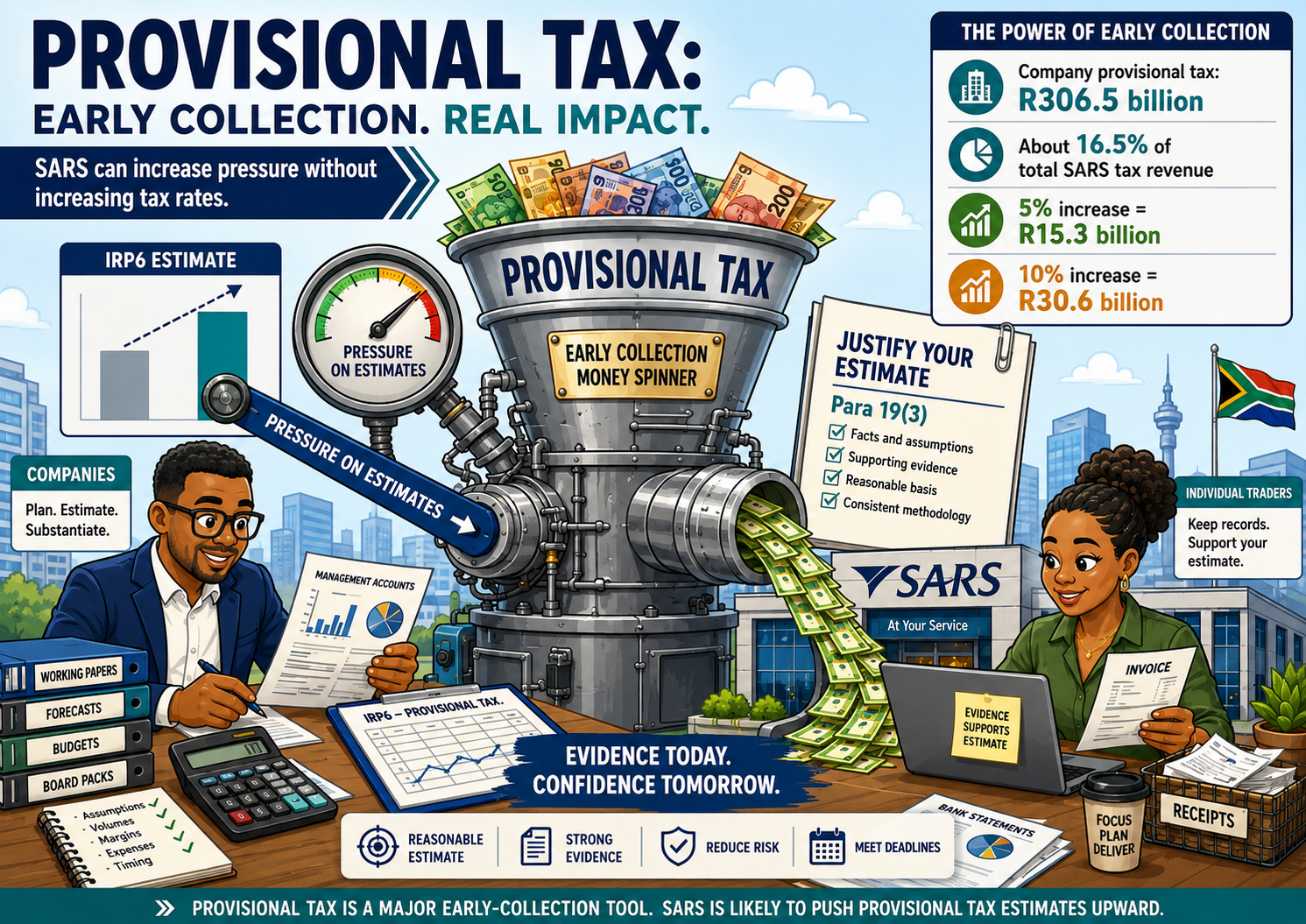
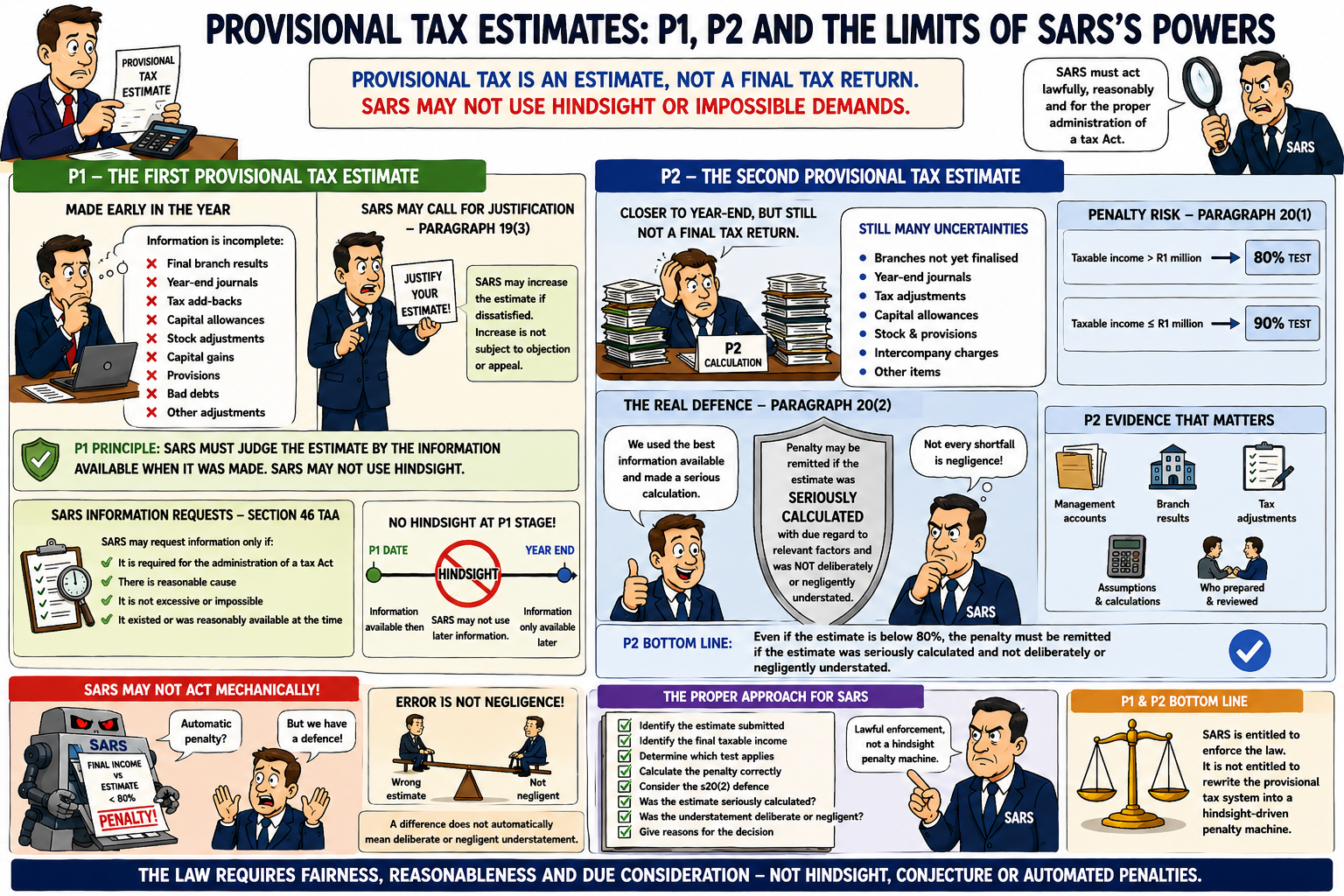
SARS is sharpening its focus on provisional tax estimates, under-estimation penalties and unsupported calculations.

Under paragraph 19(3) of the Fourth Schedule, SARS may require a provisional taxpayer to justify the estimate submitted and to provide particulars of income, expenditure and other relevant information. If SARS is not satisfied with the estimate, SARS may increase the estimate to an amount it considers reasonable — and that increase is not subject to objection or appeal.

AI and data analytics concept

SARS and the use of AI in audits

How SARS is leveraging machine learning to identify discrepancies and target audits.

SARS has invested heavily in data analytics and AI tools. Practitioners need to understand how these systems flag returns, what data is being matched, and how to prepare clients for a new era of automated scrutiny.

Legal documents and time concept

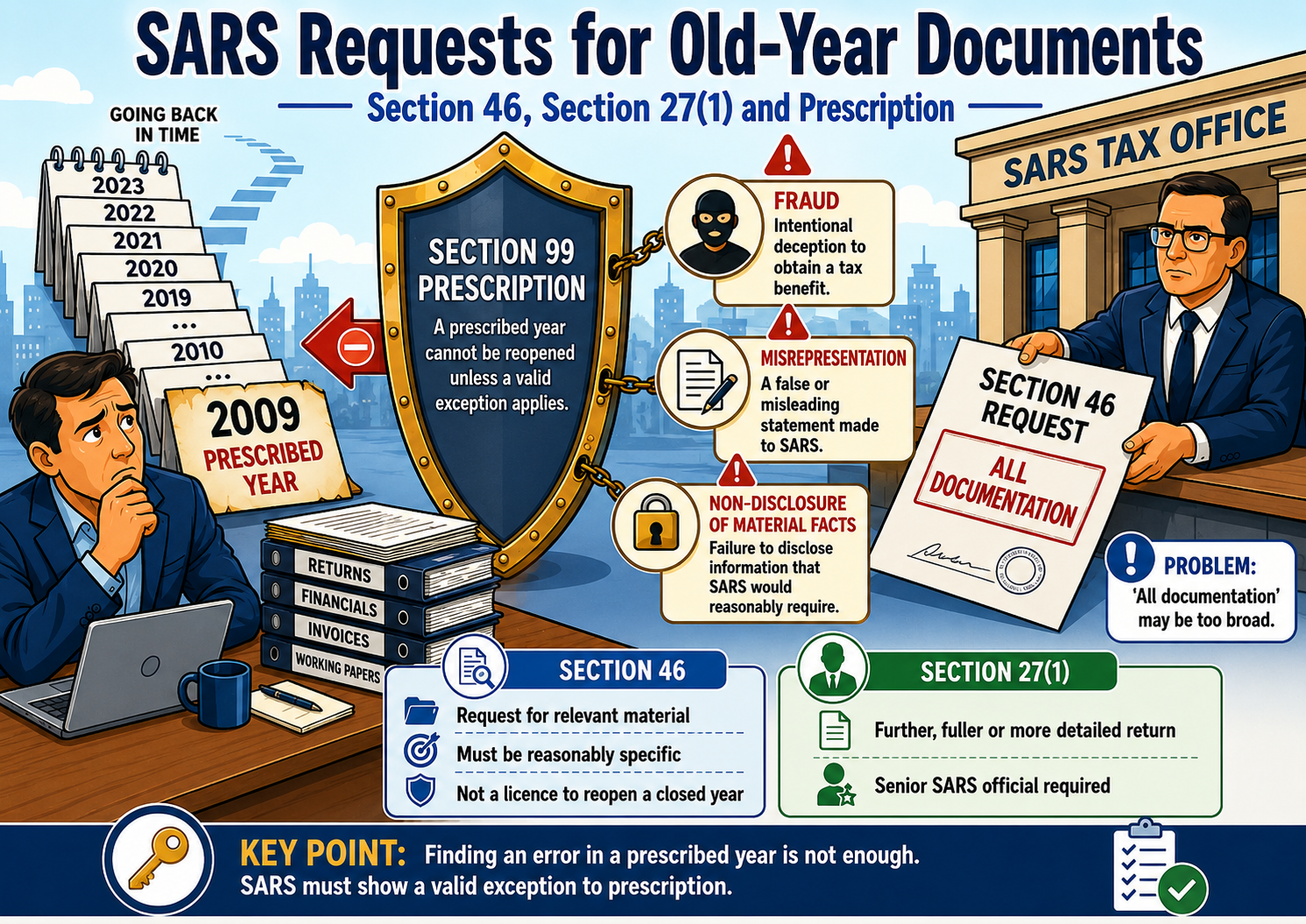
Going back in time: SARS reopening assessments

When can SARS reopen prescribed assessments — and what are your client's rights?

Section 99 of the Tax Administration Act sets out the prescription rules. There are important exceptions where SARS can reopen assessments outside the three-year window, particularly where fraud, misrepresentation or non-disclosure is alleged.