
Tax Knowledge Centre
When SARS Declares an Objection Invalid: What Taxpayers and Tax Practitioners Need to Know
By Mark Silberman B.Acc CA(SA), SAICA Tax Technology Committee · 11 August 2026
Introduction
An objection to a SARS assessment is not automatically entitled to consideration on its merits merely because it has been lodged.
Before SARS is required to decide whether the taxpayer's substantive tax position is right or wrong, the objection itself must comply with the Tax Administration Act 28 of 2011 ("the TAA") and the rules governing tax disputes ("the Rules").
Under Rule 7, a taxpayer must properly identify what is being disputed, state the grounds of objection in detail and submit the documents required to substantiate those grounds where those documents have not already been provided to SARS. If the objection does not comply with Rule 7(2), SARS may regard it as invalid.
This creates a critical distinction in tax dispute procedure:
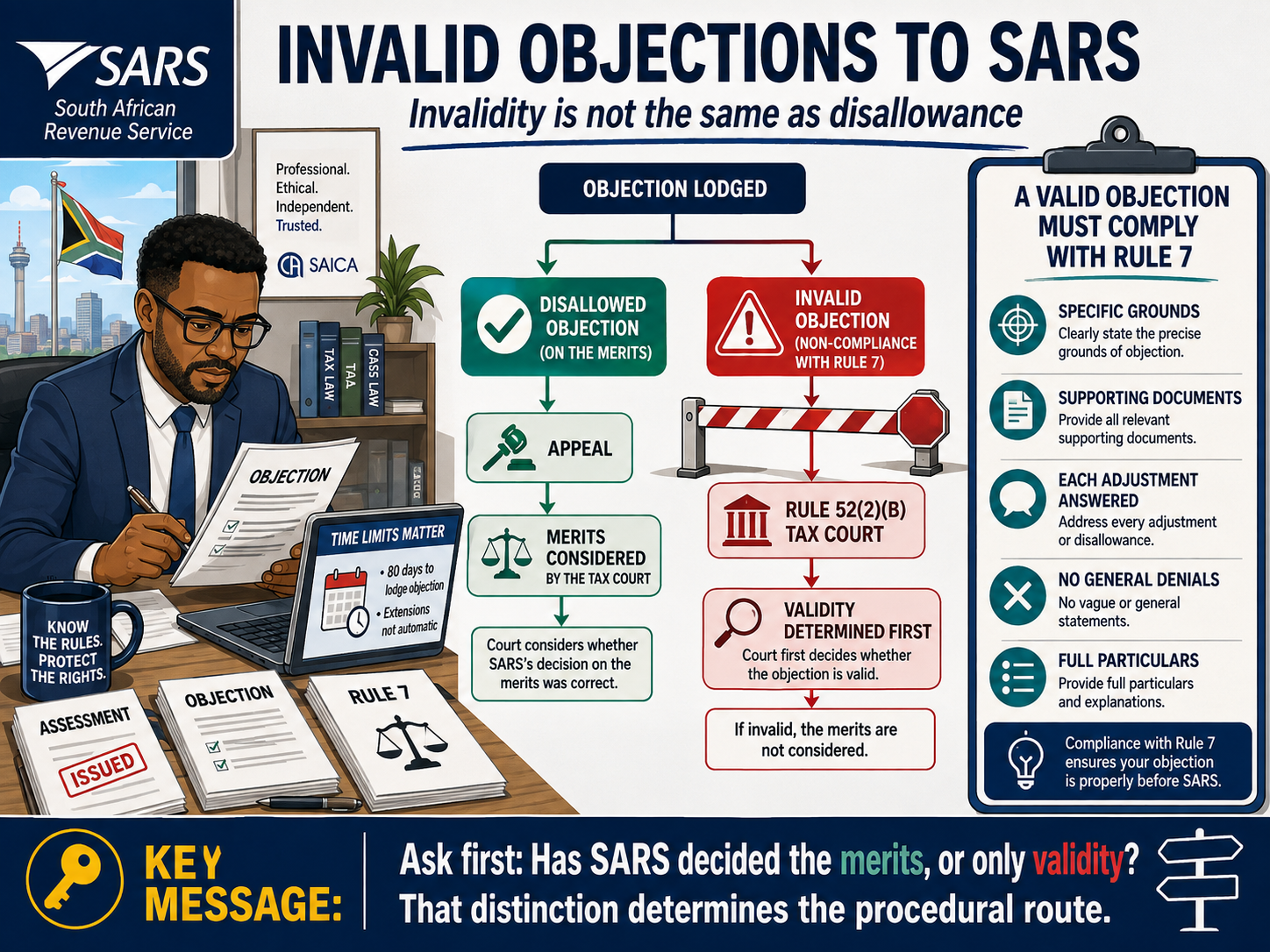
An invalid objection is not the same as a disallowed objection.
Where SARS disallows an objection, it has considered a valid objection and made a decision on the merits.
Where SARS declares an objection invalid, SARS is saying that the taxpayer has not yet crossed the procedural threshold necessary for the merits to be considered.
That distinction determines what happens next.
The objection is the foundation of the dispute
An objection should never be treated as a placeholder.
It is the document that formally establishes the taxpayer's challenge to an assessment.
Rule 7(2) requires a taxpayer, amongst other things, to:
- complete the prescribed form;
- set out the grounds of objection in detail;
- identify the part or specific amount of the disputed assessment being objected to;
- identify which grounds of assessment are disputed; and
- submit documents required to substantiate the objection which have not previously been provided to SARS.
Accordingly, an objection which merely states:
"The assessment is incorrect and should be revised"
does little more than communicate disagreement.
It does not necessarily tell SARS what is wrong with the assessment, which amounts are disputed, what facts support the taxpayer's position or what evidence establishes those facts.
The objection should enable SARS to understand the taxpayer's case.
The 2023 Rules increased the documentary burden
An important development occurred when the current dispute-resolution Rules were promulgated in 2023.
Under the earlier version of Rule 7, a taxpayer was required to identify or specify supporting documentation. The present Rule 7(2)(b)(iii) goes further: the taxpayer must submit the documents required to substantiate the grounds of objection if those documents have not previously been delivered to SARS.
This change was specifically considered by the Western Cape High Court in X and Another v Commissioner for the South African Revenue Service in April 2026.
The court held that section 106(1) of the TAA, read with Rules 7(2) and 7(4), creates preconditions which must be satisfied before SARS is obliged to consider an objection on its merits. The requirement to submit substantiating documents was described as being akin to an evidentiary burden imposed on the objecting taxpayer.
This significantly increases the importance of preparing the objection properly at the outset.
The X case: taxpayers cannot decide for themselves what is sufficient
The 2026 High Court decision in X and Another v CSARS arose from an appeal against the Tax Court's refusal to declare the taxpayers' objection valid under Rule 52(2)(b).
The Tax Court had found that the taxpayers had adopted a generalised approach to the objection instead of dealing with the assessed amounts individually and had failed to provide basic substantiating documents.
On appeal, the High Court upheld the Tax Court.
A significant issue was whether the taxpayer could decide for itself which documents were necessary to substantiate the objection.
The taxpayers argued, in effect, that SARS should request any further documents it wanted under Rule 8.
That argument failed.
The court endorsed the conclusion that Rule 7(2)(b)(iii) cannot be interpreted as giving the taxpayer a wholly subjective choice as to which documents to provide. Otherwise a taxpayer could provide little or nothing and nevertheless insist that SARS proceed immediately to the merits.
The practical message is important:
An objection should contain not only the argument but the material required to substantiate that argument.
General or "globular" objections are dangerous
The courts have also emphasised the importance of specificity.
Where SARS has identified individual transactions, deposits, deductions or adjustments, the taxpayer should ordinarily deal with them individually.
In Commissioner for the South African Revenue Services v M, the dispute concerned undeclared receipts and deposits identified by SARS. The High Court stressed the need for the taxpayer to address the individual receipts and accruals on which the assessments were based.
The case should not be understood as an invalid-objection case in itself. It was substantially concerned with the merits and the taxpayer's burden of proof.
Its importance in the present context is that it illustrates the danger of broad denials where SARS has identified specific amounts.
For example, where SARS identifies a series of deposits as taxable income, it may not be sufficient simply to say:
"The amounts are not taxable."
The objection should explain what the amounts actually represent.
Depending upon the facts, that may involve demonstrating that particular receipts constitute:
- transfers between the taxpayer's own bank accounts;
- loans;
- shareholder funding;
- reimbursements;
- capital receipts;
- inheritances;
- amounts already included in income elsewhere; or
- some other identified receipt which does not bear the tax treatment adopted by SARS.
Where the explanation depends upon bank statements, contracts, loan agreements, ledgers, reconciliations or other records, those records should ordinarily accompany the objection if Rule 7(2)(b)(iii) requires them.
A weak objection and an invalid objection are not necessarily the same thing
An important distinction must nevertheless be maintained.
An objection may be valid but ultimately unsuccessful.
Suppose the taxpayer:
- lodges the objection within the prescribed period;
- identifies the disputed amount;
- states the relevant facts;
- provides supporting documents;
- sets out the legal basis for the objection; and
- complies with the other Rule 7 requirements.
SARS may still disagree with the taxpayer's interpretation of the law.
That is ordinarily a merits dispute.
It should result in SARS allowing, partially allowing or disallowing the objection.
Validity should not be confused with whether the taxpayer will ultimately win.
The 2026 X judgment itself draws this distinction. A valid objection is the procedural gateway to SARS considering the merits. If SARS regards that gateway as not having been crossed, the validity question must be dealt with first.
PRACTICE WARNING: INVALIDITY IS NOT DISALLOWANCE
This is perhaps the most important procedural distinction in the entire subject.
A disallowed objection
A disallowance means SARS has dealt with a valid objection and decided against the taxpayer, wholly or partly.
The ordinary sequence is:
Assessment → Valid objection → SARS considers merits → Objection disallowed → Appeal.
Rule 10 provides that a notice of appeal is lodged after delivery of the notice of disallowance under Rule 9.
An invalid objection
Where SARS declares the objection invalid, SARS maintains that there is no compliant objection before it.
The merits have therefore not yet been determined.
The sequence becomes:
Assessment → Objection → SARS declares objection invalid → Validity problem must be dealt with first.
The taxpayer should therefore not automatically proceed as though SARS has disallowed the substantive tax case.
SARS must state why the objection is invalid
Rule 7(4) is important in this regard.
Where SARS regards an objection as invalid for failing to comply with Rule 7(2), SARS must notify the taxpayer and state the ground for invalidity in its notice.
The practitioner should therefore identify precisely what SARS alleges is defective.
Questions to ask include:
- Which part of Rule 7(2) does SARS say was not complied with?
- Does SARS allege that the grounds are inadequate?
- Does SARS allege that a particular amount was not identified?
- Does SARS allege that supporting documents were missing?
- Were those documents in fact already supplied?
- Has SARS misunderstood the objection?
- Is SARS really identifying a procedural defect, or is it expressing disagreement with the merits?
The taxpayer should not accept an invalidity notice without examining the reason SARS gives for it.
What can the taxpayer do after receiving an invalidity notice?
This is where an important distinction needs to be made between fixing the objection and challenging SARS.
They are not the same remedy.
Route 1: Correct the objection under Rule 7(5)
If the original objection was lodged within the prescribed 80-business-day period, Rule 7(5) provides an important opportunity to remedy the situation.
A taxpayer who receives a notice of invalidity may submit a new objection within 20 business days after delivery of the invalidity notice, without having to apply for an extension under section 104(4) of the TAA. The Rules define a "day" as a business day.
This is a very important practical remedy.
If, for example, SARS correctly identifies that:
- a supporting document was omitted;
- an adjustment was insufficiently explained;
- the prescribed form was incomplete; or
- a ground was inadequately formulated,
the practitioner may decide that the simplest and most efficient route is to correct the defect and lodge a fresh compliant objection within the 20-business-day period.
Do not ignore the 20-day period
Rule 7(6) provides that if the taxpayer does not lodge the new objection within that period, or if the replacement objection is itself non-compliant, the taxpayer may thereafter have to submit a new valid objection together with an application for extension under section 104(4), where required.
An invalidity notice should therefore be treated as urgent.
Route 2: Challenge SARS under Rule 52(2)(b)
The taxpayer may take a different view.
The taxpayer may believe:
There is nothing wrong with our objection. SARS is wrong in declaring it invalid.
In those circumstances, merely redrafting the objection may amount to accepting SARS's premise when the taxpayer believes the original objection already complied with Rule 7.
The Rules provide a specific court remedy.
Under Rule 52(2)(b), a taxpayer may apply to the Tax Court for an order that an objection treated as invalid under Rule 7 is valid.
The 2026 X judgment confirms the significance of this procedure.
The High Court held that where SARS declines to consider the merits because it regards the Rule 7 requirements as unmet, the stage of allowance or disallowance cannot be reached until the disputed validity has first been resolved. Rule 52(2)(b) provides the mechanism for doing that.
Importantly, the court also held that a Rule 52(2)(b) application is not simply a judicial review of SARS's decision.
The Tax Court itself must determine whether the objection satisfies Rule 7.
The taxpayer therefore has to establish to the Tax Court that the objection is valid.
Cure or challenge?
The practitioner should therefore make a deliberate choice after receiving the invalidity notice.
If SARS is right about the defect
Correct it promptly and consider using the Rule 7(5) 20-business-day opportunity.
If SARS is wrong
Consider challenging the invalidity determination under Rule 52(2)(b).
If there is uncertainty
The practitioner must carefully consider the taxpayer's position, the time periods and the consequences of the available procedural choices.
The important point is that Rule 7(5) and Rule 52(2)(b) perform different functions.
One is principally a mechanism to submit a new compliant objection.
The other is a mechanism for having the Tax Court declare that the disputed objection was valid.
Why a normal appeal is not the answer
The distinction between validity and disallowance explains why a taxpayer cannot simply jump into the ordinary appeal process.
Section 106 requires SARS to consider a valid objection. Only once SARS has made its decision on that objection does the appeal mechanism arise.
The 2026 X judgment confirms this sequence.
The Supreme Court of Appeal had already emphasised the same fundamental principle in Commissioner for the South African Revenue Service v Candice-Jean van der Merwe.
The SCA held that an appeal had to be preceded by a valid objection and a decision on that objection. Without those prerequisites there could be no appeal.
This is why an invalidity notice cannot simply be treated as though it were a normal disallowance.
Default judgment does not solve an invalid objection
The Van der Merwe case is also important because the taxpayer attempted to invoke the default judgment procedure.
The SCA found that the necessary procedural requirements had not been met. Because there was no valid objection followed by the necessary decision and appeal, the default judgment procedure could not be used as though a valid appeal already existed.
The broader principle is important:
A procedural remedy available later in the dispute process cannot ordinarily be used to bypass a missing procedural step at the beginning of the dispute.
The objection also determines how far the taxpayer may go later
Even where an objection is valid, the grounds formulated at objection stage may significantly affect what the taxpayer can argue later.
This issue must, however, be stated carefully.
The Rules do permit certain new grounds to be introduced during the appeal process.
Rule 10(3) permits a taxpayer to appeal on a new ground not raised in the objection unless that new ground constitutes a new objection against a part or amount of the disputed assessment which was not objected to under Rule 7.
Rule 32(3) contains a similar limitation in relation to the taxpayer's statement of grounds of appeal before the Tax Court.
The rule is therefore not that a taxpayer can never raise a new legal argument.
The limitation is more subtle.
HR Computek: you cannot later object to an amount you never objected to
In HR Computek (Pty) Ltd v CSARS, the taxpayer had objected to additional tax, penalties and interest, but had not objected to the capital amount of the VAT assessment.
It later attempted to raise the capital amount as an issue.
The SCA held that it could not do so because that part of the assessment had not been objected to. The principle remains relevant under the present Rules.
This demonstrates why the objection must identify every material part or amount of the assessment which the taxpayer intends to dispute.
Baseline Civil Contractors: the SCA confirms the limits on new grounds
The issue has now been considered again by the Supreme Court of Appeal in the important 2026 decision of Baseline Civil Contractors (Pty) Ltd v CSARS.
Baseline had originally disputed SARS's refusal to allow an amount as a deduction.
At a later stage it sought to introduce an alternative argument that the amount should not have formed part of gross income in the first place.
The SCA held that this was not simply another way of arguing the original deduction ground.
It amounted to a materially different case directed at an issue that had not been objected to under Rule 7.
The new ground was therefore impermissible.
The SCA nevertheless recognised that new grounds are permissible where, in substance, they remain within the dispute properly established by the original objection.
The practical lesson is therefore:
A new argument may sometimes be permitted; a new objection to a part or amount never disputed under Rule 7 is another matter.
This makes the original objection critically important.
Do not rely on appeal to repair a badly conceived objection
Practitioners should therefore resist the temptation to lodge a short or incomplete objection on the assumption that the case can be developed properly later.
That strategy creates two risks:
First: SARS may declare the objection invalid.
Second: the taxpayer may later discover that an important part of the assessment was never properly objected to and cannot simply be introduced during the Tax Court proceedings.
The objection should therefore be prepared with the possibility of eventual litigation in mind, even though the objective should ordinarily be to resolve the dispute as early as possible.
What about approaching the High Court directly?
Taxpayers sometimes consider approaching the High Court instead of following the Chapter 9 objection-and-appeal process.
Section 105 of the TAA provides that a taxpayer may only dispute an assessment or decision under Chapter 9 unless a High Court directs otherwise.
The Constitutional Court considered the operation of section 105 extensively in United Manganese of Kalahari (Pty) Ltd v CSARS and four other cases.
The Court confirmed that the High Court has a discretionary power to permit appropriate matters to proceed outside the ordinary tax-dispute route, but section 105 remains an important limitation which must be addressed.
Direct High Court proceedings should therefore not be viewed as an automatic alternative whenever difficulties arise in the objection procedure.
Where the real issue is simply whether SARS correctly treated an objection as invalid, Rule 52(2)(b) specifically provides for the Tax Court to determine that validity question.
Exceptional High Court proceedings remain a separate question governed by section 105 and the principles explained in United Manganese.
Practical checklist before lodging an objection
Before an objection is submitted, the practitioner should ask:
- Have we identified every amount or part of the assessment being disputed? Do not object vaguely to the assessment as a whole where SARS has made identifiable adjustments.
- Have we dealt with every SARS adjustment? Where SARS has listed adjustments individually, respond to them individually.
- Have we stated the facts? Explain what actually occurred.
- Have we stated the legal basis? Explain why those facts produce a different tax result.
- Have we answered SARS's reasons? The objection should engage directly with the basis on which SARS made the assessment.
- Have we supplied the necessary documents? Rule 7 now expressly requires the taxpayer to submit documents required to substantiate the grounds if they have not already been provided to SARS.
- Have we avoided general denials? "SARS is wrong" is not a substitute for explaining why SARS is wrong.
- Have we dealt with all material grounds? Do not assume the dispute can simply be reformulated later.
- Are we within the time limit? Rule 7 provides an 80-business-day objection period, subject to the rules relating to extensions.
- Have we preserved the proof? Keep: the objection as submitted; eFiling acknowledgements; supporting documents; SARS correspondence; submission confirmations; calculations; and evidence of the relevant dates.
What should a practitioner do immediately after an invalidity notice?
The invalidity notice should trigger an immediate procedural review.
Ask:
- What exactly does SARS say is invalid?
- Does the alleged defect actually exist?
- Was the original objection lodged within the 80-business-day period?
- Is the Rule 7(5) 20-business-day opportunity available?
- Should a replacement objection be lodged?
- Or is SARS wrong and should the validity finding be challenged under Rule 52(2)(b)?
- What documents prove that the original objection complied with Rule 7?
These questions should be answered before the practitioner simply lodges the next document in the ordinary dispute sequence.
The central procedural distinction
The easiest way to understand the position is to ask one question:
Has SARS decided the merits, or has SARS decided only validity?
If SARS has considered a valid objection and rejected the taxpayer's substantive position, the taxpayer is ordinarily dealing with a disallowance and may proceed into the appeal process.
If SARS says the objection itself is invalid, the taxpayer is dealing first with a procedural validity problem.
At that stage the taxpayer may, depending on the circumstances:
- cure the defect under Rule 7(5); or
- challenge SARS's conclusion under Rule 52(2)(b).
Those are fundamentally different procedural responses.
Conclusion
The objection is one of the most important documents in a SARS dispute.
It should never be approached as a simple administrative form that merely records the taxpayer's dissatisfaction.
A properly prepared objection establishes:
- what is disputed;
- which amounts are involved;
- the relevant facts;
- the applicable legal grounds; and
- the evidence supporting the taxpayer's position.
The 2026 decision in X and Another v CSARS makes the current position particularly clear: Rule 7 imposes procedural preconditions which must be met before SARS is required to consider an objection on its merits, and the supporting-document requirement cannot be treated as optional.
At the same time, SARS's declaration that an objection is invalid is not necessarily the end of the matter.
If SARS correctly identifies a defect, Rule 7(5) may allow the taxpayer to lodge a new compliant objection within 20 business days.
If the taxpayer maintains that SARS is wrong and the objection was valid, Rule 52(2)(b) provides a mechanism for the Tax Court to determine the validity issue.
And if the objection ultimately proceeds to appeal, HR Computek and the SCA's recent decision in Baseline Civil Contractors demonstrate why practitioners should not assume that omitted parts of an assessment can simply be challenged later.
The final question every practitioner should therefore ask when a SARS dispute notice arrives is:
Has SARS decided that my client's tax position is wrong, or has SARS decided that there is no valid objection before it?
If the answer is the former, the matter is moving toward appeal.
If the answer is the latter, validity must be dealt with first.
That distinction determines the procedural route that follows.
Cases referred to
- X and Another v Commissioner for the South African Revenue Service (Tax Court case 52/2023, 2 December 2024), upheld on appeal in X and Another v Commissioner for the South African Revenue Service (A117/2025, 16 April 2026).
- Commissioner for the South African Revenue Services v M (A5036/2022) [2023] ZAGPJHC 769; 87 SATC 507.
- H R Computek (Pty) Ltd v Commissioner for the South African Revenue Services (830/2012) [2012] ZASCA 178; 75 SATC 104.
- Baseline Civil Contractors (Pty) Ltd v Commissioner for the South African Revenue Service (893/2024) [2026] ZASCA 20.
- Commissioner for the South African Revenue Service v Candice-Jean van der Merwe (211/2021) [2022] ZASCA 106; 85 SATC 10.
- United Manganese of Kalahari (Pty) Ltd v Commissioner of the South African Revenue Service and four other cases [2025] ZACC 2; 2025 (5) BCLR 530 (CC); subsequently reported as 2026 (2) SA 227 (CC).
Legislative framework
- Tax Administration Act 28 of 2011, particularly sections 104–107.
- Rule 7 – Objection against assessment.
- Rule 9 – Decision on objection.
- Rule 10 – Appeal against assessment.
- Rule 32 – Statement of grounds of appeal.
- Rule 52(2)(b) – Application for an order that an objection treated as invalid is valid.
- Section 105 of the TAA – disputes to be dealt with under Chapter 9 unless a High Court directs otherwise.
This article is intended as a general discussion of South African tax dispute procedure and should be read with the Tax Administration Act, the current dispute-resolution Rules and the applicable judgments.
