
Tax Knowledge Centre
Provisional Tax: SARS's Early Collection Money Spinner
By Mark Silberman B.Acc CA(SA), SAICA Tax Technology Committee
Why tax practitioners should expect greater pressure on estimates
Provisional tax has traditionally been viewed by many taxpayers as a routine compliance obligation. Twice a year, the taxpayer or tax practitioner calculates an estimate, submits the IRP6, arranges payment, and moves on to the next deadline.
That view is becoming increasingly dangerous.
In the current fiscal environment, provisional tax is far more than an administrative process. It is one of SARS's most powerful early collection mechanisms. It enables SARS to collect tax before the final assessment is issued and before the normal income tax liability has been finally determined.
From SARS's perspective, the attraction is obvious. Provisional tax accelerates cash collection. It reduces the delay between the earning of income and the payment of tax. It gives SARS a basis to monitor current-year taxable income. It also gives SARS a mechanism to challenge taxpayers who submit low estimates.
For this reason, tax practitioners should expect SARS to pay closer attention to provisional tax estimates, especially where the taxpayer has used the basic amount, submitted a reduced estimate, traded better than expected, or failed to retain proper evidence supporting the calculation.
The collection numbers show why provisional tax matters
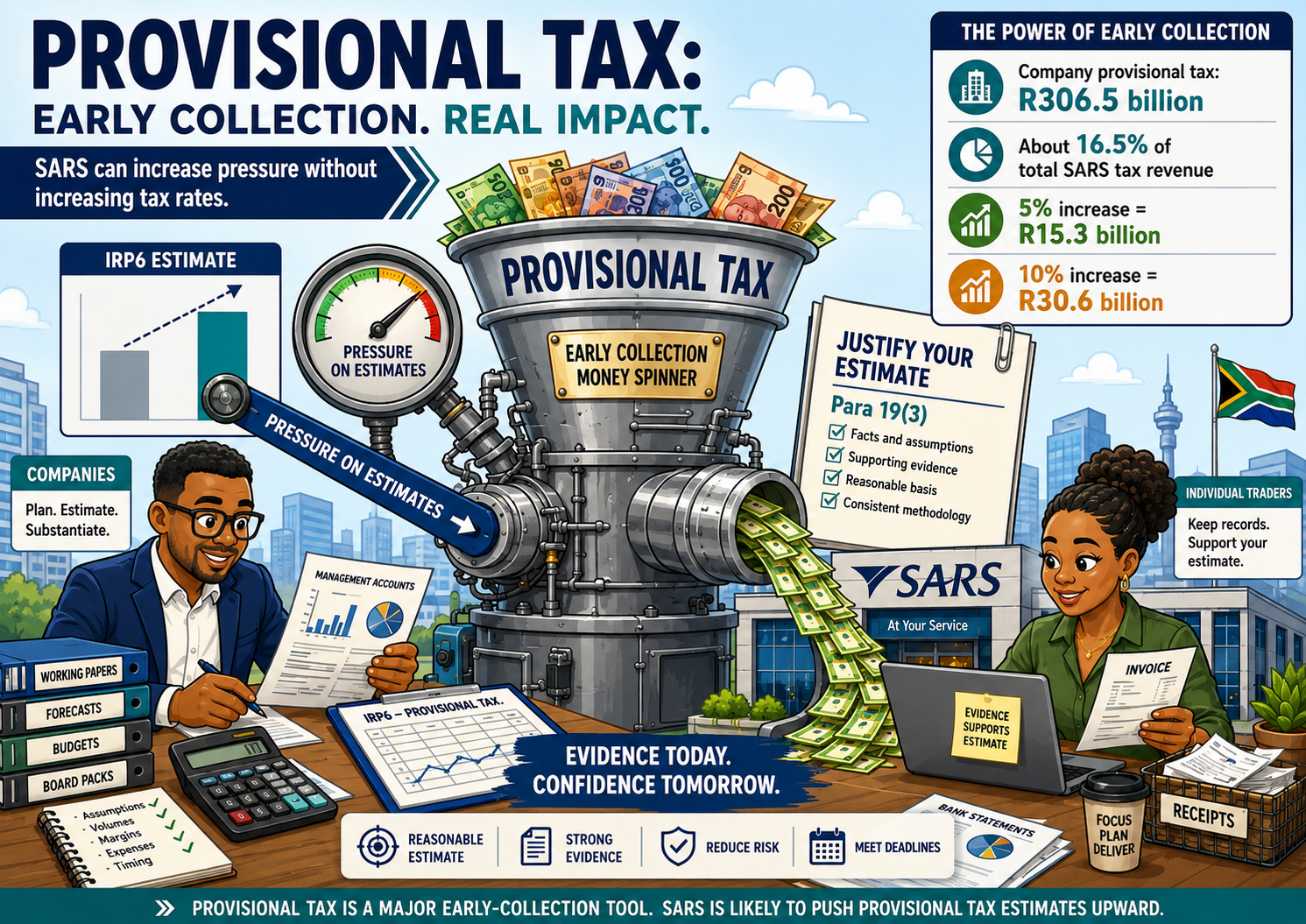
The SARS Tax Statistics demonstrate the significance of provisional tax as a revenue collection tool. For the 2024 tax year, company provisional tax payments amounted to approximately R306.5 billion.
- First provisional period — R129.9 billion
- Second provisional period — R167.8 billion
- Third provisional period / top-up — R8.8 billion
- Total company provisional tax — R306.5 billion
Total SARS tax revenue for 2024/25 was approximately R1.855 trillion. Company provisional tax alone therefore represents roughly 16.5% of total SARS tax revenue — about one-sixth of SARS's total tax collection.
The cash-flow impact of even a small increase is significant: a 5% increase would collect roughly R15.3 billion earlier, and a 10% increase would collect roughly R30.6 billion earlier. SARS does not need to increase tax rates to improve early collections — it can achieve a major cash-flow benefit simply by applying pressure to provisional tax estimates.
Provisional tax is not a separate tax
Provisional tax is not a separate tax. It is an advance payment system. The taxpayer is required to estimate taxable income for the year and pay normal tax in advance. The final liability is still determined when the annual income tax return is assessed.
The practical risk is that taxpayers often treat provisional tax as a cash-flow decision rather than a tax calculation. They ask, "How much can I afford to pay?" The correct question is, "What is my estimated taxable income for the year, and can I justify that estimate if SARS asks?"
Who is a provisional taxpayer?
A provisional taxpayer is not only a company. It includes:
- a company;
- a person, other than a company, who earns income that is not remuneration;
- a person who earns remuneration from an employer that is not registered for employees' tax;
- a person notified by the Commissioner that he or she is a provisional taxpayer;
- and a labour broker with an exemption certificate.
Most ordinary salary earners are therefore not provisional taxpayers if their only income is salary and PAYE is properly deducted. However, the position changes where the individual earns income outside the PAYE system.
The individual trader trap
An individual who trades in his or her own name is generally within the provisional tax system. This includes a sole proprietor, consultant, freelancer, independent contractor, commission earner, professional person in private practice, or any person who carries on a business outside the normal PAYE system — accountants, bookkeepers, IT consultants, plumbers, electricians, doctors, advocates, architects, online businesses, commission earners, landlords and individuals with business income alongside a salary.
The practical mistake is to assume that the R30,000 rule protects all individuals. It does not. The R30,000 exclusion applies only to an individual who does not carry on any business and whose taxable income from specified passive-type sources does not exceed R30,000 for the tax year. It is not a general exemption for individual traders.
The individual trader is particularly vulnerable because taxable income can change quickly during the year. A few profitable months can make the first or second provisional tax estimate too low, and SARS can then challenge the basis of the estimate.
Why SARS is likely to challenge estimates
Where a taxpayer submits a low estimate, SARS may ask whether that estimate is reasonable. SARS may compare the estimate to prior-year taxable income, VAT turnover, PAYE information, third-party data, bank information, assessed income, investment income and other information available to SARS.
Common risk areas include using an outdated basic amount, reducing the estimate without proper support, submitting an estimate below current-year trading results, ignoring management accounts or VAT turnover, failing to adjust for once-off income or capital gains, using cash flow as the basis for the estimate, or simply submitting a low number because the client does not want to pay.
Paragraph 19(3): SARS's pressure mechanism
Paragraph 19(3) of the Fourth Schedule is central. SARS may call upon a provisional taxpayer to justify any estimate made and require particulars of income and expenditure. If SARS is dissatisfied with the estimate, SARS may increase the estimate to an amount it considers reasonable.
The most important practical point is that SARS's increase of the estimate is not subject to objection and appeal. This is a powerful collection tool, and the taxpayer must deal with the SARS request properly and immediately. A weak response may result in SARS increasing the estimate, which then directly affects the provisional tax liability.
The basic amount is not always a safe harbour
Many taxpayers believe the basic amount gives automatic protection. It does not. If the taxpayer's current-year trading position shows that taxable income is likely to be higher, SARS may question why the estimate was not increased. This is particularly important where taxable income exceeds R1 million, where the second provisional tax estimate rules are stricter.
The better question is not whether the basic amount can be used, but whether the estimate can be defended if SARS asks for justification.
Practical evidence required
The main defence against SARS pressure is evidence. A provisional tax calculation should be supported by a proper working paper and retained on the taxpayer file.
For companies, the file should include the prior-year assessment, basic amount calculation, management accounts, year-to-date turnover and profit, projected income for the rest of the year, tax adjustments, capital gains or once-off receipts, assumptions used, client instructions, the tax calculation, proof of IRP6 submission, proof of payment, and the SARS receipt.
For individual traders, the file should include year-to-date income and expenses, projected income and expenses, other taxable income, PAYE already deducted, rebates and medical credits, capital gains, retirement contributions, the estimated taxable income calculation, the tax payable, reasons for any reduction, and confirmation of client instructions.
The client instruction problem
A common practical problem arises where the client instructs the practitioner to reduce the provisional tax payment because of cash-flow pressure. The client must be warned that provisional tax is based on estimated taxable income, not affordability. If the client insists on a lower estimate, the practitioner should retain the instruction in writing and record the advice given. This protects both the taxpayer and the practitioner if SARS later raises penalties, interest or an increased estimate.
Technology and control
The provisional tax process must be controlled properly. The practitioner should be able to show how the estimate was calculated, what information was used, what SARS data was available, what the client instructed, what was submitted, what SARS accepted, what was paid, and what documents support the position. This is where proper workflow, document retention, sticky notes, statuses, SARS receipts and calculation records become essential.
AI Taxman can assist by identifying the legal issue, helping draft responses to SARS, highlighting paragraph 19(3) risks, and suggesting practical remedies where SARS places improper or excessive pressure on the taxpayer. However, AI does not replace professional judgment.
Conclusion
Provisional tax has become one of SARS's most important early collection mechanisms. Company provisional tax alone amounted to approximately R306.5 billion for the 2024 tax year — roughly one-sixth of total SARS revenue. A 5% increase could move more than R15 billion forward; a 10% increase could move more than R30 billion forward. That is why SARS is likely to place increasing pressure on provisional tax estimates.
The risk is not limited to companies — individual traders, sole proprietors, consultants, freelancers and professionals in private practice are also exposed. In the new SARS environment, the taxpayer who cannot justify the estimate is vulnerable, and the practitioner who cannot produce the working paper is exposed. Provisional tax is no longer just a deadline. It is a major SARS collection weapon.
