
Free Webinar Recording Below
Sky FIC – Are you an accountable institution?
Not registered with the FIC? That does not necessarily mean FICA does not apply to your practice.
A practice does not become an accountable institution when it registers with the Financial Intelligence Centre. The activities it performs may already make it an accountable institution under Schedule 1 of the FIC Act.
Accounting, tax and company-secretarial practices that provide certain company, nominee or trust services may fall within Item 2 as trust and company service providers.
Registration is one of the obligations that follows. Remaining unregistered does not remove the underlying obligation and may create additional compliance exposure.

Free Recorded webinar: Are you an accountable institution?
What every accounting, tax and company-secretarial practice must establish now.
Many accounting practices believe that FICA does not apply because they have never registered as accountable institutions. That may be a serious misunderstanding.
Webinar documents — free downloads
The correct first question is not:
“Have we registered?”
It is:
“Do the activities we perform require us to be registered?”
During this practical webinar, Mark Silberman will explain how an accounting practice may become an accountable institution because of the services it provides, even though the practice has never registered with the FIC.
The FIC’s guidance on trust and company service providers is the authoritative source for Item 2 of Schedule 1.
Read PCC 6A — Guidance on trust and company service providersWhat the webinar will cover
- Why accountants are not accountable institutions merely because they are accountants
- Why the activities performed by the practice determine whether Schedule 1 may apply
- Which company, nominee and trust services may bring a practice within Item 2
- Why non-registration does not remove the underlying obligation
- The difference between FIC registration, the Risk and Compliance Return and actual FICA implementation
- Which accountable institutions were required to submit the 2026 RCR
- What an unregistered, registered-only or partly compliant practice should do next
- How Sky FIC can support a structured and repeatable implementation process
This webinar provides general educational and implementation-readiness information. It is not a legal opinion, compliance audit or certification.
You are not accountable merely because you are an accountant. You may be accountable because of what you do.
An accounting practice may fall within Item 2 of Schedule 1 where it carries on specified trust and company service activities for clients.
Does your practice:
- Register or create companies for clients?
- Assist with the operation or management of companies or close corporations?
- Maintain statutory company records or share registers as part of an ongoing company-service function?
- Arrange company structures, directors or shareholders?
- Act as, or arrange for another person to act as, a nominee?
- Create trust arrangements for clients?
- Act as a trustee or assist with transactions involving trust property?
- Administer, control, safeguard or manage trust property?
If your practice performs any of these services, it should urgently establish whether it falls within Item 2 and is required to register and comply.
Not registered does not mean not liable
Registration does not create accountable-institution status.
If the activities performed by a practice bring it within Schedule 1, the practice may already be an accountable institution. Registration is one of the legal obligations that follows from that status.
An unregistered accountable institution may therefore face more than one problem:
- It may have failed to register with the FIC.
- It may not have implemented the required risk-based controls.
- It may not have completed the required customer due diligence and beneficial-ownership processes.
- It may not have submitted applicable regulatory reports.
- It may have been unable to submit the 2026 Risk and Compliance Return because it did not have an FIC-issued organisation identity number.
Non-registration is not a compliance strategy. The first step is to establish whether the activities performed by your practice make it accountable.
What is the Risk and Compliance Return?
The Risk and Compliance Return, or RCR, is a regulatory self-assessment through which specified accountable institutions provide the FIC with information about:
- Their understanding of money-laundering, terrorist-financing and proliferation-financing risks
- Their risk-based controls
- Their implementation of FIC Act obligations
- Their governance, client-risk, monitoring and compliance arrangements
For Item 2 trust and company service providers, the 2026 RCR covered the period from 1 April 2023 to 31 March 2026 and was due by 30 June 2026.
Only a registered accountable institution with an FIC-issued organisation identity number could submit the RCR.
A practice may have been required to register and submit the RCR but may have been unable to submit because it had never registered. Remaining unregistered does not necessarily remove the underlying exposure.
Complimentary FICA Registration and Implementation Review
A limited 20-minute review with Mark Silberman CA(SA).
After attending the webinar, qualifying practices may apply for a complimentary 20-minute review with Mark Silberman. The review is intended to help the practice identify its starting position and its next practical step.
The review will consider
- The company, nominee and trust services performed by the practice
- Whether those activities may indicate that registration is required
- Whether the practice is already registered under the appropriate category
- Whether the 2026 RCR was addressed
- Whether the practice has moved beyond registration into actual implementation
- Whether a Sky FIC demonstration or implementation discussion is appropriate
The practice will receive
- A starting classification
- Three priority next actions
- A recommended route: registration clarification, RCR remediation, implementation or Sky FIC demonstration
Important qualification
A short pre-review questionnaire must be completed before an appointment is confirmed. Appointments are limited because Mark personally conducts the professional review.
The review is a high-level implementation-readiness discussion. It is not a binding determination that a practice is or is not an accountable institution, and it is not a legal opinion, compliance audit or certification.
Move from registration to practical implementation with Sky FIC
Registration is only the first administrative step. The larger challenge is implementing FICA consistently across the practice’s client base and being able to demonstrate what has been done.
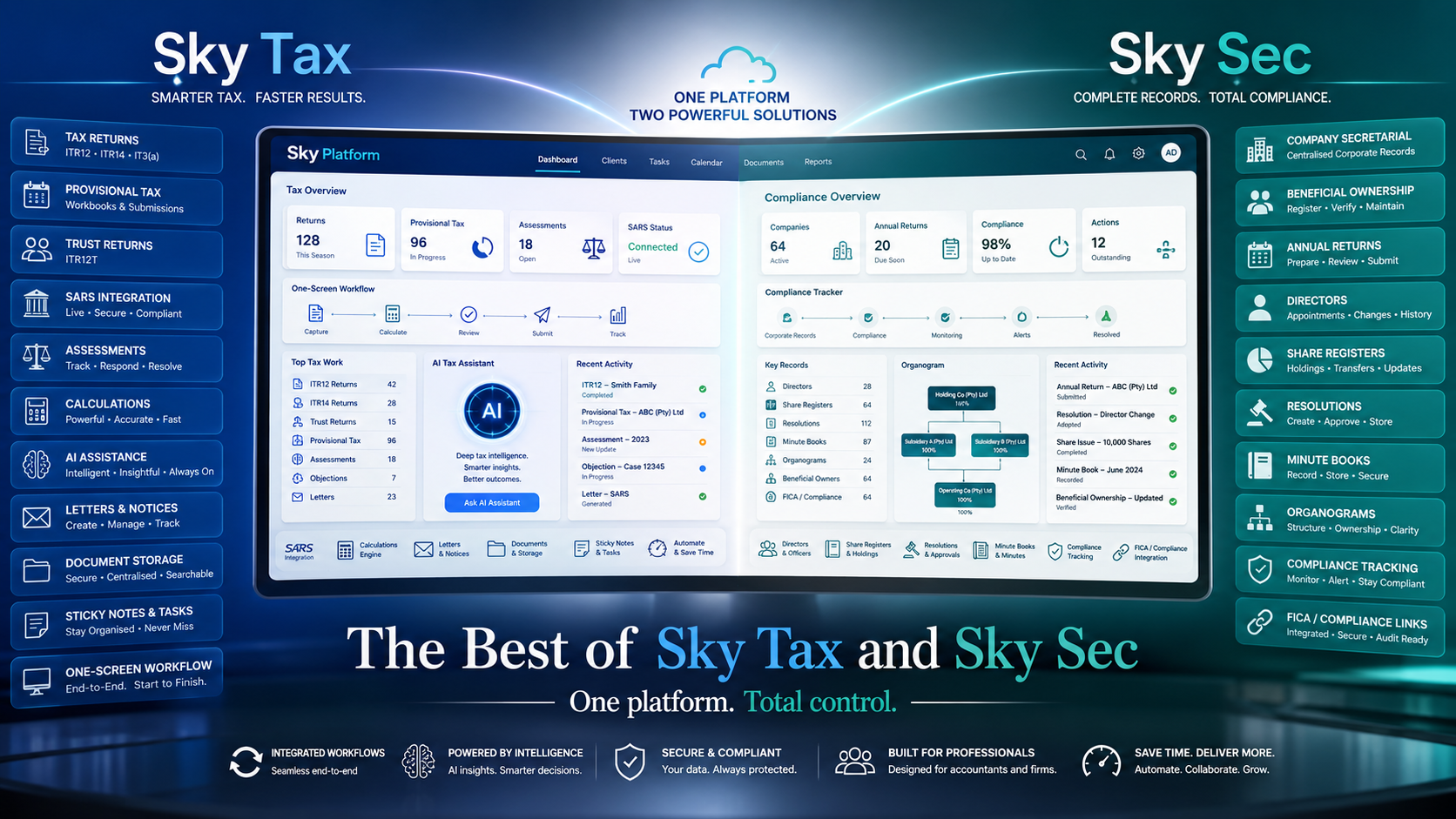
Sky FIC helps accounting and company-secretarial practices establish a structured and repeatable FICA workflow.
- Shared client master data with Sky Tax and Sky Sec
- Reusable default documents and questions by client type
- Client demographics and standard setup requirements
- Links, uplinks and downlinks between related persons and entities
- Director and shareholder relationships
- Beneficial-owner identification and relationship records
- Supporting documents and declarations
- Visibility of outstanding information and requirements
- Responsibility, workflow and audit-trail controls
Configure the requirements once. Apply them repeatedly across the appropriate client types. See what is outstanding and who is responsible.
Has your practice implemented FICA for every applicable client?
Many practices hold copies of identity documents, proof of address and company records. Holding documents, however, is not the same as operating a consistent, risk-based and properly documented FICA compliance process.
The challenge is scale. Creating questions, requesting documents, capturing information and monitoring compliance separately for every client can become expensive and difficult to manage.
Sky FIC addresses this implementation barrier by turning FICA into a repeatable, practice-wide process.
Repeated setup
Staff recreate requirements separately for different clients.
Duplicate data capture
Information already held for tax and secretarial work is captured again.
Inconsistent processes
Different staff members may ask different questions or request different documents.
Poor visibility
Partners and compliance officers struggle to see what remains outstanding.
Design the process once. Apply it repeatedly.
Sky FIC allows the practice to establish default questions and document requirements for each client type. When the relevant client type is selected, the appropriate requirements can be applied consistently.
Individuals
Set the standard questions, identification records, address information, declarations and other supporting requirements for individual clients.
Companies
Establish requirements for the company, its directors, shareholders, authorised representatives and beneficial owners.
Trusts
Set the required information and documents for the trust, trustees, beneficiaries, founder and other relevant parties.
Other entities
Configure appropriate requirements for close corporations, partnerships, non-profit organisations, public-benefit organisations, estates and other entity types used by the practice.
A practice with 1,000 clients does not need to design 1,000 separate FICA processes. It establishes the standard requirements for each client type and applies them throughout the client base.
Default FICA questions and requirements set by client type.
Required documents by entity or client type, with outstanding items visible.
Your client information is already there
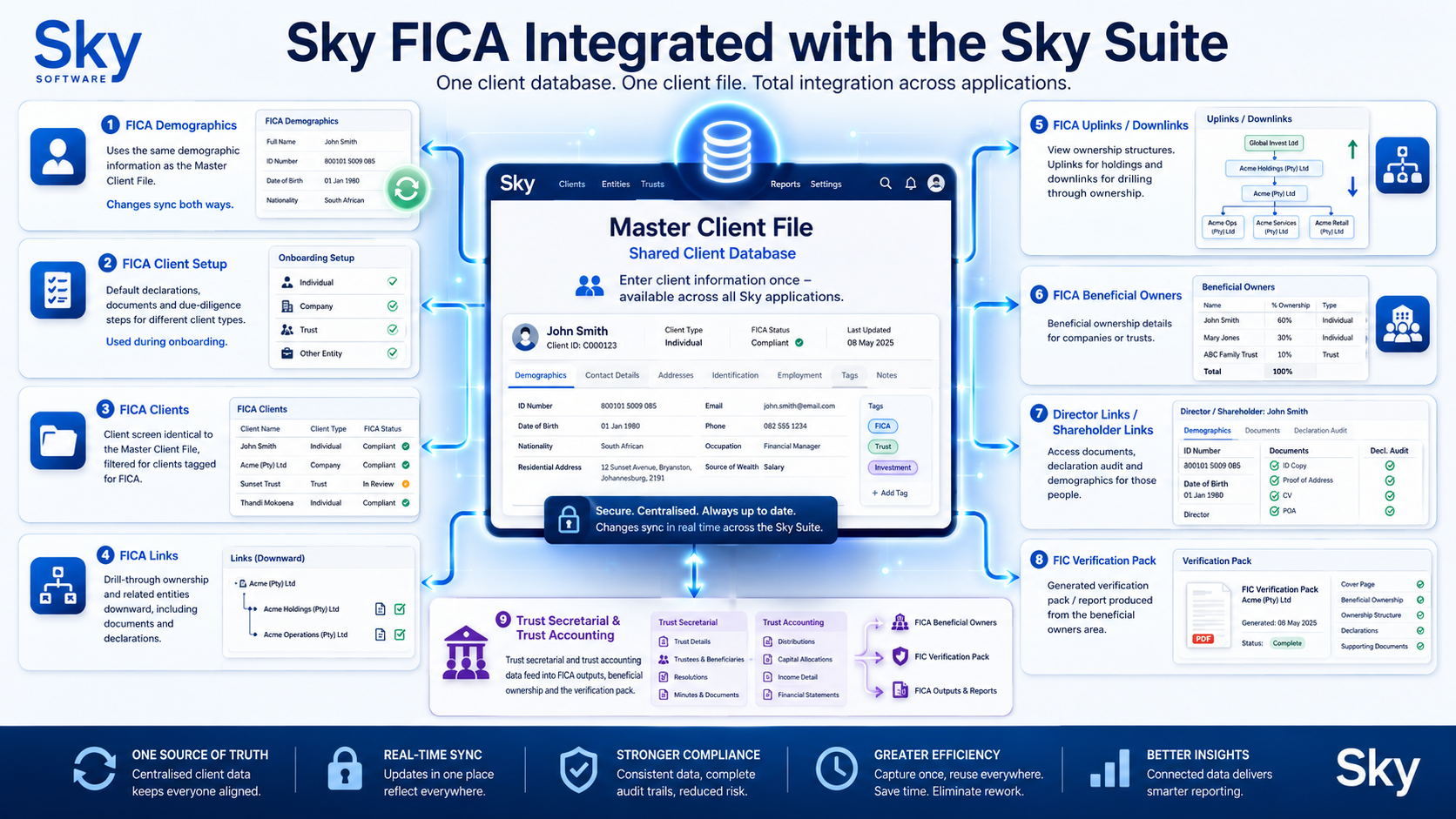
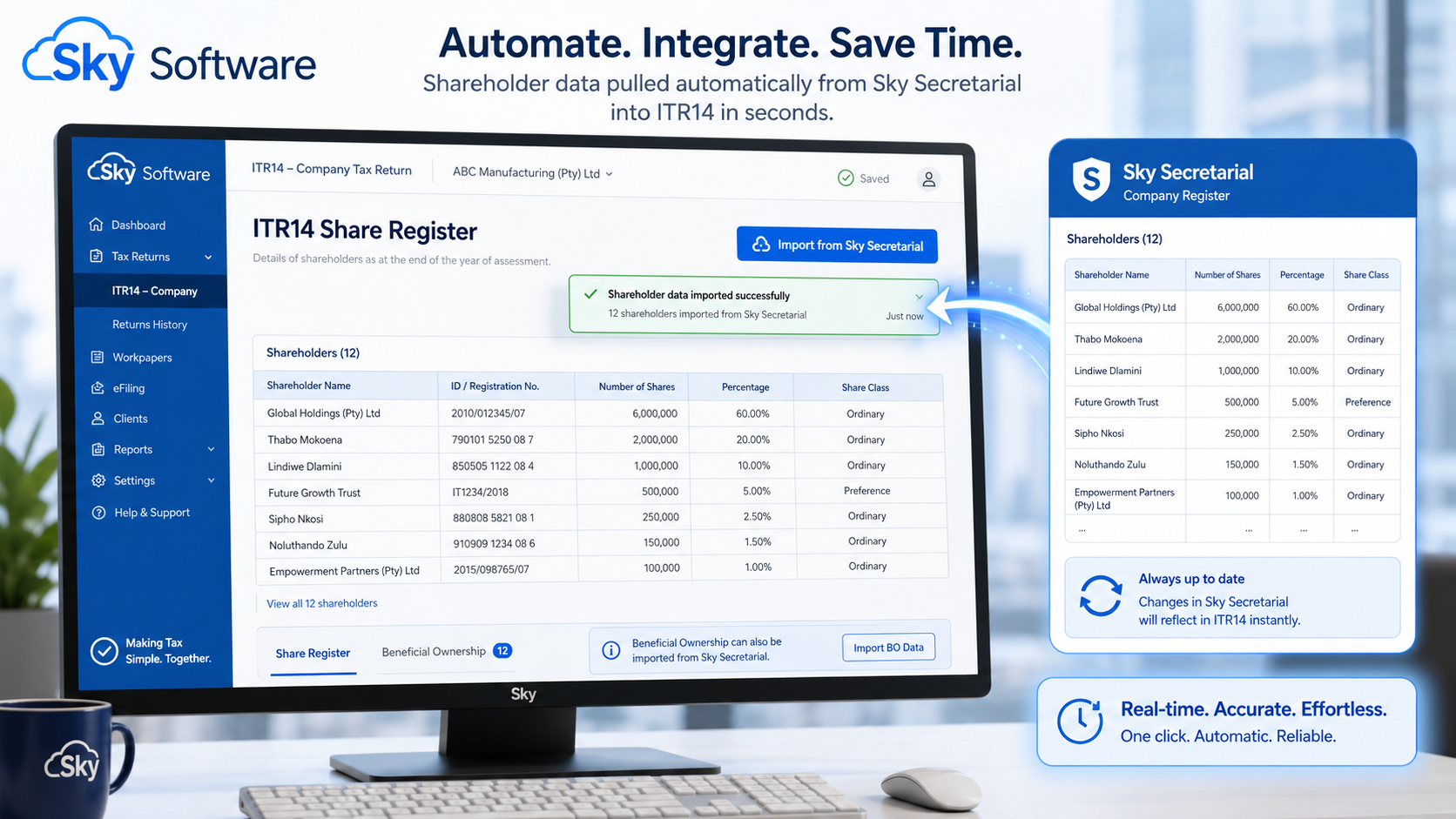
Sky FIC shares the Accfin master client file with Sky Tax and Sky Sec. The practice can use available tax, secretarial, entity and ownership information as part of the FICA process instead of creating another disconnected client database.
Tax, entity, statutory and ownership records maintained in daily work.
One client record across the Sky range.
FICA questions, documents, parties and reviews built on existing information.
Information that may already be available
- Client demographics
- Entity information
- Directors
- Shareholders
- Beneficial owners
- Linked individuals and entities
- Client relationships
- Stored supporting documents
Director, shareholder and beneficial-owner relationships held in the shared Sky records.
Sky FIC creates two major savings: the practice does not have to redesign the process for every client, and it does not have to recapture information already held in Sky.
Before Sky FIC and with Sky FIC
Before Sky FIC
- Separate spreadsheets and folders
- Requirements designed client by client
- Repeated capture of existing information
- Different questions from different staff members
- Documents requested inconsistently
- Limited visibility over outstanding work
With Sky FIC
- Centralised FICA process
- Defaults established by client type
- Shared Sky Tax and Sky Sec information
- Consistent practice-wide questions
- Standard document requirements
- Clearer monitoring of incomplete work
How Sky FIC works
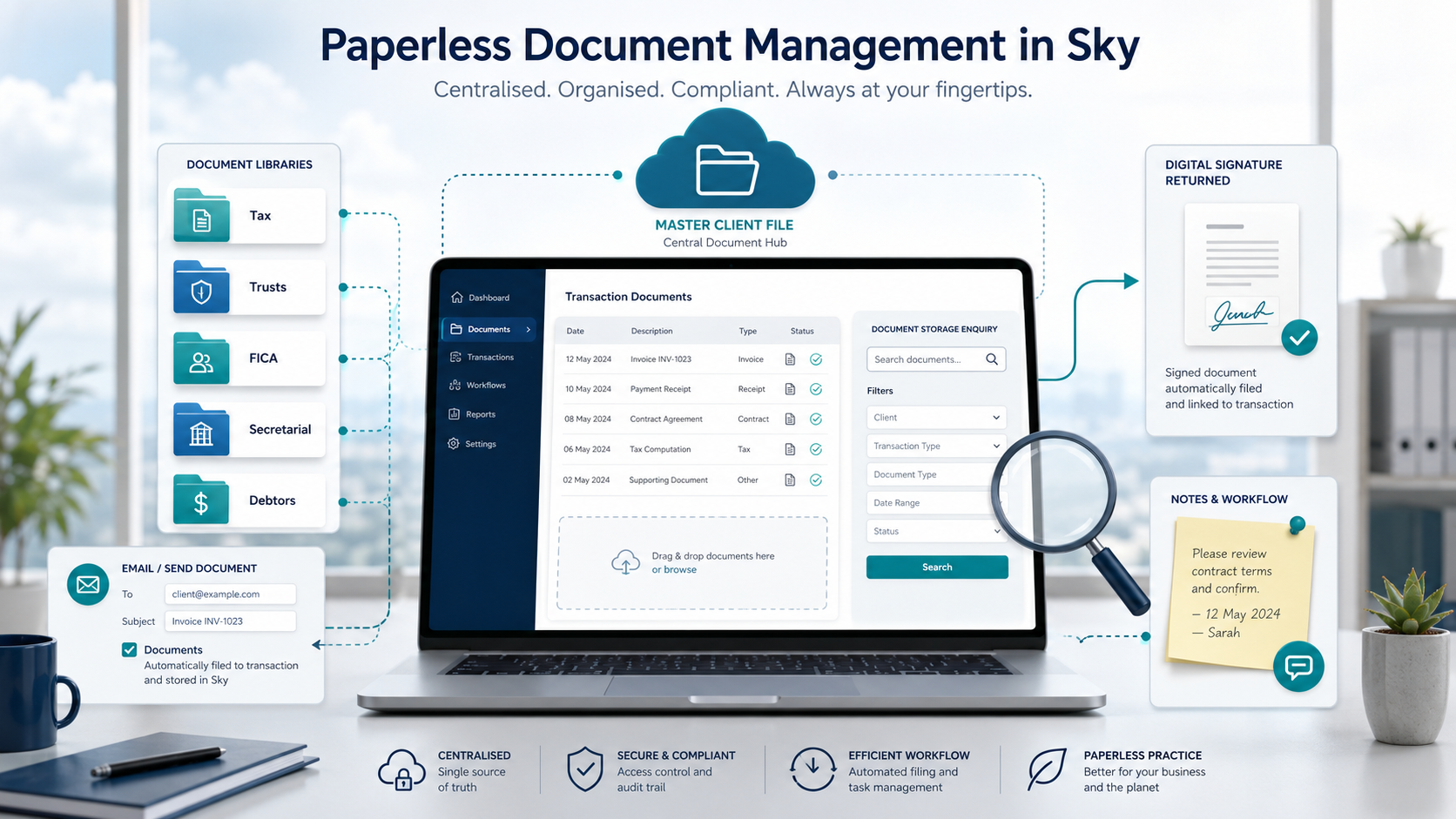
A walkthrough of Sky FIC: setting up requirements, working through the FICA process and using shared Sky client information.
- 01
Establish the practice standard
Create default questions, documents and requirements for each client type.
- 02
Select or identify the client type
Apply the appropriate requirements to the client.
- 03
Use existing Sky information
Use available client, entity, director, shareholder and beneficial-ownership information from the shared master file.
- 04
Complete the FICA process
Answer questions, collect documents, identify connected parties and perform the required reviews.
- 05
Monitor what remains outstanding
Identify missing answers, documents, declarations and other incomplete requirements.
The tools needed to support your FICA programme
Sky FIC carries the working detail of a FICA programme once your defaults are in place.
- Risk-based client questionnaires
- Client due diligence
- Enhanced due diligence
- Beneficial-ownership records
- Directors, shareholders and related parties
- Required-document management
- Declarations and supporting evidence
- Links, uplinks and downlinks
- PEP and sanctions screening
- Ongoing reviews
- Audit trails
- FIC reporting support
- RMCP record management
Sky FIC records and supports the reports a practice is required to consider, and keeps the records of your Risk Management and Compliance Programme. It does not replace the professional judgement of the practice, and reporting to the Financial Intelligence Centre remains the responsibility of the accountable institution.
The saving increases across the client base
The value of Sky FIC is not limited to the time saved on one client. The practice creates reusable standards and applies them across hundreds or thousands of clients.
The potential saving comes from
- Creating questions once rather than separately for every client
- Establishing standard document lists by client type
- Reusing data maintained in Sky Tax and Sky Sec
- Reducing repeated requests for the same information
- Giving staff a consistent process to follow
- Making outstanding requirements easier to identify
- Reducing partner and manager supervision time
Estimate it on your own numbers
Enter your own figures. Every result below is an estimate calculated from your inputs.
Your estimate
- Estimated current manual effort
- 500 hours
- Estimated effort saved
- 350 hours
- Estimated cost of current effort
- R225 000
- Estimated cost saved
- R157 500
These figures are estimates calculated only from the values you enter. They are not a guaranteed saving and do not represent measured results from any practice.
We help your practice get started
Low FICA implementation is not solved by providing software alone. Accfin can help the practice configure Sky FIC and begin a structured rollout across its client base.
FICA readiness assessment
Review the practice's present process and client base.
Client-type planning
Identify the different individuals and entities serviced by the practice.
Default setup
Configure standard questions and document requirements.
Shared-data review
Identify the information already held in Sky Tax and Sky Sec.
Staff training
Show the team how to apply and manage the process.
Phased rollout
Begin with selected client groups and expand across the practice.
Registration, Item 2, the RCR, the review and Sky FIC
Is every accountant an accountable institution?
Which accounting-practice services may fall within Item 2?
Does FICA apply if the practice has never registered?
Does registration mean the practice is compliant?
What is the Risk and Compliance Return?
Who was required to submit the 2026 RCR?
What happens if the practice did not submit the RCR?
What does the complimentary review include?
Is the review a legal opinion or compliance certification?
How does Sky FIC assist with implementation?
The information on this page is general and educational. It is not a legal opinion, compliance audit, certification or FIC endorsement. Each practice must establish its own position against the current FIC Act, applicable directives and official FIC guidance.
Where does your practice stand?
We are unsure whether our activities require registration.
We believe we should register but have not done so.
We are registered but have not properly implemented FICA or dealt with the RCR.
We are ready to implement and control FICA across our client base.