
Tax Knowledge Centre
When SARS Overreaches: Why Practitioners Must Separate the Adjustment from the Penalty
By Mark Silberman B.Acc CA(SA), SAICA Tax Technology Committee
Introduction
Tax practitioners have become accustomed to strong language in SARS correspondence. Audits are framed robustly, findings are often expressed confidently, and letters sometimes carry an unmistakable tone of finality even where important facts remain disputed. That is not, by itself, the problem. SARS is entitled to audit, to question return positions, and to raise additional assessments where it believes the fiscus has been prejudiced. The real problem begins when SARS moves too quickly from a disputed adjustment to a behavioural finding, and from that behavioural finding to a severe understatement penalty.
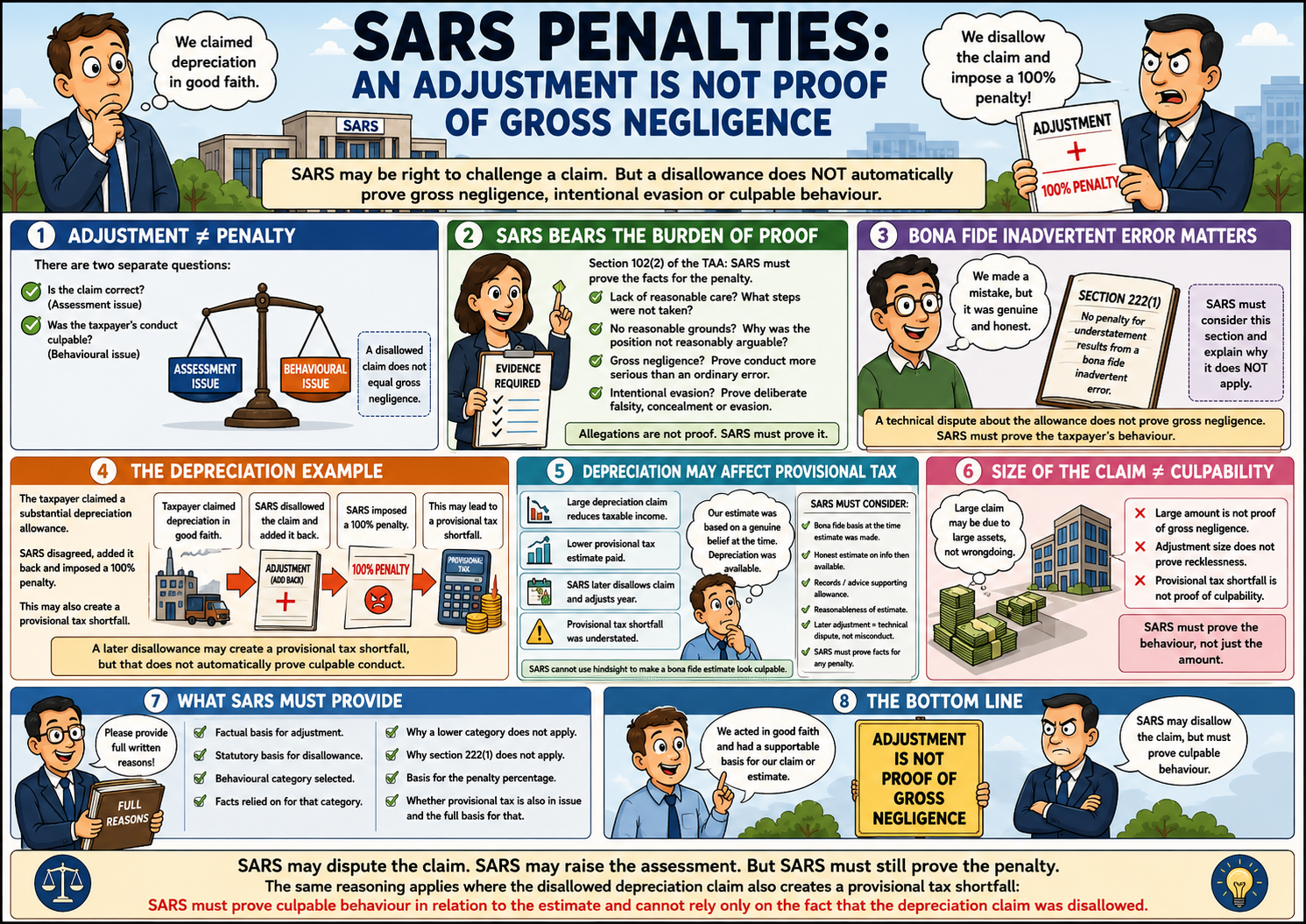
That pattern deserves careful attention because it can distort the dispute process. A deduction may be disallowed. An allowance may be recalculated. A VAT figure may be reconstructed. But none of those outcomes automatically means the taxpayer acted negligently, grossly negligently, or intentionally. Those are separate enquiries and should always be treated as such.
The distinction is well illustrated by two recent types of SARS correspondence. In one corporate income tax audit findings letter, SARS proposed finance cost and depreciation adjustments for the 2023 and 2024 years of assessment and then proposed understatement penalties of 100% for gross negligence and, in relation to one depreciation item, 150% for alleged intentional tax evasion. In a separate VAT finalisation letter, SARS reconstructed output tax from bank deposits, revised its view after receiving further explanations and loan-account material, but still imposed a 25% understatement penalty on the basis of "reasonable care not taken". Together, those letters show how SARS overreach can develop in practice.
The first mistake practitioners must avoid
One of the easiest traps in practice is to accept SARS's structure of argument. SARS will often present matters in a sequence that feels natural: the return was wrong, therefore there was an understatement, therefore a penalty follows, therefore the behaviour fits into a serious category. If the practitioner accepts that structure without breaking it apart, the case becomes far harder to defend.
The correct approach is to separate every issue.
The first question is whether the tax treatment was in fact wrong. The second is whether SARS has properly explained why it says the treatment was wrong. The third is whether the factual material relied upon by SARS is complete and properly particularised. Only then should one ask whether the conduct was blameworthy, and if so at what level. In other words, the tax issue and the penalty issue are related, but they are not the same.
This distinction is essential because SARS sometimes writes as if an adjustment is already proof of culpability. That is simply not so. A tax adjustment is about the correct tax outcome. An understatement penalty is about the taxpayer's behaviour. Those are different legal and practical enquiries, and practitioners should resist any attempt to merge them into one.
A good example of overreach: documentation disputes turned into behavioural findings
The corporate income tax audit findings letter provides a useful illustration. SARS proposed disallowing finance costs and depreciation, recording total proposed adjustments of more than R10 million. In relation to depreciation, SARS stated that only limited invoices had been provided and that depreciation would be allowed only to the extent supported by the asset register and invoices. It then linked that dispute to a penalty narrative based on gross negligence.
This is a familiar move. A documentation problem becomes a tax problem, and then, almost immediately, a behavioural problem.
But incomplete documentation does not automatically prove culpable conduct. It may weaken the taxpayer's evidential position, but that is not the same thing as proving that the taxpayer acted with serious fault. In practice, the existence, ownership and use of an asset may often be supported by more than just one class of document. Asset registers, finance agreements, bank records, insurance schedules, registration documents, maintenance records and internal working papers may all become relevant. SARS is entitled to test the evidence, but it is not entitled to assume that any documentary gap automatically converts the matter into gross negligence.
That is a practical lesson practitioners should remember: weak proof is not the same thing as bad faith. SARS often compresses those ideas together, and advisers need to unpack them again.
The danger of treating absence of receipts as proof of no trade
The most striking feature of the income tax letter is SARS's treatment of the 2024 depreciation claim. SARS stated that there was no trading during the year of assessment and that bank statements reflected no business receipts. On that basis, it concluded that depreciation had to be disallowed because the assets were not used in the production of income. It then went much further and proposed a 150% understatement penalty on the basis of alleged intentional tax evasion.
This is precisely the kind of analytical leap practitioners should challenge.
A year with no business receipts does not always mean there was no trade in the relevant tax sense. Businesses may experience temporary inactivity. Assets may be held ready for use. Vehicles may be under repair, off the road for regulatory reasons, standing idle in a weak market, or retained as part of a business structure awaiting contracts. The absence of visible revenue may be relevant, but it is not self-proving. Much depends on the broader factual context.
Even more importantly, the step from "no receipts" to "intentional tax evasion" is simply too large unless SARS can point to proper facts supporting intention. Intentional tax evasion is an extremely serious allegation. One would ordinarily expect concealment, falsification, fabricated records, knowingly false statements, or some similar conduct demonstrating conscious evasion. Yet the letter, as framed, moves from a dispute about depreciation to a conclusion of intent without setting out the sort of factual foundation that such a conclusion would ordinarily require.
Practitioners should therefore be alert to a crucial point: a wrong allowance, even if it is wrong, is not automatically tax evasion. SARS must prove intention separately. A disputed deduction and a moral accusation are not the same thing.
Estimated assessments and behavioural conclusions
The VAT finalisation letter illustrates a different but equally important form of overreach. SARS explained that it reviewed the annual financial statements and the vendor's bank statements, identified deposits over the audit period, later removed some deposits after the vendor explained that they were intercompany flows, and then retained four deposits as taxable supplies. On that basis, SARS finalised an output tax adjustment and imposed a 25% understatement penalty for reasonable care not taken.
This raises a different set of concerns.
Where SARS reconstructs VAT from bank deposits, it is working by inference. A bank deposit is not automatically output tax. It may be a loan, a capital movement, an intercompany transfer, a non-taxable receipt, or the proceeds of a transaction whose VAT character still needs to be examined properly. In the letter itself, SARS acknowledged that some of its initial assumptions had to be revised once the vendor provided a further explanation and loan-account support. That is important because it shows that the reconstructed position was not self-evident from the start.
Practitioners should use that fact carefully. If SARS's own view changed once fuller information was supplied, that is a strong indication that the matter was fact-sensitive rather than obvious. It becomes much harder, in those circumstances, to treat the reconstructed liability as automatic proof that the vendor failed to take reasonable care. Estimation may justify further enquiry or even adjustment, but estimation is not the same as behavioural proof.
That point matters well beyond VAT. Whenever SARS is working from approximation, inference, or reconstruction, advisers should be cautious about allowing those techniques to become the basis for strong behavioural language.
What practitioners should do when SARS overreaches
The best response is not outrage. It is discipline.
When a SARS letter shows signs of overreach, practitioners should structure their response in layers. First, identify exactly what SARS is alleging. Secondly, test whether SARS has actually proved the facts it relies on. Has it identified the precise assets, entries, invoices, deposits or schedules in dispute? Has it explained its calculations? Thirdly, test whether the legal conclusion really follows from those facts. Fourthly, and separately, deal with behaviour. Even if the adjustment survives in whole or in part, why does that not justify gross negligence, reasonable care not taken, or intentional tax evasion?
This last stage is where many cases are won or lost. Practitioners often spend all their energy on the underlying tax position and leave the penalty issue underdeveloped. That is a mistake. Even where a taxpayer does not succeed entirely on the merits, it may still succeed on penalty. In many matters, that can make a very substantial difference to the eventual outcome.
The wider lesson for the profession
The broader lesson is straightforward. SARS letters must be read critically, not reverently. Strong wording is not the same as strong reasoning. A formal conclusion is not always a fully demonstrated conclusion. The letters discussed here show how easily SARS can move from adjustment to behaviour, and from behaviour to severe penalty language, even where the factual foundation is thinner than the tone suggests.
Practitioners therefore need to hold on to one central discipline: do not let SARS turn every tax disagreement into a moral accusation.
Mistakes happen. Misallocations happen. Documentation gaps happen. Estimated reconstructions happen. None of those situations automatically proves blameworthy conduct. If advisers consistently separate the adjustment from the penalty, and the penalty from the behavioural category, they will often find that SARS's most aggressive conclusions are much weaker than they first appear.
