
Tax Knowledge Centre
Provisional Tax Estimates: P1, P2 and the Limits of SARS's Powers
By Mark Silberman B.Acc CA(SA), SAICA Tax Technology Committee
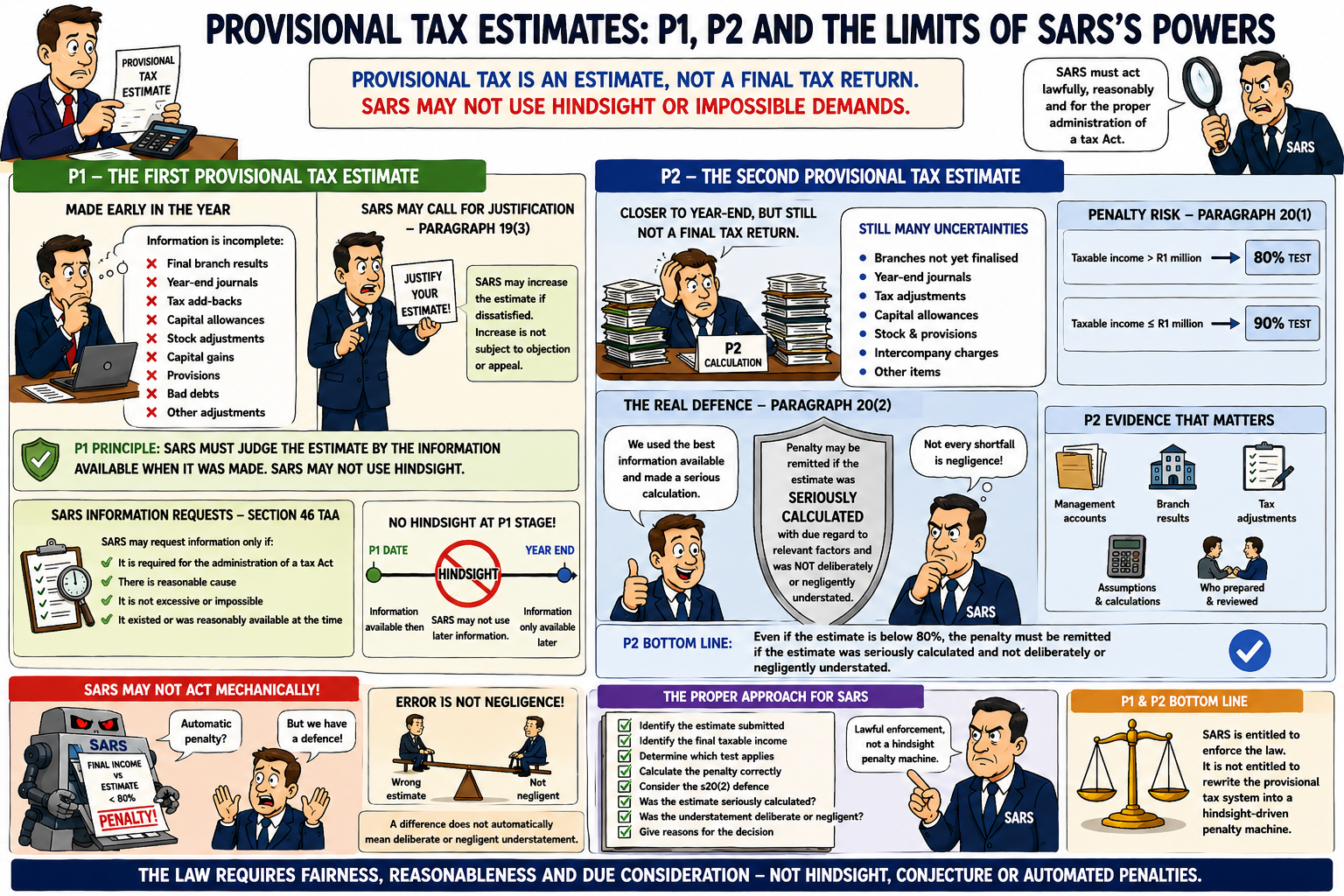
Introduction
Provisional tax is a system that requires a taxpayer to estimate taxable income before the final taxable income for the year has been determined.
That point is important. A provisional tax estimate is not an income tax return. It is not a final tax computation. It is not a completed set of annual financial statements.
This distinction matters most where SARS challenges a provisional tax estimate, calls for justification, increases an estimate under paragraph 19(3) of the Fourth Schedule to the Income Tax Act, or imposes an underestimation penalty under paragraph 20.
The law does not allow SARS to treat every difference between estimated taxable income and final taxable income as proof of negligence, understatement, or non-compliance. SARS may also not use hindsight, incomplete statutory reasoning, or automated processes to create provisional-tax liabilities outside the proper limits of the Fourth Schedule and the Tax Administration Act.
P1: The first provisional tax estimate
For a company, paragraph 19(1)(b) requires the taxpayer to submit an estimate of total taxable income during the relevant provisional-tax period. Paragraph 19(1)(c) deals with the first estimate. It provides that the first estimate may not be less than the basic amount, unless the circumstances justify a lower estimate.
The first provisional tax estimate is therefore made early in the year. At that point, the taxpayer does not yet know the final taxable income for the year. The taxpayer may not yet have final branch results, year-end journals, tax add-backs, capital allowance calculations, stock adjustments, capital-gains computations, provisions, bad-debt assessments, or other final tax adjustments.
SARS is not entitled to pretend that this information already exists.
SARS may call for justification under paragraph 19(3)
Paragraph 19(3) allows SARS to call on a provisional taxpayer to justify an estimate. SARS may also require particulars of income and expenditure, or other required particulars. If SARS is dissatisfied with the estimate, it may increase the estimate to an amount that it considers reasonable. That increase is not subject to objection and appeal.
That is a powerful SARS provision, but it is not unlimited. SARS must still exercise the paragraph 19(3) power lawfully, rationally, and for the proper administration of a tax Act. SARS cannot use paragraph 19(3) as a shortcut to cash collection. SARS also cannot use the provision to demand a premature income tax return.
A lawful paragraph 19(3) increase may not be subject to objection and appeal. But an unlawful abuse of paragraph 19(3) is a different matter. SARS cannot place itself beyond legality merely by labelling its conduct as paragraph 19(3) action.
SARS may not use hindsight at P1 stage
The central P1 principle is simple: SARS must judge the taxpayer's estimate by reference to the information available when the estimate was made.
A taxpayer cannot be required to look into the future. It cannot be expected to take later trading results, later management accounts, later accounting adjustments, later capital transactions, or later tax computations and import them backwards into the P1 estimate.
Where SARS uses later information to attack a P1 estimate, the problem is not necessarily the taxpayer's estimate. The problem may be SARS's method. The correct question is not "what was the final taxable income?" but "what information was available to the taxpayer when the P1 estimate was submitted, and was the estimate properly made on that information?"
SARS information requests must remain within section 46
If SARS requests information under section 46 of the Tax Administration Act, the information must be required for the administration of a tax Act. SARS may not request information without reasonable cause.
This is important in provisional tax disputes. SARS may not use section 46, read with paragraph 19(3), to demand final-year information that does not yet exist. SARS may also not use section 46 to force the taxpayer to prepare a premature annual tax return.
A taxpayer is entitled to require SARS to identify:
- the statutory provision relied upon;
- why each item of information is required;
- why the information is necessary for the administration of a tax Act;
- whether SARS is relying on paragraph 19(3), section 46, or both;
- whether the information existed or was reasonably available when the estimate was made.
SARS should not be allowed to shift the burden by issuing broad, unexplained, impossible, or premature information demands.
P1 conclusion
For P1, the taxpayer's strongest position is that the first estimate must be tested at the time it was made. SARS cannot use hindsight, later figures, later profits, or later adjustments to convert a genuine first provisional estimate into an alleged understatement.
Where SARS increases or threatens to increase a P1 estimate under paragraph 19(3), the taxpayer should insist that SARS act within the provision. SARS should identify the facts relied upon, provide the calculation, and explain why the original estimate was unacceptable based on the information available at the time.
P2: The second provisional tax estimate
P2 is different. The second provisional tax estimate is still an estimate — it is not a final income tax return. However, by P2 stage the taxpayer is much closer to year-end, and paragraph 20 of the Fourth Schedule becomes the main risk.
For taxpayers with taxable income exceeding R1 million, paragraph 20(1)(a) applies. If the final or last estimate is less than 80% of actual taxable income, SARS must impose the underestimation penalty. For taxpayers with taxable income of R1 million or less, paragraph 20(1)(b) applies the 90% test and also refers to the basic amount.
This means that, for larger taxpayers, the basic amount is not the answer at P2 stage. The taxpayer must focus on the 80% test and, more importantly, the remission defence under paragraph 20(2).
P2 is still not a final tax return
Large taxpayers often face real practical constraints at P2 stage. A taxpayer with multiple branches, divisions, accounting systems, stock locations, debtors, creditors, tax adjustments, capital allowance schedules, and intercompany charges may not have a final taxable income figure before the year has ended.
That does not mean the taxpayer may guess. It does mean SARS may not pretend that the taxpayer had final information when it did not. The proper P2 enquiry is whether the taxpayer made a serious estimate on the information reasonably available at the time.
Paragraph 20(2): the real P2 defence
Paragraph 20(2) provides the key defence. The penalty may be remitted where the estimate was seriously calculated with due regard to the factors having a bearing on it, and was not deliberately or negligently understated.
For P1, the argument is: SARS cannot use hindsight against an early estimate. For P2, the argument becomes: even if the final taxable income later exceeded the estimate, the P2 estimate was seriously calculated on the information then available, with due regard to the relevant factors, and was not deliberately or negligently understated. That is the correct legal battleground.
SARS may not impose P2 penalties mechanically
SARS should not impose paragraph 20 penalties by rote. It is not enough for SARS simply to compare the final taxable income with the P2 estimate, find that the estimate was below 80%, and leave the penalty standing without considering remission.
Paragraph 20(1) may trigger the penalty. But paragraph 20(2) requires SARS to consider whether the taxpayer's estimate was seriously calculated and whether the understatement was deliberate or negligent. A mechanical penalty process is legally vulnerable.
SARS must engage with the taxpayer's actual calculation, the information available at the time, the taxpayer's assumptions, and the reasons why the final taxable income later differed from the estimate. A taxpayer should resist any SARS approach that treats the penalty as automatic and the taxpayer's explanation as irrelevant.
Practical evidence for P2
For P2, evidence is everything. The taxpayer should be able to show:
- the management accounts used;
- the trial balance used;
- the branch results available at the calculation date;
- which branches or divisions had not yet reported final figures;
- the tax add-backs considered;
- the deductions considered;
- the capital allowances considered;
- the stock, bad debt, provision, capital gain, or other adjustments considered;
- the assumptions used;
- who prepared the calculation;
- who reviewed it;
- why the final taxable income later differed from the estimate.
Where the taxpayer can show that the estimate was prepared from accounting records, adjusted for known tax issues, reviewed by an accountant or tax practitioner, and based on the best available information, the taxpayer has a proper paragraph 20(2) defence.
SARS must separate error from negligence
A later difference between estimated taxable income and final taxable income does not automatically prove negligence. A taxpayer may be wrong without being negligent. A taxpayer may underestimate without deliberately understating.
A taxpayer may miss the 80% mark because of later branch results, late accounting entries, unexpected income, reversed provisions, disallowed deductions, capital gains, exchange movements, or year-end tax adjustments that were not reasonably ascertainable at P2 stage. SARS must not collapse these categories into one another.
The legal question is not merely whether the estimate was low. The legal question is whether the estimate was seriously calculated and whether the shortfall arose from deliberate or negligent understatement.
The proper approach for SARS
A lawful SARS approach should be to:
- identify the estimate submitted;
- identify the final taxable income;
- identify whether paragraph 20(1)(a) or paragraph 20(1)(b) applies;
- calculate the alleged penalty correctly;
- consider the taxpayer's paragraph 20(2) explanation;
- decide whether the estimate was seriously calculated;
- decide whether there was deliberate or negligent understatement;
- give reasons for refusing remission, if remission is refused.
Anything less is vulnerable to challenge.
Conclusion
P1 and P2 are both provisional tax estimates, but they raise different legal issues. For P1, SARS may not use paragraph 19(3) to demand a premature income tax return, rely on hindsight, or increase an estimate by reference to information unavailable when the estimate was made.
For P2, the taxpayer faces the paragraph 20 underestimation-penalty regime, especially the 80% test for taxpayers above R1 million. But SARS still may not treat final taxable income as proof of negligence. The taxpayer's protection lies in paragraph 20(2): the estimate was seriously calculated, with due regard to the relevant factors, and was not deliberately or negligently understated.
SARS is entitled to enforce the law. It is not entitled to rewrite the provisional tax system into a hindsight-driven penalty machine.
