
Tax Knowledge Centre
SARS "Reasons": Why They Matter, What Counts as Adequate, and What to Do When SARS Refuses or Gives Poor Reasons
By Mark Silberman B.Acc CA(SA), SAICA Tax Technology Committee
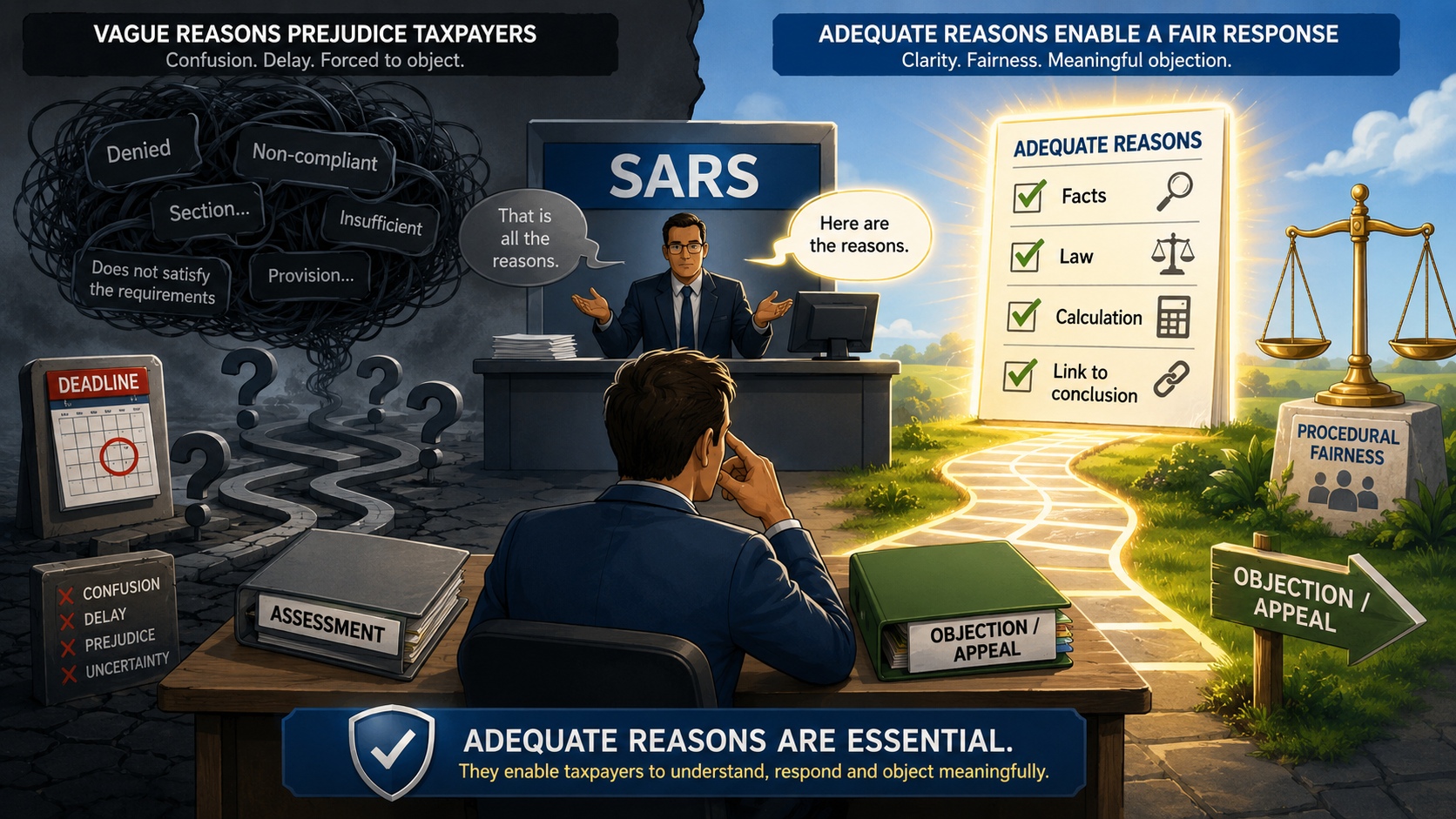
In South African tax administration, the right to object and appeal is one of the taxpayer's most important protections. That right, however, only works properly if the taxpayer can understand what SARS decided, why it decided it, and how it arrived at the amount or conclusion in question. Where SARS provides no reasons, vague reasons, or formulaic reasons, the taxpayer is often forced to object "in the dark". That is not merely inconvenient. It can undermine the fairness of the entire dispute process.
The importance of reasons is therefore not procedural trivia. It goes to the heart of whether a taxpayer can formulate a proper objection, determine whether the objection is timeous, and assess whether further remedies are available. In practice, poor reasons from SARS are one of the most common causes of unnecessary dispute, delay, and prejudice.
Why reasons matter in the tax dispute process
A taxpayer cannot object effectively unless the real basis of the assessment or decision is known. It is not enough for SARS simply to communicate an outcome. A proper objection requires the taxpayer to identify the factual issue in dispute, the legal rule relied upon, and the respect in which SARS is alleged to have erred. If those matters are unclear, the taxpayer is placed at an immediate disadvantage.
This is particularly important because an objection must be detailed and specific. A bare denial is not enough. The taxpayer must engage with the actual grounds of assessment or decision. If SARS has not explained those grounds properly, the taxpayer's objection may become speculative, incomplete, or too general. That, in turn, may expose the objection to disallowance or procedural attack.
Reasons also matter because dispute time periods are affected by them. Under the dispute framework, the date from which the objection period runs may depend on whether reasons were requested and when they were provided. This means that inadequate or disputed reasons are not only relevant to the merits. They can also affect whether SARS later alleges that the objection was out of time.
The legal framework
The duty to provide meaningful reasons does not arise from one source alone. It sits at the intersection of the Tax Administration Act 28 of 2011, the dispute resolution rules, SARS guidance, and broader administrative-law principles.
The TAA establishes the formal structure for assessments, objections, appeals, and certain procedural decisions. The dispute rules then provide the machinery through which a taxpayer may request reasons where the basis of an assessment or decision is not apparent. These rules are critical because they recognise a practical reality: a taxpayer cannot be expected to formulate a proper objection where the assessment or decision is not properly intelligible.
Interpretation Note 15 is also important because it explains how the timing of objections and appeals may be influenced by requests for reasons and the delivery of reasons. It further addresses SARS's discretion to extend time periods in appropriate cases. Although an interpretation note does not have the force of legislation, it is important in practice because it reveals how SARS approaches the issue and how timelines are intended to operate administratively.
Over and above this lies the broader principle of just administrative action. SARS is a public authority exercising statutory power. Its decisions must therefore be lawful, reasonable, and procedurally fair. Fairness includes the giving of intelligible and responsive reasons, especially where the decision has a direct impact on a taxpayer's rights. In this sense, adequate reasons are not merely a matter of convenience. They are part of the procedural fairness that must accompany the exercise of public power.
What counts as "adequate reasons"?
The real issue is not whether SARS has sent some response, but whether the response is good enough to enable the taxpayer to understand the case that must be met. That is the true standard.
Adequate reasons should ordinarily disclose at least four things. First, they should identify the material facts on which SARS relies. Second, they should identify the legal basis for the conclusion reached. Third, they should explain the methodology or calculation used, where an amount has been adjusted or imposed. Fourth, they should show the connection between the facts and the conclusion. Unless these features are present, the taxpayer may still not know what SARS is actually saying.
This is where many SARS communications fall short. In practice, the problem is often not complete silence, but rather reasons that are vague, generic, or non-responsive. A response is unlikely to be adequate where SARS merely states a conclusion without explaining the factual basis for it. It is also inadequate where SARS recites sections of legislation in the abstract but does not explain how those provisions apply to the taxpayer's specific facts. Equally problematic is the situation where SARS provides information that is broadly related to the matter, but does not actually answer the question raised by the taxpayer.
A formulaic response does not become adequate merely because it is dressed in official language. If the taxpayer still cannot identify the factual dispute, the legal premise, or the basis of the computation, the reasons remain deficient.
The importance of issue-specific reasons
One of the key principles emerging from the authorities is that reasons must be responsive to the issue actually raised. This is a critical practical point. A taxpayer may ask why a deduction was denied, why an objection was treated as invalid, or why an extension of time was refused. If SARS replies in broad and general language without addressing the specific complaint, the taxpayer has still not been given proper reasons.
The law is concerned with substance, not form. Calling something "reasons" does not make it adequate. The question is whether the taxpayer now knows enough to formulate a meaningful response. If the answer is no, the requirement has not truly been met.
Reasons are important beyond assessments
The problem does not arise only with substantive assessments. It also arises in a range of procedural decisions that can materially affect a taxpayer's rights.
A common example is a refusal to extend the time for lodging an objection or an appeal. Such a refusal can be decisive because it may shut the taxpayer out of the dispute system altogether. For that reason, the refusal must be supported by proper reasons. If SARS simply states that the request is refused, without explaining the basis upon which its discretion was exercised, the taxpayer may be unable to challenge the refusal meaningfully.
Another example is where SARS treats an objection as invalid. In that situation, SARS must communicate the grounds of invalidity clearly enough to enable the taxpayer to correct the problem if it can be corrected. A vague statement such as "non-compliant" or "does not meet the rules" is often not enough. Without proper particulars, the taxpayer is denied a fair opportunity to cure the defect.
In this way, the adequacy of reasons affects the entire dispute chain, not merely the first assessment.
Why inadequate reasons are so prejudicial
Poor reasons create prejudice at several levels. First, they impair the taxpayer's ability to prepare a focused objection supported by appropriate documents and legal argument. Second, they create uncertainty around time limits, particularly where the running of the objection period depends on the delivery of reasons. Third, they may undermine an application for condonation or extension, because the taxpayer may struggle to demonstrate prospects of success if the true basis of SARS's case is still unclear.
This is especially serious in South African tax practice, where procedural deadlines are strictly applied and where SARS often places heavy emphasis on formal compliance with the rules. It is unjust for SARS to expect precision from taxpayers while itself providing reasons that are imprecise, generic, or evasive.
What should taxpayers do in practice?
Where an assessment or decision is unclear, the first step is to request reasons promptly under the dispute rules and retain proof of delivery. Dates, case numbers, screenshots, correspondence logs, and acknowledgements should all be preserved carefully. Good recordkeeping is essential because disputes about reasons often become disputes about timing as well.
The second step is to assess the response critically. The taxpayer or practitioner should ask: does this response explain the facts relied on, the legal basis, the method of calculation, and the link between the facts and the conclusion? If not, SARS should be told clearly and specifically why the reasons are inadequate.
The third step is to avoid accepting labels at face value. A communication from SARS may be styled as reasons, but that does not settle the matter. The practical question is whether it truly enables a proper objection or response.
The fourth step is to consider what procedural remedy is appropriate if SARS persists in giving poor reasons. Depending on the circumstances, this may include challenging a related procedural decision, raising the inadequacy directly in the objection process, or relying on broader fairness principles where the taxpayer has been prejudiced.
At the same time, taxpayers must be careful not to assume that delay will always be excused simply because SARS's conduct has been poor. Time periods should be monitored rigorously, and a protective approach should be adopted where there is any uncertainty.
Conclusion
Adequate reasons are not a courtesy. They are a procedural necessity. Without them, the taxpayer cannot understand the assessment or decision, cannot formulate proper grounds of objection, and may be unfairly prejudiced in relation to deadlines and condonation. The real question is not whether SARS provided some form of response, but whether SARS provided reasons that genuinely explain the decision in a way that enables the taxpayer to exercise dispute rights effectively.
For tax practitioners, this is the critical practical point: whenever SARS gives vague, generic, or non-responsive reasons, the issue should be confronted directly and methodically. The fairness of the dispute process depends on it.
