
Tax Knowledge Centre
When SARS Requests Bank Statements: Verification or Audit?
By Mark Silberman B.Acc CA(SA), SAICA Tax Technology Committee · 20 July 2026
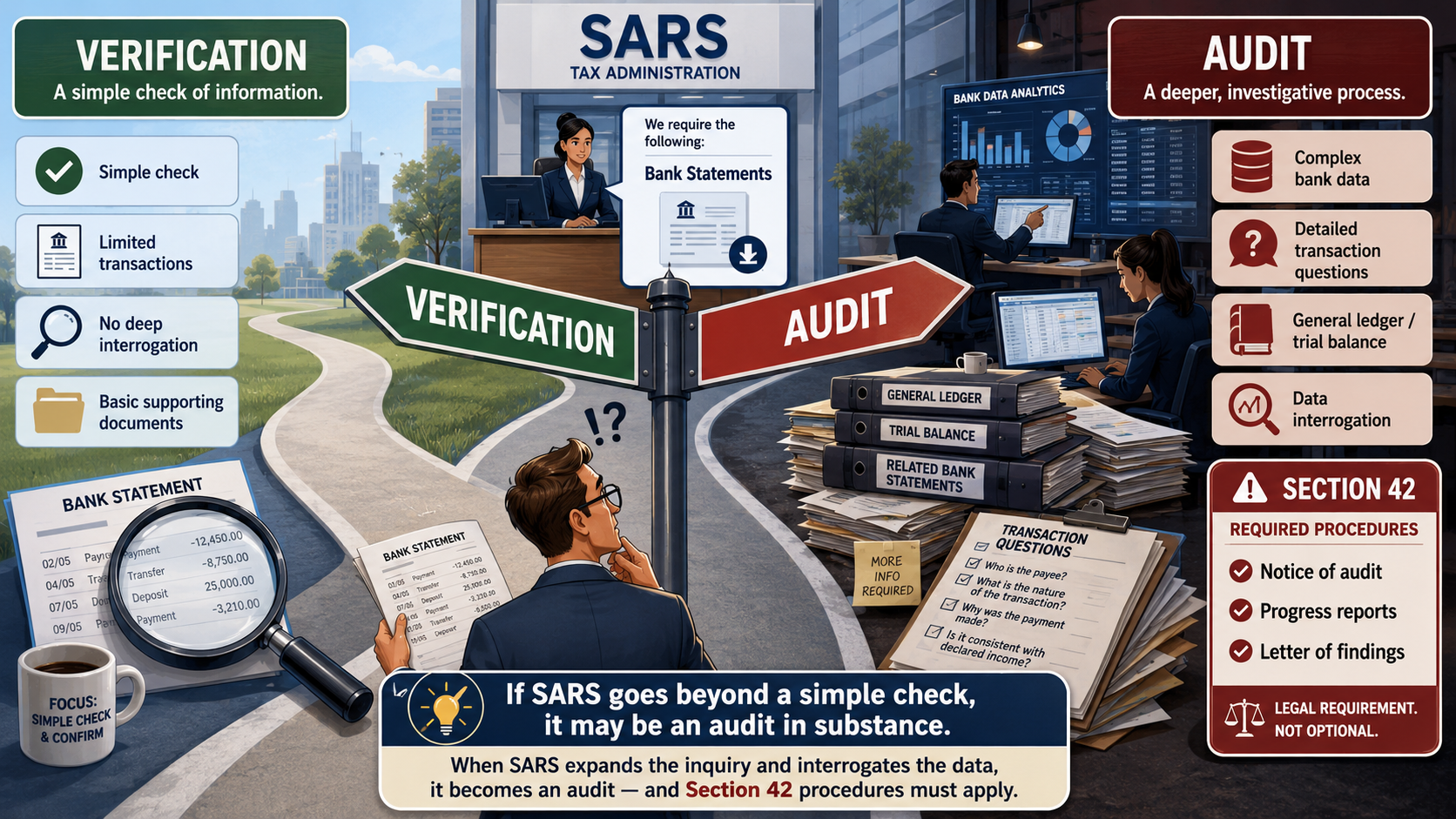
Tax practitioners are increasingly encountering situations where SARS requests bank statements shortly after the submission of a tax return. On the surface, these requests are often labelled as "verifications." However, in the field, there is growing concern that SARS is using these seemingly routine requests as an entry point to conduct audits — without following the correct legal procedures required under the Tax Administration Act (TAA).
Understanding the Legal Distinction
A critical starting point is to recognise that the TAA does not contain a formal definition of either "verification" or "audit." Instead, SARS operationalises these terms through practice notes and administrative conduct.
Based on SARS's own guides and interpretation:
- A verification is understood as a basic check of a taxpayer's return against third-party data or supporting documentation. It is administrative in nature and usually occurs shortly after a return is filed.
- An audit, by contrast, is a more in-depth inquiry that involves the examination of books, records, and underlying transactions to determine the accuracy of the return or the taxpayer's compliance with tax laws.
Critically, Section 42 of the TAA lays out the procedural obligations for audits, which include:
- A notice of commencement of the audit;
- Progress reports throughout the process; and
- A letter of audit findings before finalisation.
If these steps are not followed, the audit may be procedurally defective.
This distinction has been tested in case law such as Forge Packaging (Pty) Ltd v Commissioner for SARS, where the court ruled that SARS had not initiated an audit because it failed to follow the procedural requirements under Section 42 — even though the information requested was extensive.
My Professional View: When Does a Verification Become an Audit?
Based on experience in the field, I am of the opinion that the complexity of the bank statement and the depth of SARS's engagement with the data are what determine whether the process remains a verification or becomes an audit.
When It Is a Verification
- The bank statement is simple, with limited transactions.
- SARS does not interrogate individual transactions.
- SARS does not request general ledgers or supporting documents.
- No additional correspondence or inquiries are made beyond the initial submission.
In such cases, the process falls within the realm of a verification.
When It Becomes an Audit
However, when the bank statement is complex, the situation changes:
- SARS cannot properly assess tax compliance without further documents — specifically the general ledger, which is necessary to interpret the transactions.
- If the taxpayer is part of a group of companies, SARS would logically need all related bank statements across the group, and general ledgers showing intercompany entries and reconciliations.
Furthermore, if SARS begins to:
- Interrogate the bank data (e.g., asking detailed questions or requesting source documents for individual transactions),
- Run the data through internal analytical systems, or
- Augment the data with information from third parties or other tax years,
then SARS is no longer verifying — it is auditing, in substance if not in name. This escalation triggers the procedural requirements of Section 42, and SARS cannot avoid those obligations by continuing to call the process a "verification."
What Happens in Practice: Procedural Breaches
On the ground, practitioners are finding that SARS often begins with a verification request — such as for 3–6 months of bank statements — and then quietly expands the scope into a full audit without:
- Issuing a formal audit notice;
- Providing progress reports; or
- Issuing a letter of findings.
In many instances, SARS:
- Rejects objections or verifications even where supporting documents are provided;
- Demands explanations for every bank transaction;
- Requests general ledgers, trial balances, or supporting contracts;
- And electronically processes or interrogates the data.
Yet these cases remain labelled as "verifications," despite clearly meeting the threshold of an audit. This conduct is problematic and potentially challengeable in law. SARS cannot ignore its statutory duties simply by calling an audit a verification.
Why This Matters
The distinction between a verification and an audit is not academic — it carries significant legal and practical implications:
- Taxpayers subjected to audits have a right to transparency, including audit notifications and findings, which can be critical for objections or litigation.
- Failure by SARS to comply with Section 42 can render the process procedurally unfair and provide grounds for a legal challenge or Tax Ombud complaint.
- Practitioners must be alert to signs of escalation and challenge SARS where due process is ignored.
Conclusion
The simple act of requesting a bank statement may start as a verification, but if the data is complex, or if SARS begins to interrogate or augment that data, it becomes an audit in everything but name.
In these cases, SARS must issue a formal audit notice and follow the procedures set out in the Tax Administration Act. Where this does not happen, taxpayers and practitioners should assert their rights and, where necessary, demand that SARS reclassify the process and comply with the law.
This issue is not theoretical. It is unfolding in the field, daily. As practitioners, we must hold SARS accountable to the law and ensure our clients are afforded the procedural fairness that the TAA requires.
