
Tax Knowledge Centre
SARS requests for documents after prescription: rent apportionment, relevant material and the taxpayer's response
By Mark Silberman B.Acc CA(SA), SAICA Tax Technology Committee
Introduction
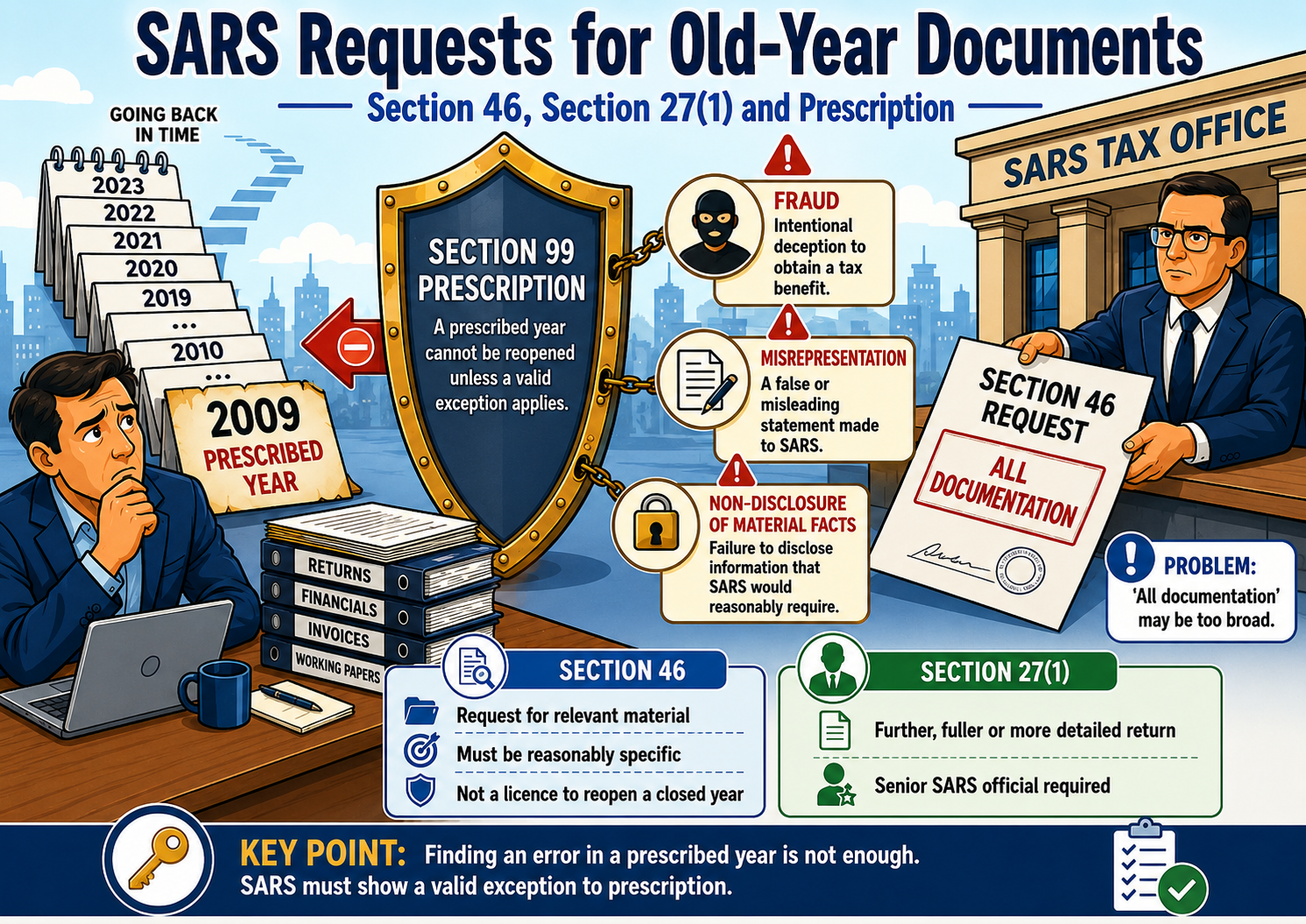
Prescription is one of the most important protections available to taxpayers in the South African tax administration system. It prevents tax affairs from remaining open indefinitely and creates finality once the statutory period has expired. The practical question often arises where SARS, during the verification or audit of a later year, identifies a problem that may also have existed in an earlier year. A common example is rent expenditure that SARS believes should have been apportioned between deductible and non-deductible use. SARS may then request documents for an earlier year that has already prescribed. The taxpayer must then decide how to respond.
The issue is not whether SARS may ever request information. SARS has wide powers to request relevant material. The issue is whether SARS may use a document request after prescription to reopen a year that is already closed. The taxpayer's response must be careful. A flat refusal may create unnecessary risk. Full compliance without reservation may also create risk, because SARS may attempt to use the documents to support an additional assessment. The correct approach is usually a qualified response that records prescription, reserves the taxpayer's rights, and requires SARS to identify the legal basis for requesting documents relating to a prescribed year.
The purpose of prescription
Prescription under section 99 of the Tax Administration Act exists to provide certainty. Once the prescribed period has passed, SARS is generally barred from issuing a further assessment for that year. Section 99 establishes the limitation period for SARS to issue assessments and the default period is three years after the original assessment, subject to specified exceptions.
For most income tax assessments, the ordinary prescription period is three years from the date of the original assessment. For self-assessment taxes, such as VAT and PAYE, the period is generally five years. This distinction is important. In an income tax rent-apportionment matter, the first question is whether SARS is within three years from the date of the original assessment. If SARS is outside that period, SARS must identify an exception before it can raise an additional assessment. For VAT or PAYE matters, the question is usually whether SARS is within five years.
The rent apportionment example
Assume a taxpayer claimed rent expenses in an earlier income tax year. The taxpayer used the premises partly for trade and partly for another purpose, or SARS later forms the view that the rent was not fully deductible. SARS then audits a later year, still within prescription, and discovers that the rent expense in that later year should have been apportioned.
SARS may be entitled to examine and adjust the later year if it is still within prescription. The taxpayer must engage with SARS on the merits of that open year. The taxpayer may have to provide the lease agreement, floor plan, usage schedule, management accounts, general ledger, and calculation of the deductible portion of the rent.
However, the later-year finding does not automatically reopen an earlier prescribed year. SARS cannot simply say: "We found the apportionment was wrong in 2024, therefore we will reopen 2020." Prescription still applies to the earlier year. SARS must show why the earlier year falls within one of the statutory exceptions.
The section 99 exceptions
Section 99(2) is the key provision. Prescription does not apply where the full amount of tax was not assessed due to fraud, misrepresentation, or non-disclosure of material facts. In the case of an assessment by SARS, prescription may be displaced where the failure to assess the full amount was due to fraud, misrepresentation, or non-disclosure of material facts.
For self-assessment, the exceptions are expressed more specifically. They include fraud, intentional or negligent misrepresentation, intentional or negligent non-disclosure of material facts, or failure to submit a return or make the required payment.
The distinction matters. SARS must do more than identify an error. SARS must identify the statutory exception. In a rent case, SARS must show that the non-apportionment was not merely an incorrect tax treatment, but was caused by fraud, misrepresentation, or non-disclosure of material facts.
Error versus non-disclosure
A disagreement about rent apportionment is not automatically non-disclosure. Many tax disputes arise because SARS and the taxpayer disagree on the application of the law to disclosed facts. That is different from the taxpayer hiding facts.
For example, if the taxpayer disclosed rental expenditure in the tax return, financial statements, tax computation, or accounting records, and SARS could have requested supporting documents within the prescription period but failed to do so, the taxpayer has a strong prescription argument. SARS may say the rent should have been apportioned. The taxpayer may say the rent was fully deductible, or that any apportionment adopted was reasonable. That is a merits dispute. It does not automatically become a prescription exception.
Non-disclosure requires a material fact that was not disclosed. In a rent case, a material fact might be that part of the premises was used privately, or by another entity, or for exempt activities, and that this fact was not disclosed or could not be identified from the return or supporting records. Even then, SARS must connect the non-disclosure to the failure to assess the full amount of tax within the ordinary prescription period.
The taxpayer should therefore insist that SARS identify the specific material fact allegedly not disclosed. It is not enough for SARS to state generally that the rent was incorrectly claimed. SARS must explain what was not disclosed, why it was material, and how it caused the under-assessment.
SARS' power to request relevant material
Section 46 of the Tax Administration Act gives SARS power to request relevant material for the purposes of the administration of a tax Act. SARS may require a taxpayer or another person to submit relevant material within a reasonable period.
The same provision requires that the taxpayer submit relevant material at the place, in the format, and within the time specified in the request. It also allows SARS to extend the period if reasonable grounds for an extension are submitted by the taxpayer. Importantly, section 46(6) provides that relevant material required by SARS must be referred to in the request with reasonable specificity.
This means that SARS cannot make an unlimited or vague demand. A request for "all documents relating to rent for the past ten years" may require challenge or clarification. SARS must identify the material required with reasonable specificity. The taxpayer may ask SARS to specify the year, tax type, issue, document category, and relevance.
However, the existence of section 46 does not mean SARS may revive a prescribed year merely by requesting documents. SARS' information-gathering power must be considered together with section 99. Where a year has prescribed, the taxpayer should not ignore SARS, but should require SARS to explain the statutory basis for requesting documents in relation to a closed year.
The danger of a flat refusal
A taxpayer should be cautious before simply refusing to provide documents. A refusal may be used by SARS to allege non-cooperation. It may also escalate the matter unnecessarily. In some cases, SARS may contend that the documents are relevant to an open year, even if they relate historically to a prior year. For example, SARS may request the original lease agreement signed in an earlier year to verify the rent deduction in a later year that is still open. In that case, the document may be relevant to an open year, even though the document was created in a prescribed year.
The correct question is therefore not merely whether the document is old. The correct question is whether SARS is using the document request to administer an open year or to reopen a prescribed year.
A flat refusal may be risky where the document is relevant to an open year. But where SARS expressly requests documents for the purpose of adjusting a prescribed year, the taxpayer should raise prescription immediately.
The better response: qualified engagement
The safest response is usually to engage, but under reservation of rights. The taxpayer should respond within the SARS deadline and say: the year has prescribed; the taxpayer does not waive prescription; the taxpayer does not accept that SARS may reopen the year; SARS must identify the legal basis for the request; SARS must confirm whether it relies on section 99(2); SARS must identify the alleged fraud, misrepresentation, or non-disclosure; SARS must confirm that any documents supplied will not constitute a waiver of prescription; and SARS must confirm that no additional assessment will be issued unless SARS establishes a valid section 99(2) exception.
This approach avoids non-compliance while protecting the taxpayer's legal position.
SARS cannot extend prescription after it has expired
A further important point concerns extensions of prescription. The Commissioner may extend a prescription period by prior notice of at least 30 days to the taxpayer, before the expiry of the period, by a period approximate to a delay arising from the taxpayer's failure to provide relevant material requested under section 46 or from resolving an information entitlement dispute.
The words "before the expiry" are critical. If the year has already prescribed, SARS cannot normally revive it by issuing a fresh document request after expiry and then saying the taxpayer's delay extends prescription. Section 99(3) operates before the prescription period expires. It does not convert an already prescribed year into an open year.
Any agreement to extend prescription must be made before the expiry of the original period. This supports the taxpayer's argument that SARS must act timeously if it wants to preserve its ability to assess.
Where SARS never requested documents during prescription
The taxpayer's position is stronger where SARS never requested documents during the prescription period. SARS had the statutory power to verify, audit, and request relevant material before prescription expired. If SARS did not exercise those powers, it cannot later convert its own inaction into taxpayer non-disclosure.
This is particularly important in the rent apportionment example. If the rent expense was disclosed in the financial statements or tax computation, and SARS never asked for the lease, floor plan, or allocation schedule before prescription expired, the taxpayer can argue that SARS had the opportunity to investigate the issue and did not do so.
The taxpayer should not say only: "SARS never asked." The stronger formulation is: SARS had the right to request documents before prescription; the taxpayer submitted the return; the rent expense was disclosed; no documents were withheld because no request was made; SARS did not extend prescription before expiry; SARS has not identified fraud, misrepresentation, or non-disclosure; therefore, the year remains prescribed.
Later-year findings do not automatically prove earlier-year non-disclosure
SARS may argue that a later-year rent apportionment adjustment reveals a pattern. That may be factually relevant, but it does not by itself override prescription. A later-year finding may cause SARS to suspect that the same issue existed earlier. Suspicion is not enough. SARS still has to identify the section 99(2) exception for the prescribed year.
The taxpayer should separate the years. For the later year that is within prescription, the taxpayer should deal with the merits of the apportionment. For the earlier prescribed year, the taxpayer should raise prescription and require SARS to prove the exception.
This separation is essential. If the taxpayer mixes the two years together, SARS may try to treat the merits of the later year as an admission for the earlier year. The taxpayer should avoid making unnecessary admissions. A concession that apportionment may be appropriate in the later year should not be framed as an admission that the earlier year was incorrectly or dishonestly filed.
Practical wording for the taxpayer's position
A suitable position is:
"The taxpayer records that the year of assessment concerned has prescribed under section 99(1) of the Tax Administration Act. The taxpayer does not waive reliance on prescription. SARS did not request the relevant material during the prescription period and did not issue any notice extending prescription before expiry. The rent expense was disclosed in the taxpayer's return, financial statements, tax computation, or accounting records. There was no fraud, misrepresentation, or non-disclosure of material facts. SARS is requested to identify the specific section 99(2) exception relied upon and the material facts allegedly not disclosed before requiring documents for a prescribed year."
This wording does three things. It responds to SARS. It preserves prescription. It shifts the focus to SARS' burden to identify the exception.
Documents supplied under reservation of rights
Where the taxpayer decides to provide documents, the submission should be expressly qualified. The covering letter should state that the documents are provided under reservation of rights, without waiver of prescription, and only to avoid any allegation of non-cooperation.
The taxpayer should also state that the documents may not be used to contend that the taxpayer agreed to reopen the year. If SARS wants to assess the prescribed year, SARS must first identify a valid statutory exception.
A reservation of rights is not a magic formula, but it is important evidence of the taxpayer's position. It prevents SARS from arguing that the taxpayer voluntarily accepted that the year was open.
Conclusion
Where SARS requests documents for a year that is already out of prescription, especially in relation to rent apportionment, the taxpayer should not ignore SARS and should not issue a reckless refusal. The proper approach is a controlled and qualified response.
Prescription is a substantive protection. SARS generally has three years for income tax and five years for self-assessment taxes. Once that period has expired, SARS must rely on a section 99(2) exception such as fraud, misrepresentation, or non-disclosure of material facts. A disagreement about rent apportionment is not, by itself, proof of any of those exceptions.
SARS may request relevant material under section 46, but the request must be reasonably specific and must be connected to a valid tax administration purpose. If the request concerns a prescribed year, SARS should be asked to identify the statutory basis for the request and whether it relies on section 99(2). If SARS did not request documents before prescription and did not extend prescription before expiry, it cannot usually revive the year by making a late request.
The taxpayer's best position is to respond promptly, reserve all rights, refuse to waive prescription, ask SARS to identify the exception relied upon, and provide documents only where appropriate and strictly under reservation. This approach protects the taxpayer while avoiding the risks that come with outright non-compliance.
