
Tax Knowledge Centre
The double taxation problem within the lump sum aggregation framework
By Mark Silberman B.Acc CA(SA), SAICA Tax Technology Committee
Introduction
Lump sums are taxed using separate tax tables, not the ordinary income tax tables. They are intended to be taxed once, in the year received. By law, prior and current lump sums are aggregated when a taxpayer receives multiple lump sums over time. The issue is how the credit for prior tax is calculated.
Aggregation itself is accepted and not in dispute. The distortion arises from re-calculating prior lump sums using current tables rather than crediting the actual tax already paid. This creates a hidden double taxation that many taxpayers and practitioners do not immediately recognise.
The 2014 lump sum — taxed in 2014
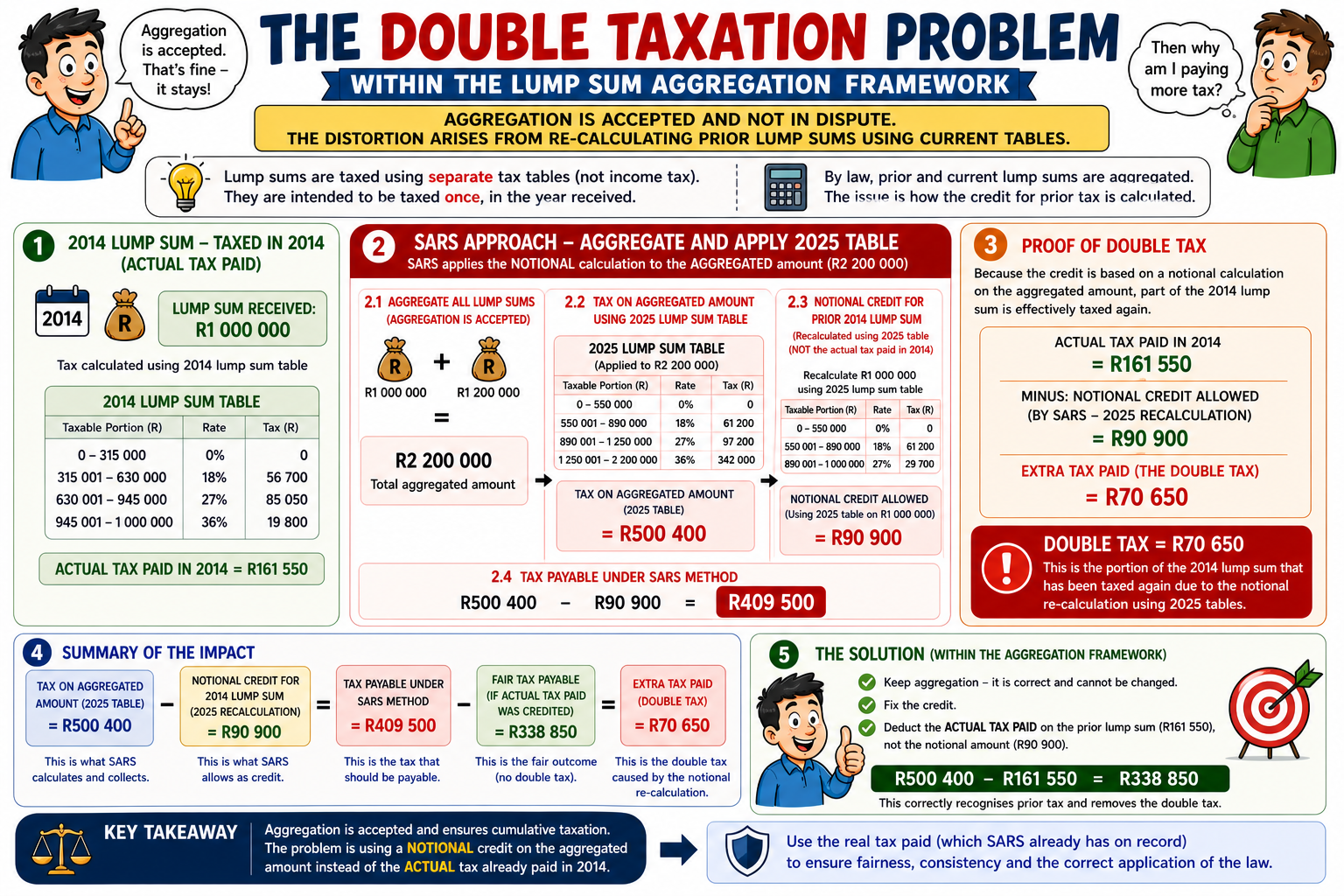
Consider a taxpayer who received a lump sum of R1 000 000 in 2014. The tax was calculated using the 2014 lump sum table. The actual tax paid in 2014 was R161 550. This is the real tax that SARS collected and that the taxpayer has already paid.
The 2014 table applied progressive rates: 0% on the first R315 000, 18% on the band up to R630 000, 27% on the band up to R945 000, and 36% on the balance up to R1 000 000. The total tax of R161 550 was correct at the time and has been paid.
SARS approach — aggregate and apply the 2025 table
When the taxpayer later receives another lump sum — say R1 200 000 in 2025 — SARS aggregates the two amounts. The total aggregated amount is R2 200 000. SARS then applies the 2025 lump sum table to the aggregated amount. The tax on R2 200 000 under the 2025 table is R500 400.
The problem arises in the credit for the prior 2014 lump sum. SARS recalculates the tax on the 2014 R1 000 000 using the 2025 table, not the 2014 table. This produces a notional credit of R90 900 — substantially less than the R161 550 actually paid in 2014.
The SARS method then calculates tax payable as R500 400 minus the notional credit of R90 900, giving R409 500. But this is not the correct outcome.
Proof of double tax
The double tax becomes clear when the actual tax paid is compared with the notional credit allowed. The actual tax paid in 2014 was R161 550. The notional credit allowed by SARS under the 2025 recalculation is only R90 900. The difference — R70 650 — is the extra tax paid because of the notional re-calculation.
This R70 650 represents the portion of the 2014 lump sum that has been taxed again. It is not a new tax on the 2025 lump sum. It is a second layer of tax on the 2014 lump sum that arises solely because SARS used a current table to recalculate historical tax rather than crediting the tax that was actually paid.
Summary of the impact
The distortion can be summarised in four steps. First, SARS calculates tax on the aggregated amount using the 2025 table: R500 400. Second, SARS allows a notional credit for the 2014 lump sum recalculated using the 2025 table: R90 900. Third, the tax payable under the SARS method is R409 500.
Fourth, and most important, the fair tax payable — if the actual tax paid in 2014 was properly credited — is R338 850. The extra tax paid, the double tax, is R70 650. This is the amount that should not have been charged.
The solution
The correct approach is straightforward. Aggregation must remain because the law requires it and it ensures cumulative taxation. The credit, however, must be fixed. The taxpayer should deduct the actual tax paid on the prior lump sum — R161 550 in this example — not the notional amount of R90 900.
Applying this correction: R500 400 minus R161 550 equals R338 850. This correctly recognises the prior tax already paid and removes the double tax. It ensures fairness, consistency and the correct application of the law.
Key takeaway
Aggregation is accepted and ensures cumulative taxation. The problem is using a notional credit on the aggregated amount instead of the actual tax already paid in the earlier year. SARS already has the real tax paid on record. The taxpayer and practitioner should insist on crediting the actual tax paid to ensure fairness, consistency and the correct application of the law.
