Accfin Sky
Sky Academy

Secretarial Practice Centre

Download our editable company secretarial mandate and resolution template — covering AI usage and POPIA compliance for your firm.

Free download

Company Secretarial Mandate & Resolution (AI / POPIA Template)

Editable Word template — a combined company secretarial mandate and resolution covering AI usage and POPIA compliance for your firm. Complete a short form and we'll email the editable Word document straight to your inbox.

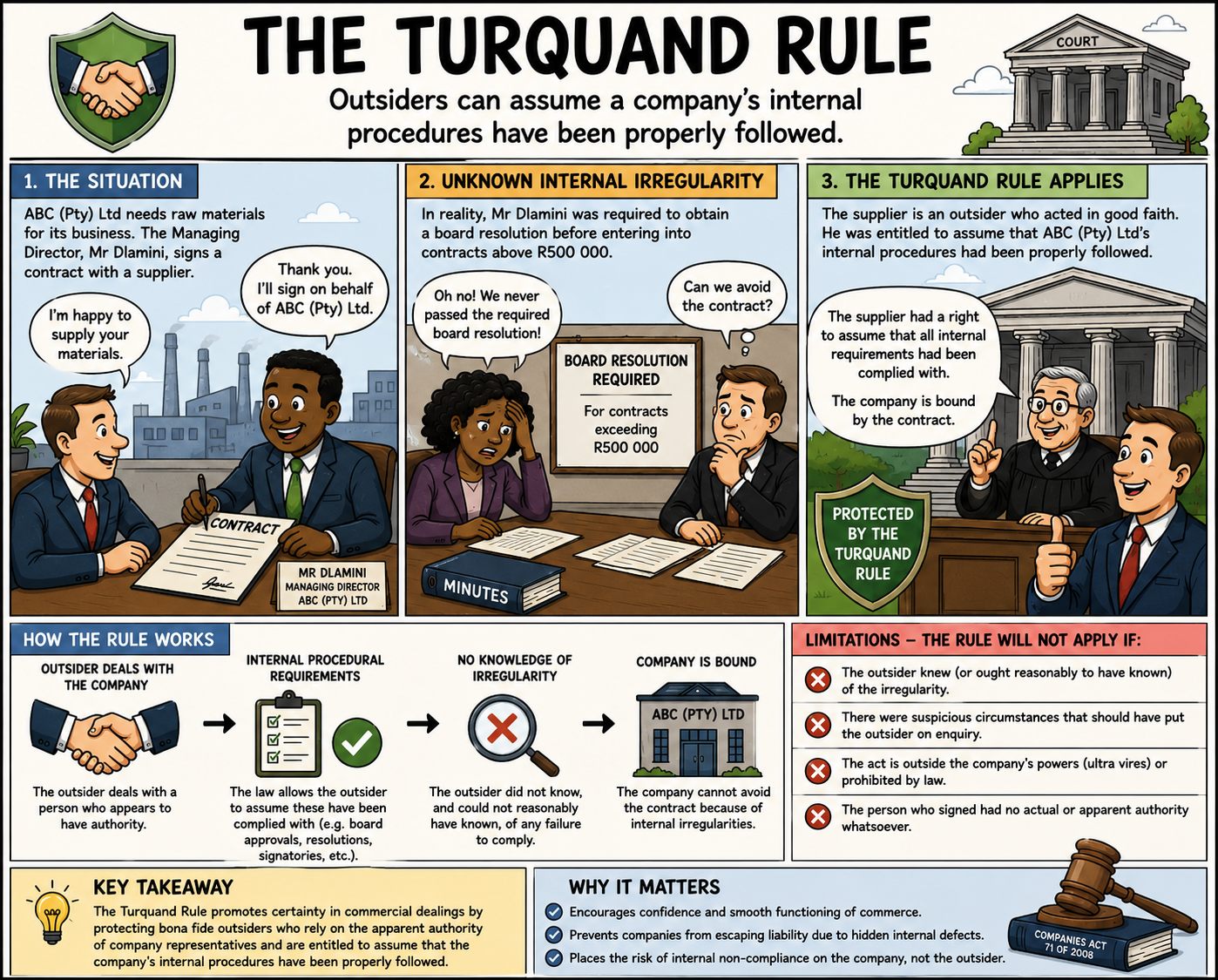
The Turquand Rule — South African company law boardroom with gavel, scales of justice and the Companies Act

The Turquand Rule in South African Company Law – Protection for Outsiders or a Trap for the Unwary?

Origin, purpose and modern statutory codification of the Indoor Management Rule — when outsiders are protected, and when suspicious circumstances defeat the rule.

Introduction

Every day, businesses enter into contracts on the assumption that the person signing on behalf of a company has the necessary authority to do so. Suppliers deliver goods, banks advance funds, insurers issue policies, landlords conclude leases, and professional firms accept instructions, all without demanding sight of every board resolution or shareholder approval.

If every outsider were required to investigate the internal workings of every company before concluding a transaction, commerce would grind to a halt.

The law therefore developed a practical solution known as the Turquand Rule, or the Indoor Management Rule. The rule protects outsiders dealing with companies by allowing them to assume that internal company procedures have been properly followed.

The principle has become one of the most important doctrines in company law. However, it is not unlimited. South African courts have repeatedly held that the rule cannot be used where there are suspicious circumstances, where the outsider had knowledge of irregularity, or where the transaction is fundamentally unauthorised.

This article examines the origin of the Turquand Rule, its development in South African law, its codification in the Companies Act 71 of 2008, and the circumstances in which it will and will not protect a third party.

The Origin of the Rule

The rule derives from the English case of Royal British Bank v Turquand (1856).

The company's constitution allowed the directors to borrow money provided a resolution of shareholders authorised the borrowing. The directors borrowed money from a bank and issued a bond, but the required shareholder resolution had never been passed.

When the company later sought to avoid liability, it argued that the internal requirements for borrowing had not been complied with.

The court rejected this argument. It held that the bank was entitled to assume that the necessary internal procedures had been followed. The bank was not required to investigate whether the shareholders had in fact passed the required resolution.

The court recognised a fundamental commercial reality: outsiders can inspect a company's public documents, but they cannot reasonably be expected to supervise its internal governance. This became known as the Indoor Management Rule.

The Purpose of the Rule

The rule serves an important commercial purpose. Companies act through human beings. Internal authority is frequently dependent upon resolutions, delegations, approvals, quorums and procedural requirements that are not visible to outsiders.

Without the Turquand Rule, a company could routinely avoid contractual obligations by pointing to some internal procedural defect unknown to the other contracting party.

The rule therefore promotes:

  • Commercial certainty.
  • Confidence in business transactions.
  • Protection of innocent third parties.
  • Efficient contracting.

At its heart, the rule places the risk of internal non-compliance on the company rather than on the outsider.

Adoption in South African Law

South African courts accepted the Turquand Rule as part of our common law. The leading authority is Mine Workers' Union v Prinsloo 1948 (3) SA 831 (A).

In that case, a union constitution required approval by its General Council before certain transactions could be concluded. Contracts were entered into without the required approval. The union attempted to escape liability by arguing that the internal approval process had not been followed.

The Appellate Division rejected the argument. The court held that an outsider dealing with the organisation was entitled to assume that the necessary internal requirements had been complied with.

The significance of the case extends far beyond trade unions. It firmly established the principle that a contracting party is generally entitled to assume that internal management requirements have been satisfied. Prinsloo remains the cornerstone of the South African Turquand Rule.

What the Rule Actually Protects

One of the most common misunderstandings is that the Turquand Rule creates authority. It does not.

The rule only allows an outsider to assume that internal procedures have been complied with. It does not create authority where none exists. The distinction is critical.

Suppose a company's board has delegated authority to a managing director subject to obtaining board approval. If the managing director signs a contract without obtaining that approval, the Turquand Rule may protect the outsider. However, if an ordinary employee with no authority signs the contract, the rule does not magically create authority that never existed.

The outsider must still show that the individual appeared to have authority to act on behalf of the company. The rule deals with internal irregularities. It does not deal with a complete absence of authority.

The Relationship Between the Turquand Rule and Estoppel

The Turquand Rule is often confused with estoppel. Although both doctrines can produce similar outcomes, they are fundamentally different.

Estoppel requires:

  • A representation by the company.
  • Reliance by the third party.
  • Reasonable reliance.
  • Prejudice suffered by the third party.

The focus is on the company's conduct.

The Turquand Rule requires:

  • A company representative who appears to have authority.
  • An internal irregularity.
  • A bona fide outsider.
  • No knowledge of non-compliance.

The focus is on presumed regularity of internal processes. An outsider may succeed under the Turquand Rule even where there has been no direct representation by the company.

When the Rule Applies

The courts generally apply the rule where:

  • The transaction is within the company's powers.
  • The representative appears authorised.
  • The defect is procedural.
  • The outsider acts in good faith.
  • There are no suspicious circumstances.

Examples include:

  • Missing board resolutions.
  • Defective meeting procedures.
  • Internal approval requirements not being met.
  • Failure to obtain a quorum.
  • Defects in delegation procedures.

In such cases the outsider is entitled to assume regularity.

When the Rule Does Not Apply

The courts have consistently imposed important limitations.

Suspicious Circumstances. The most important limitation is the existence of suspicious circumstances. Where a reasonable person would have questioned the authority being exercised, the outsider loses the protection of the rule. This principle appears repeatedly throughout the case law.

Burnstein v Yale. In Burnstein v Yale 1958 (1) SA 786 (W) a single director purported to bind the company in circumstances where board approval was required. The court regarded the transaction as sufficiently unusual to place the outsider on enquiry. The outsider could not simply assume compliance. The Turquand Rule therefore failed.

Wolpert v Uitzigt Properties. In Wolpert v Uitzigt Properties (Pty) Ltd 1961 (2) SA 257 (W) a director signed promissory notes without the required board authority. The court held that the outsider could not rely on the Turquand Rule because there was no evidence that authority existed in the first place. The case highlights the distinction between an internal irregularity and a complete absence of authority.

Nieuwoudt NO v Vrystaat Mielies. In Nieuwoudt NO v Vrystaat Mielies (Edms) Bpk 2004 (3) SA 486 (SCA) the company's constitution required formal delegation of authority. No such delegation had ever occurred. The Supreme Court of Appeal held that the outsider could not invoke the Turquand Rule. There was no basis upon which to assume the required delegation had occurred.

Farren v Sun Service. In Farren v Sun Service SA Photo Trip Management (Pty) Ltd 2003 (2) SA 146 (C) the sale of a business required shareholder approval under section 228 of the old Companies Act. No shareholder resolution had been passed. The court refused to apply the Turquand Rule. To do so would have undermined the statutory protection afforded to shareholders. The decision illustrates an important principle: the rule cannot override substantive statutory requirements.

The Companies Act 71 of 2008

The 2008 Companies Act significantly changed the landscape. The Act abolished most aspects of the old doctrine of constructive notice. Third parties are generally no longer deemed to know the contents of a company's constitutional documents.

At the same time, the legislature codified the Turquand Rule.

Section 20(7). Section 20(7) provides that a person dealing with a company in good faith may presume that the company has complied with all formal and procedural requirements in terms of the Act, the Memorandum of Incorporation and the company's rules. This presumption does not apply where the person knew or reasonably ought to have known of the non-compliance. The section effectively places the common-law rule into statutory form.

Section 20(8). Section 20(8) is often overlooked but is critically important. It provides that section 20(7) must be construed concurrently with, and not in substitution for, any relevant common-law principle relating to the presumed validity of company actions. In practical terms, section 20(8) preserves the common-law Turquand Rule. The statute did not replace the common law. It supplemented it. The courts are therefore entitled to continue applying common-law principles alongside section 20(7).

One Stop Financial Services v Neffensaan Ontwikkelings

The leading modern authority is One Stop Financial Services (Pty) Ltd v Neffensaan Ontwikkelings (Pty) Ltd 2015 (4) SA 623 (WCC). The court analysed the interaction between sections 20(7) and 20(8). It concluded that the statutory provision must be interpreted consistently with the traditional common-law rule.

Importantly, the court emphasised that section 20(7) does not create authority where none exists. The outsider must still show that the person acting for the company possessed actual, apparent or ostensible authority. Only then does the presumption of internal compliance arise. The judgment remains one of the most important modern discussions of the Turquand Rule.

Practical Lessons for Practitioners

The Turquand Rule is often raised in disputes involving:

  • Company contracts.
  • Insurance arrangements.
  • Banking facilities.
  • Property transactions.
  • Suretyships.
  • Company secretarial matters.
  • Delegations of authority.

Practitioners should be alert to warning signs. The following are classic red flags:

  • A single director signing an unusually large transaction.
  • Transactions benefiting directors personally.
  • Payments being made by one entity for another.
  • Absence of supporting documentation.
  • Transactions outside the company's ordinary business.
  • Contradictions between documents.

Where such circumstances exist, a prudent third party should seek proof of authority. A simple request for a board resolution or company secretary certificate can avoid years of litigation.

Conclusion

The Turquand Rule remains one of the most important protections available to third parties dealing with companies. Its purpose is straightforward: outsiders should not be expected to police the internal workings of every company with which they transact.

South African courts have consistently protected innocent third parties where authority appears regular and the defect is merely procedural. At the same time, the courts have been equally clear that the rule is not a licence for carelessness. Suspicious circumstances, lack of authority, statutory non-compliance and knowledge of irregularity will defeat its operation.

The Companies Act 71 of 2008 has strengthened rather than weakened the doctrine. Through sections 20(7) and 20(8), the legislature has codified the principle while preserving its common-law foundations.

For accountants, company secretaries, attorneys and corporate advisors, the lesson is simple: the Turquand Rule provides significant protection, but it does not remove the need for commercial vigilance. The moment a transaction raises questions that a reasonable person would investigate, the protection of the rule may disappear.

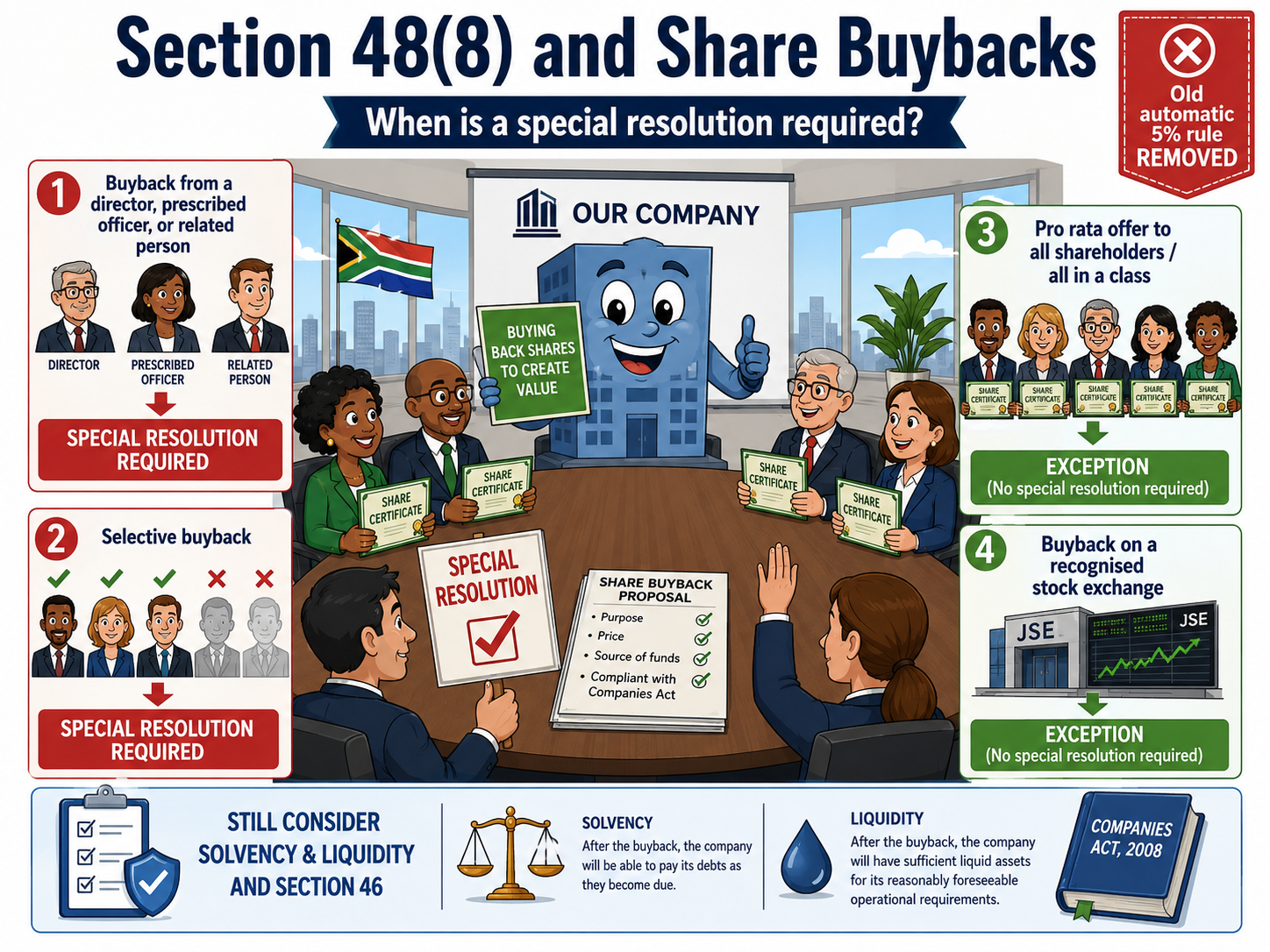
Section 48(8) share buybacks — stock certificates, gavel and balance scale in a corporate boardroom

Section 48(8) and Share Buybacks: The New Rules Practitioners Must Understand

Why the old 5% trigger has fallen away, what the new approval test means in practice, and the documentation every practitioner must now keep on file.

Introduction

Share buybacks are a common commercial tool. They are used to restructure ownership, return capital to shareholders, settle disputes between shareholders, facilitate exits, simplify a shareholding structure, or acquire shares held by a departing shareholder.

However, a share buyback is not merely an accounting transaction or a commercial agreement between the company and the selling shareholder. It is a transaction regulated by the Companies Act 71 of 2008, and it affects capital maintenance, creditor protection, shareholder equality, board responsibility, and in some cases takeover regulation.

The amendment to section 48(8) has materially changed the way practitioners must approach share buybacks. The old "5% rule" has been removed. This is an important simplification, but it does not mean that buybacks are now informal or free of shareholder approval. In fact, the new section 48(8) creates a different and arguably broader approval test.

The practical message is this: under the new regime, the question is no longer simply whether the buyback exceeds 5% of a class of shares. The correct questions are now: who is selling, how is the offer made, whether the transaction is pro rata or selective, whether the shares are traded on a recognised exchange, whether the solvency and liquidity test is satisfied, and whether the transaction is in substance a scheme of arrangement.

The Old Section 48(8): The Former 5% Trigger

Before the amendment, section 48(8) created two important triggers.

First, if the company acquired shares from a director, prescribed officer, or a person related to a director or prescribed officer, the board decision had to be approved by special resolution of shareholders.

Secondly, if the buyback, considered alone or together with other transactions in an integrated series, involved the acquisition by the company of more than 5% of the issued shares of any particular class, the transaction was made subject to sections 114 and 115.

This created a major practical difficulty. A buyback exceeding the 5% threshold could be forced into the procedural framework normally associated with schemes of arrangement and fundamental transactions. This could involve additional procedural requirements, expert reports, shareholder approvals and potential appraisal rights.

For many private companies, this was cumbersome. A perfectly commercial buyback between a company and a willing shareholder could be treated procedurally as if it carried the same weight as a major corporate restructuring. The result was often delay, cost and uncertainty.

The New Section 48(8): The 5% Rule Falls Away

The new section 48(8) changes the approach. The previous automatic rule that linked a buyback of more than 5% of a class of shares to sections 114 and 115 has been removed.

This is the most important change. A buyback is no longer automatically pushed into the scheme of arrangement procedure simply because it exceeds 5% of a class of shares.

Instead, the new section 48(8) focuses on whether a special resolution is required.

A decision by the board of a company to acquire its own shares must be approved by special resolution if the shares are acquired from a director, prescribed officer, or a person related to a director or prescribed officer.

In addition, a special resolution is required where the transaction entails the acquisition by the company of its own shares, unless the acquisition arises from one of two exceptions.

The first exception is a pro rata offer made by the company to all shareholders, or to all shareholders of a particular class. This remains so even if the pro rata offer includes shareholders who are directors, prescribed officers or persons related to them.

The second exception is a transaction effected on a recognised stock exchange on which the shares are traded, being a licensed exchange under the Financial Markets Act.

The effect is that selective buybacks will usually require a special resolution. Pro rata buybacks and exchange-traded buybacks may fall outside the special resolution requirement in section 48(8), although other legal, MOI, listing, tax and regulatory requirements must still be considered.

The New Practical Test

Practitioners should no longer start with the old 5% question. The better approach is to apply a practical decision tree.

  • Is the company acquiring its own shares? If yes, section 48 is engaged.
  • Is the selling shareholder a director, prescribed officer, or related person? If yes, a special resolution is required unless the transaction falls within the pro rata offer wording.
  • Is the buyback pro rata to all shareholders or to all shareholders of a particular class? If yes, the transaction may fall within the statutory exception.
  • Is the transaction effected through a recognised stock exchange? If yes, the second exception may apply.
  • If neither exception applies, the transaction is a selective repurchase and a special resolution will be required.
  • Even if section 48(8) does not require sections 114 and 115 merely because of size, the practitioner must still consider whether the transaction is in substance a scheme of arrangement.

Sections 114 and 115: Not Gone, But No Longer Automatic

It would be wrong to conclude that sections 114 and 115 are irrelevant after the amendment. What has been removed is the automatic 5% gateway.

A buyback may still be structured in a way that amounts to a scheme of arrangement. This will depend on the facts. Where the transaction is simply a consensual agreement between the company and a willing selling shareholder, and it does not bind non-consenting shareholders or alter their rights, it is less likely to be a true scheme of arrangement.

However, where the transaction forms part of a broader arrangement between the company and holders of a class of securities, and shareholders are bound through a statutory approval mechanism, sections 114 and 115 may still need to be considered.

The distinction is important. The practitioner must examine the substance of the transaction, not merely the percentage of shares being repurchased.

Solvency and Liquidity Remain Central

The removal of the 5% rule does not dilute the capital maintenance protections in the Act.

A share buyback remains subject to the solvency and liquidity requirements. The board must consider whether the company will satisfy the solvency and liquidity test immediately after completing the transaction. This is not a box-ticking exercise.

The board should record the financial information considered, the basis of the valuation, the effect of the payment on creditors, cash flow forecasts, liabilities, contingent liabilities and whether the company will be able to pay its debts as they become due in the ordinary course of business.

The buyback should also be considered as a distribution for purposes of the Act. This means that section 46 must be dealt with properly, including the board resolution and the reasonable conclusion that the company will satisfy the solvency and liquidity test.

A failure to document this properly may expose directors to personal risk, especially if the company later experiences financial difficulty.

MOI and Template Risk

One of the most practical dangers is that many companies still have memoranda of incorporation, precedent resolutions and secretarial checklists based on the old section 48(8).

A company's MOI may repeat the old 5% rule or impose stricter approval requirements than the Act. If so, the MOI must still be followed unless and until it is amended.

This creates a practical trap. The Act may have been simplified, but the company's own constitutional document may preserve the old approach. Practitioners should therefore never assume that the statutory amendment automatically changes the company's internal approval requirements.

Every buyback should begin with a review of the MOI.

Private Companies and Shareholder Exits

The amendment is particularly important for private companies.

In many private companies, a buyback is used when one shareholder exits and the remaining shareholders do not want to buy the shares personally. The company buys back the shares, cancels or holds them as permitted, and the ownership percentages of the remaining shareholders effectively increase.

Under the old regime, if the buyback exceeded 5% of a class, there was a risk that the transaction would be pushed into the procedural world of sections 114 and 115. Under the new regime, the practitioner must rather determine whether the transaction is a selective buyback requiring a special resolution, and whether it is in substance a scheme.

In most private company exit transactions, the buyback will be selective and will therefore require shareholder approval by special resolution. That is simpler than the old automatic sections 114 and 115 trigger, but it is still a formal process.

Regulated Companies and TRP Considerations

The buyback analysis should not stop at section 48.

Where the company is a regulated company, the takeover provisions and Takeover Regulation Panel requirements must also be considered. This is particularly relevant where the buyback changes control percentages or forms part of an affected transaction.

The amendment to section 48(8) does not eliminate the need to consider Chapter 5 of the Act. A private company may also be a regulated company in certain circumstances. Practitioners should therefore consider whether the company falls within the regulated company provisions before treating the buyback as a purely internal matter.

Tax and Accounting Considerations

A share buyback also has tax and accounting consequences.

For tax purposes, the treatment of the payment must be considered carefully. The transaction may involve dividend tax consequences, capital gains tax implications, contributed tax capital considerations, and possible anti-avoidance concerns depending on how the transaction is structured.

From an accounting perspective, the company must account properly for the repurchase, the reduction in equity, and any related disclosures. The board should ensure that the accounting treatment aligns with the legal form and commercial substance of the transaction.

The company secretary, accountant and tax practitioner should therefore work together. A buyback should not be processed only as a secretarial event.

Practical Documentation Checklist

A proper buyback file should include at least the following:

  • The signed buyback agreement or offer documentation.
  • The current MOI and confirmation that its requirements were checked.
  • A board memorandum explaining the commercial rationale.
  • A board resolution approving the transaction.
  • A solvency and liquidity assessment.
  • Management accounts or financial information relied upon by the board.
  • The special resolution, where required.
  • Confirmation whether the transaction is pro rata, selective, or exchange-traded.
  • Confirmation whether the seller is a director, prescribed officer or related person.
  • Confirmation whether sections 114 and 115 were considered.
  • Confirmation whether the company is a regulated company.
  • Tax advice or tax working papers.
  • Updated securities register and beneficial ownership records.
  • Proof of payment and accounting entries.
  • Any CIPC or regulatory filings required by the transaction.

This documentation is not merely administrative. It is the evidence that the board applied its mind and that the transaction was lawfully implemented.

Conclusion

The amendment to section 48(8) is a welcome change. It removes the mechanical and often burdensome rule that treated a buyback of more than 5% of a class as automatically subject to the procedural requirements of sections 114 and 115.

However, the amendment does not make buybacks informal. It changes the compliance question.

Practitioners must now focus on whether the buyback is selective, whether the seller is connected to management, whether the transaction is pro rata or exchange-traded, whether the solvency and liquidity test is satisfied, whether the MOI imposes additional requirements, and whether the transaction is in substance a scheme of arrangement.

The old 5% shortcut is gone. The need for careful professional judgement remains.

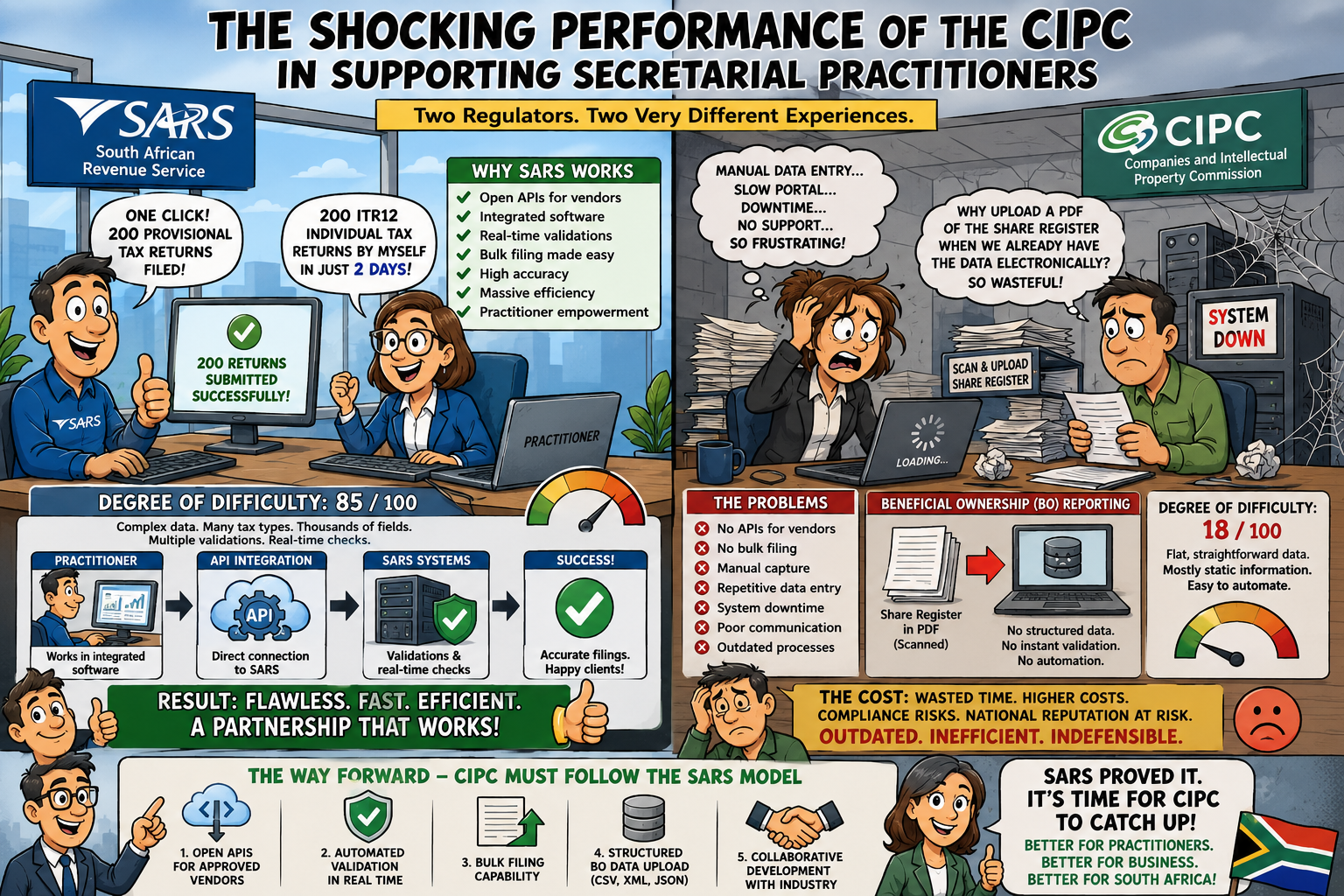
The Shocking Performance of the CIPC — comparison infographic of SARS efficiency vs CIPC frustration

The Shocking Performance of the CIPC in Supporting Secretarial Practitioners

Two regulators, two very different experiences — why SARS's open API model works, and why the CIPC's outdated portal is failing practitioners and the economy.

In a country where compliance burdens grow heavier by the year, one would expect our regulators to be at the forefront of efficiency, innovation, and digital transformation. Unfortunately, when it comes to the Companies and Intellectual Property Commission (CIPC), the reality for secretarial practitioners is a story of frustration, inefficiency, and outdated processes that actively undermine the profession.

A Stark Contrast: SARS vs CIPC

To understand just how far behind the CIPC has fallen, we need only look at the South African Revenue Service (SARS). SARS made a critical, forward-thinking decision years ago: rather than forcing taxpayers and practitioners to rely on a single government-built interface, it opened the door for software vendors to integrate directly into its systems.

The results of this decision speak for themselves. Consider these examples from practice:

  • One practitioner filed 200 provisional tax returns with a single click.
  • Another filed 200 ITR12 individual tax returns by himself in just two days.

This level of productivity is possible only because the SARS ecosystem enables practitioners to work within integrated software that communicates directly with the SARS back-end through APIs. Modern tax systems validate data before submission, flagging errors instantly, and making bulk filing effortless. The result?

  • High accuracy: Errors are detected upfront, drastically reducing rejections.
  • Massive efficiency gains: Large volumes of returns can be filed in hours, not weeks.
  • Practitioner empowerment: Firms can scale compliance work without scaling headcount.

Today, tax return filing in South Africa is almost flawless — a near-perfect system born out of collaboration between the regulator and private software providers.

The CIPC's Failure to Modernise

The CIPC, by contrast, has clung to an archaic, centralised model that forces every practitioner to work through its own clunky, government-managed portal. There is no facility for vendors to integrate directly. There is no API for automated filings. There is no streamlined process for bulk submissions.

Instead, company secretarial practitioners are subjected to:

  • Manual data capture into slow and unstable online forms.
  • Repetitive entry of identical information for each filing, instead of reusing validated client data.
  • Frequent downtime and technical errors with little communication or support.
  • No industry collaboration to design systems that actually meet professional needs.

The most glaring inefficiency is in beneficial ownership (BO) reporting. BO data is generated directly from a company's share register — yet practitioners are forced to upload share registers as scanned paper or PDF documents. This means:

  • No structured data for automated compliance checks.
  • No ability for the CIPC to instantly validate or cross-reference ownership changes.
  • Practitioners wasting time converting perfectly usable electronic data into dead, unsearchable formats.

Imagine the alternative — if we could upload the share register in a structured data format (CSV, XML, JSON, etc.), CIPC could instantly populate its BO database without manual keying, while practitioners could file in seconds. The technology already exists; what's missing is the will to implement it.

Degree of Difficulty for Software Vendors

When SARS opened its systems to software vendors, it wasn't easy. Tax return data is among the most complicated datasets in compliance work — thousands of fields, multiple tax types, cross-validations, calculations, and real-time checks both locally and on submission. Vendors had to build software that could handle:

  • Complex data capture and calculations across many tax forms.
  • Local validations to ensure internal consistency.
  • SARS-side validations at the point of filing.
  • Instant feedback loops when errors or mismatches occur.

By any standard, this was a degree of difficulty of 85 out of 100. Yet vendors rose to the challenge, and the SARS filing system of returns is seamless — enabling mass filing, automation, and accuracy.

Now compare this to the CIPC. The data required by CIPC is flat and straightforward. Practitioners already keep complete records locally in their own systems:

  • Company registers.
  • Shareholder and beneficial ownership data.
  • Director and officer information.

There is no complexity in the data structure. It is mostly static, relational information — names, ID numbers, share percentages — the kind of information that can be captured once and transferred easily. With the right design, it could be validated automatically at the point of upload.

By all measures, this is a degree of difficulty of 18 out of 100. Software vendors could easily transfer structured data directly into the CIPC with the necessary validations — just as they already do with SARS.

So the question becomes: Why has the CIPC not enabled this most basic and obvious step?

At a time when South Africa is under pressure to meet its FATF beneficial ownership transparency requirements, the answer matters. The country risks ongoing compliance failure because the CIPC insists on outdated, paper-based uploads instead of embracing a simple, proven integration model.

The Cost to the Profession and the Economy

The CIPC's refusal to modernise is not just an inconvenience — it has real economic consequences:

  • Wasted billable time for practitioners, which could otherwise be spent advising clients and adding value.
  • Delayed compliance due to backlogs, risking penalties and legal exposure for businesses.
  • Higher costs for SMEs who rely on practitioners for efficient filings.
  • National risk in failing FATF requirements and jeopardising South Africa's global standing.

For a country fighting to improve its ease of doing business ranking, this is an embarrassing and self-inflicted wound.

The Way Forward

The solution is not complex. The CIPC simply needs to follow the proven SARS model:

  • Open APIs for Approved Vendors: Let accredited software vendors build direct filing capability into their systems.
  • Automated Validation: Eliminate manual checks by running validations in real time before submission.
  • Bulk Filing Capability: Allow practitioners to submit multiple transactions in one batch.
  • Structured BO Data Upload: Accept share register uploads in machine-readable formats for instant beneficial ownership population.
  • Collaborative Development: Engage with industry bodies and software providers to design solutions that work in the real world.

SARS proved over a decade ago that partnering with the private sector is the fastest, most reliable way to modernise a regulatory process. It's time for the CIPC to catch up — because the current state of affairs is not just inefficient, it is indefensible.

FICA: NON-COMPLIANCE CAN DESTROY YOUR FIRM - 2 HOURS OF CPD

On demand GoTo webinar