
Tax Knowledge Centre
When SARS uses AI: why the TAA is not AI-friendly in formal decision-making
By Mark Silberman B.Acc CA(SA), SAICA Tax Technology Committee
Introduction
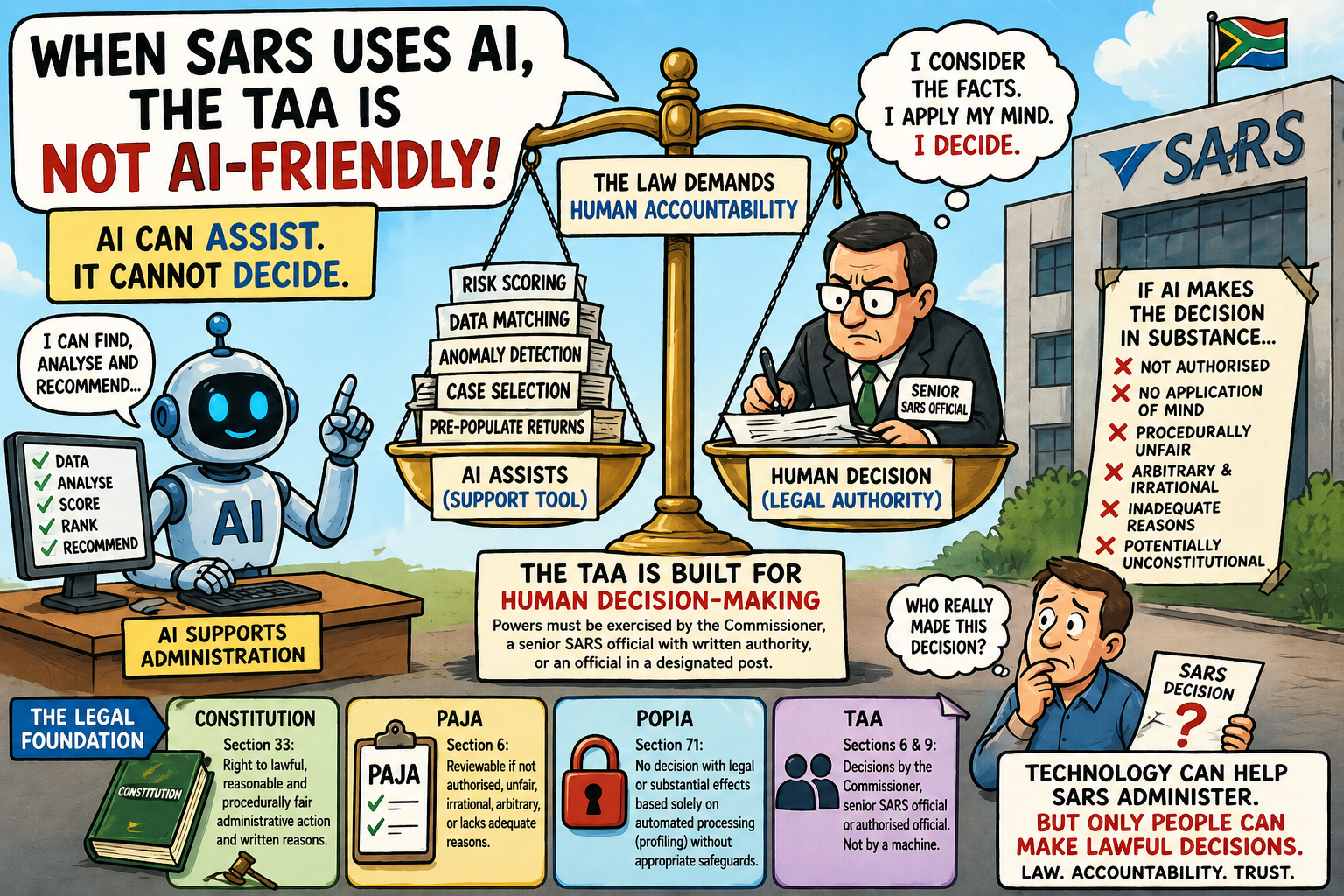
SARS is increasingly using automation, data analytics and AI in tax administration. That much is clear. But an important legal question arises when the Tax Administration Act (TAA) requires a senior SARS official to make a decision. Can AI effectively make that decision, with a human merely approving it? In my view, that is where the problem begins.
The TAA is not anti-technology, but it is not AI-native legislation. It is drafted around identifiable human functionaries, written authority, designated posts and clear lines of accountability. The Act contemplates decisions being made by the Commissioner, a senior SARS official, or another SARS official with proper authority. That structure is built for human decision-making, not for a machine to become the real decision-maker behind the outcome.
This distinction is critical. There is nothing inherently unlawful about SARS using AI to assist with administration. AI may help with case selection, risk profiling, anomaly detection, data matching and even pre-population of returns. But assistance is one thing; substitution is another. If AI becomes the substantive decision-maker, and the official merely rubber-stamps the result, the decision becomes legally vulnerable.
The Constitution strengthens this point
The Constitution strengthens this point. Section 33 requires administrative action to be lawful, reasonable and procedurally fair, and it gives a right to written reasons. Section 195 requires public administration to be accountable, transparent and fair. Those principles require more than a name at the bottom of a notice. They require that the lawful decision-maker actually apply an independent mind to the taxpayer's facts.
PAJA takes the matter further
PAJA takes the matter further. Administrative action may be reviewed if the decision-maker was not authorised, if there was no proper procedure, if the process was unfair, if relevant facts were ignored, if the decision was arbitrary or irrational, or if adequate reasons were not given. Those review grounds fit squarely into the AI debate. A machine-driven outcome, adopted without real human evaluation, may amount to no proper application of mind at all.
POPIA also matters
POPIA also matters. Section 71 places limits on decisions with legal or substantial effects where they are based solely on automated processing intended to profile a person. That provision reinforces the broader concern that fully automated adverse decisions sit uneasily with South African administrative law.
Warning signs for practitioners
For practitioners, the warning signs are practical. Does the SARS decision engage properly with the taxpayer's actual facts? Does it explain why submissions were rejected? Or does it read like a generic, formulaic response? If the reasons are standardised and disconnected from the case, one must ask whether there was a real human decision at all.
The better argument
The better argument is therefore not that SARS may never use AI. It is that the TAA allows AI support, but it is not AI-friendly where Parliament requires a human official to decide. The issue is not modernisation. The issue is legality. Where the law says a senior SARS official must decide, the final judgment must remain human, accountable and properly reasoned.
The bottom line
The bottom line is simple: AI may help SARS administer, but it cannot lawfully replace the human decision-maker where the TAA requires human authority.
