
Sky Tax Knowledge
Why Finalising Sky Transactions Matters
By Mark Silberman B.Acc CA(SA), SAICA Tax Technology Committee
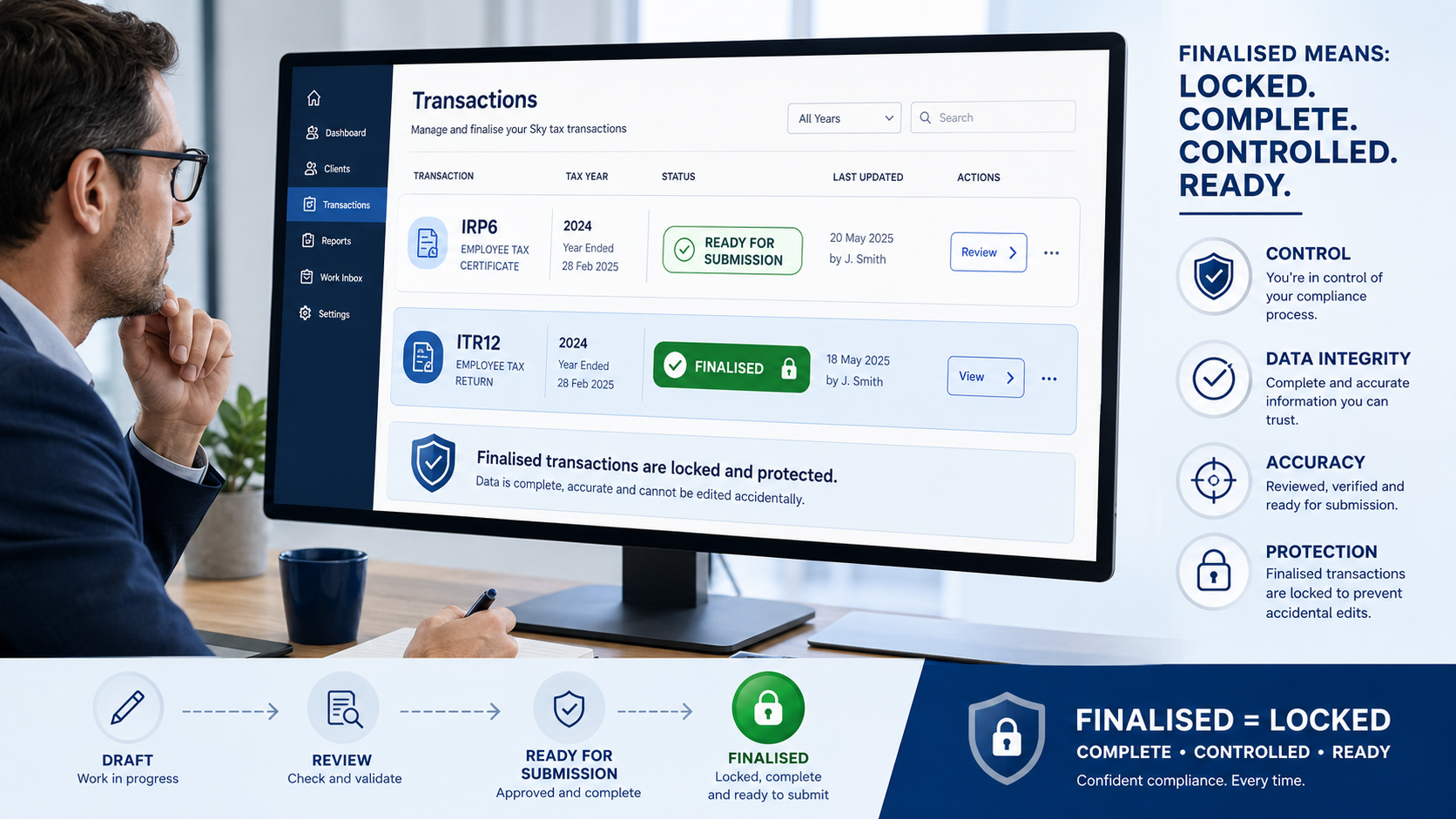
In Sky, finalising a transaction is not just an administrative step. It is an important control point in the workflow. Whether the transaction is an IRP6 provisional tax return, an ITR12 income tax return, or another Sky transaction, the purpose of finalising is to protect the integrity of the work that has been completed.
A finalised transaction tells the practice that the record has been checked, completed and is ready to be treated as the final version. Once finalised, the transaction is locked and a lock icon appears. This means the transaction cannot be changed accidentally unless it is deliberately unlocked again.
This is important because tax work is not only about completing a calculation. It is about knowing which version of the work is correct, which records are ready for submission, and which records must no longer be altered.
Finalised Means Complete and Controlled
When a transaction is marked as finalised, Sky is effectively recording that the work has reached a completed stage. The record has moved from being a working document to being a controlled record.
This is especially important in a busy tax practice where many people may be working on the same tax season, the same taxpayer base, or the same provisional tax run. Without a clear finalisation process, it becomes too easy for data to be changed after it has already been checked.
Finalising gives the practice a clear answer to a simple but critical question:
Is this transaction still being worked on, or is it complete?
Once the answer is complete, the transaction should be finalised.
Preventing Accidental Changes
One of the biggest risks in tax production is accidental change. A user may update a figure, retrieve information again, change demographic data, or overwrite information without realising that the return or provisional tax calculation had already been checked.
Finalising prevents this by locking the transaction.
This does not mean that errors can never be corrected. If a change is genuinely required, the transaction can be unlocked by an authorised user. But the act of unlocking becomes a deliberate step. This creates discipline and accountability in the process.
The benefit is simple: completed work is protected.
IRP6 and Provisional Tax Finalisation
In the IRP6 and provisional tax workflow, finalising is particularly important because the practice may be dealing with large volumes of taxpayers at the same time.
Sky uses statuses such as Ready for Submission and Finalised to help the user manage the workflow. These statuses allow the practice to filter the exact taxpayers or transactions that are ready to be submitted to SARS.
This is a major production advantage. Instead of relying on memory, spreadsheets, or informal notes, the status of the transaction tells the practice where the work stands.
Before finalising an IRP6 transaction, the user should ensure that the calculation has been reviewed, the relevant SARS assessment or statement information has been considered, and the payment position has been checked. Once that has been done, finalising records that the transaction is complete and ready to be relied on.
ITR12 Finalisation
The same principle applies to ITR12 returns.
Before filing an ITR12, the return should be previewed or pre-assessed. This allows the user to check for errors, review the expected SARS calculation, and compare the Sky result with what SARS is likely to assess.
This step is important because once the return has been worked on, the user should be careful about retrieving the return or demographics again. Re-retrieving information can overwrite work already done. Finalising the ITR12 helps protect the version of the return that has been prepared, checked and approved for filing.
In other words, finalisation protects the return from unnecessary or accidental change at the point where the practice is satisfied that the return is ready.
Finalisation Supports Better Practice Management
Finalising transactions is also a management tool.
It allows partners, managers and tax administrators to see what has been completed, what is still in progress, and what is ready for submission. This is especially important during peak tax season, when the volume of work is high and deadlines are tight.
A proper finalisation process helps a practice:
- identify completed work;
- filter records ready for submission;
- avoid submitting unfinished transactions;
- prevent accidental edits;
- maintain a reliable audit trail;
- improve review control; and
- reduce the risk of SARS submissions being based on incorrect or overwritten data.
Finalising Is Part of Data Integrity
Data integrity means that the data in the system can be trusted. In tax work, this is essential.
The practice must know that the data submitted to SARS is the same data that was reviewed and approved. If transactions remain open and editable after review, there is always a risk that the data may change before submission.
Finalising reduces that risk. It creates a controlled point in the process where the transaction is locked, complete and ready to be used.
Conclusion
Finalising Sky transactions is not merely a technical function. It is a control mechanism.
It tells the practice that the transaction has been completed. It locks the record against accidental edits. It helps users filter the correct records for SARS submission. It protects the work already done. Most importantly, it improves the integrity of the tax production process.
In a modern tax practice, where large volumes of IRP6 and ITR12 transactions are processed, finalisation should be treated as an essential step. It is the point where the practice moves from preparation to control.
Finalised means complete.
Finalised means protected.
Finalised means ready.