
Sky Tax Knowledge
Sky: Why Transaction Evidence Must Be Available at the Point of Processing
By Mark Silberman B.Acc CA(SA), SAICA Tax Technology Committee
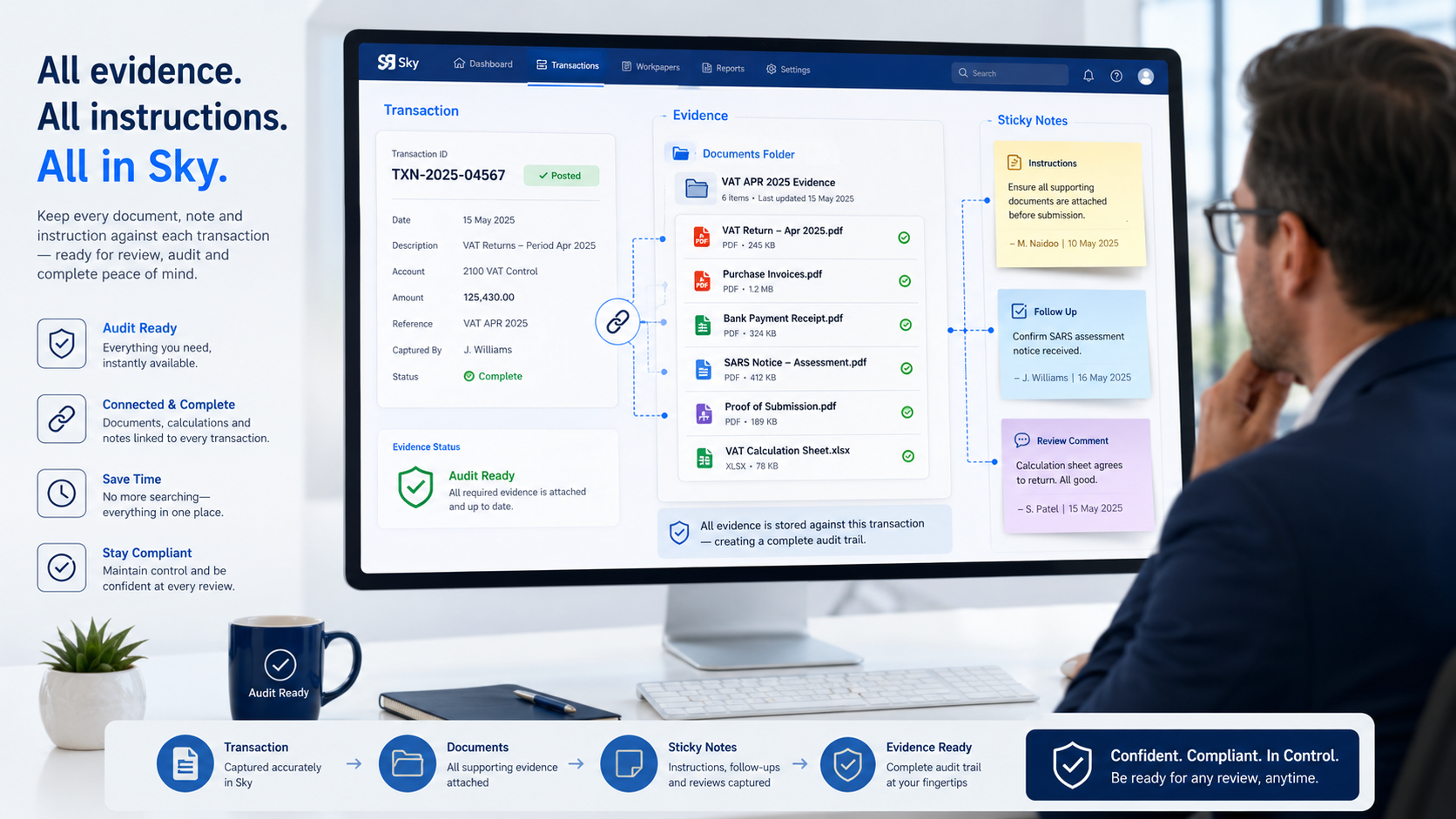
In a modern tax and accounting practice, the transaction itself is only part of the story. The real strength of a practice lies in its ability to prove, explain and defend that transaction when a client, SARS, a manager, a partner or an auditor asks the question: “Where is the evidence?”
This is where Sky plays an important role.
Sky is not simply a processing system. It is designed to create a complete working environment around each taxpayer, company, trust or client record. One of the most important parts of that environment is the ability to store documents and supporting evidence directly against the transaction to which they relate.
The documents folder and sticky notes are central to this process. Together, they help ensure that the evidence, explanations, instructions and follow-up actions relating to a transaction are not lost or separated from the work being performed.
The problem with documents stored separately
In many firms, the transaction is processed in one place, while the evidence is stored somewhere else. The supporting documents may be in an email inbox, on a staff member’s computer, in a shared drive, in a paper file, or saved under a general client folder with no clear link to the actual transaction.
This creates unnecessary risk.
When SARS raises a verification, asks for supporting documents, questions an assessment, or requests clarification, the firm must then search for the information. Staff members may need to go through emails, WhatsApps, PDFs, scanned documents and file notes just to reconstruct what happened.
This wastes time and creates uncertainty. It also makes it harder for a manager or partner to review the work properly because the transaction and the evidence are not sitting together.
Evidence belongs with the transaction
The best place to store evidence is against the transaction itself.
If a return is filed, the supporting documents should be stored with that return. If a SARS notice is received, it should be stored against the relevant matter. If a response is sent to SARS, the submission and supporting documents should be attached to the transaction. If an assessment, verification letter, statement of account, receipt or proof of payment is received, it should be available where the work is being done.
This is the practical advantage of Sky’s document functionality.
When processing a transaction in Sky, and when sending documents out, the documents checkbox should be selected so that the documents are stored automatically in the document folder against the relevant transaction. This ensures that the evidence does not disappear into a general storage area where it becomes difficult to find later.
The documents folder as the evidence file
The documents folder plays an important role in creating a proper evidence file for the transaction.
It is not merely a storage area. It is the place where the firm can retain the documents that support the transaction, including SARS correspondence, client documents, calculations, proof of submission, assessments, statements of account, receipts and other relevant material.
When documents are stored against the transaction, the user does not need to search across different systems to understand what happened. The evidence is immediately available in the same area where the transaction was processed.
This makes the practice more organised and reduces the risk of missing documents when a matter is reviewed or queried.
Sticky notes as part of the evidence trail
Sticky notes also play an important role in providing the necessary evidence.
Not all evidence is a formal document. Sometimes the key evidence is an instruction, an explanation, a follow-up note, a review comment or a record of why a particular step was taken.
Sky’s sticky notes allow these comments and instructions to be recorded against the relevant transaction or record. This is especially useful where a SARS letter requires clarification, where a verification letter has been received, where an assessment needs to be reviewed, or where a matter must be allocated to another staff member or partner.
A sticky note can record what needs to be done, who must deal with it, what the issue is, and what action was taken. This creates a practical audit trail and helps the firm show not only what documents were available, but also how the matter was managed.
In this way, sticky notes support the documents folder. The documents folder stores the evidence, while the sticky note records the instruction, explanation and follow-up action.
Better control and better review
Having the evidence available against each transaction improves the quality of the work and the control within the practice.
A reviewer can see not only that the transaction was processed, but also why it was processed in that way. A partner can check the SARS correspondence, supporting documents, client instructions and internal notes without having to ask staff to find the file.
A staff member taking over a matter can immediately see the history of the transaction, the documents attached, the sticky notes raised, the instructions given and the outcome of the matter.
This is especially important in tax work, where the firm may need to justify a position months or even years after the original transaction was processed.
Sky helps create a proper audit trail. The transaction, the SARS document, the client document, the response, the sticky note, the instruction and the outcome can all be kept together. This reduces the risk of missing information and makes the practice more efficient.
Faster responses to SARS
SARS verification and audit requests often come with short deadlines. A firm that has to start searching for documents after the request is received is already under pressure.
Where evidence has been stored correctly in Sky, the response is much easier to prepare. The user can open the transaction, review the documents folder, read the sticky notes, check what was submitted and respond with confidence.
This is a major efficiency gain.
Instead of rebuilding the file, the firm is working from an organised digital record. This saves time, reduces stress and improves the quality of the response to SARS.
Protecting the practice
Document management is not only about convenience. It is also about protecting the practice.
If a client later questions why something was done, the firm must be able to show the instruction, the calculation, the document received, the submission made and the SARS response. If SARS raises a dispute, the firm must be able to produce the relevant material quickly and accurately.
The absence of evidence can create a serious problem. A transaction may have been correctly processed, but if the supporting documents, instructions or review notes cannot be found, the firm is placed in a weak position.
Sky reduces this risk by encouraging a disciplined process: process the transaction, attach the documents, record the sticky note where necessary, store the correspondence and keep the record complete.
A better way of working
The modern accounting and tax practice must move away from scattered documents, disconnected records and informal instructions that are not properly recorded.
The future is an integrated working file where the transaction, the evidence, the documents, the instructions and the follow-up actions are kept together.
Sky provides this structure.
By storing documents against each transaction and using sticky notes to record instructions and follow-ups, Sky helps firms create a cleaner, safer and more efficient working environment. It allows staff to work better, managers to review better, partners to control risk better, and the firm to respond to SARS more effectively.
In tax practice, evidence is not an afterthought. It is part of the transaction.
Sky makes sure that the evidence is where it belongs — directly against the transaction, supported by the documents folder and strengthened by sticky notes.