
Sky Tax Knowledge
Why Accfin Uses Practitioner-Controlled eFiling Access
By Mark Silberman B.Acc CA(SA), SAICA Tax Technology Committee · 14 August 2026
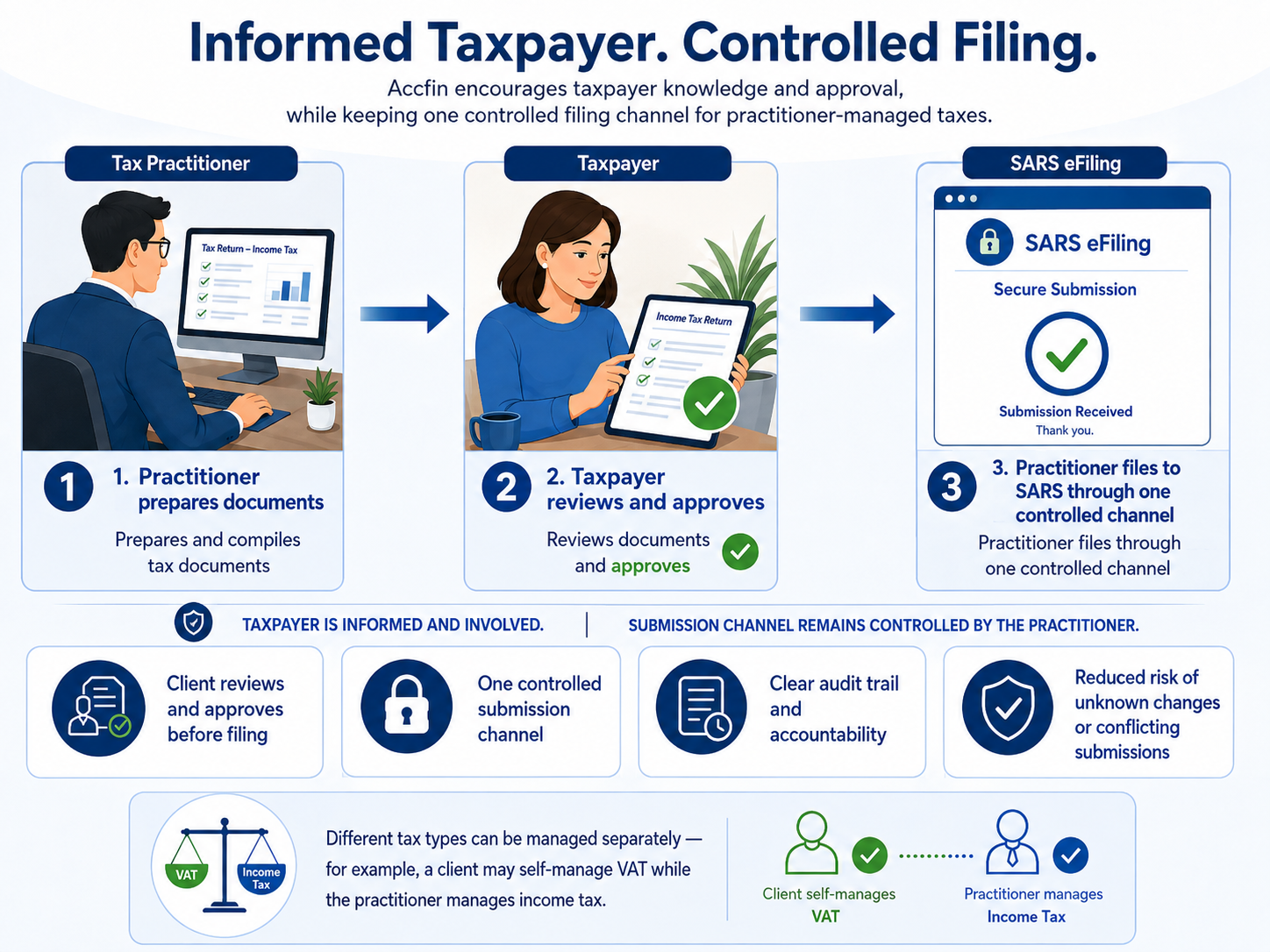
Informed taxpayer, controlled filing
Accfin strongly supports taxpayers knowing, understanding and approving their tax affairs. Our policy is about controlling who can change or submit information — not about withholding information from the taxpayer.
The principle: informed taxpayer, controlled filing
A taxpayer should always know what is being submitted to SARS. Under Accfin’s workflow, the tax practitioner prepares the calculation or return, provides it to the taxpayer for review, answers any questions, and obtains the taxpayer’s approval before filing. The taxpayer therefore remains informed and in control of the filing decision.
What Accfin does not believe is necessary is that both the practitioner and taxpayer should simultaneously be able to alter or submit the same practitioner-managed return. Full knowledge of a tax position and full transactional access to eFiling are two different things.
Why we prefer one controlled submission channel
- It avoids a taxpayer changing information or submitting a return after the practitioner has completed the work, without the practitioner knowing that the position has changed, therefore making it a major risk for the practitioner.
- It creates a clearer audit trail: the practitioner prepares, the taxpayer approves, and the approved version is filed.
- It reduces the risk of conflicting versions, duplicated actions, unexplained changes and later disputes about who submitted what.
- It allows the practitioner to accept professional responsibility for work performed under the client mandate without having to monitor a second, uncontrolled submission channel.
- It can reduce unnecessary support and reconciliation work for the taxpayer, the practice and SARS.
- In light of the significant work being done on the eFiling system, there is no guarantee that SARS will keep programming this aspect and keep it up to date.
- Over the years since the inception of Accfin eFiling tax returns, every tax practitioner has accepted our workflow because it is the safest way.
This is consistent with the mandate relationship
SARS’s eFiling Terms and Conditions require a registered tax practitioner acting for a taxpayer to hold a written mandate setting out the authority granted and acknowledging that the taxpayer’s tax liabilities remain the taxpayer’s responsibility. Accfin’s approach is built around that mandate: the practitioner acts within the agreed authority, while the taxpayer reviews and approves the information before submission.
SARS shared access is an option — not the only model
SARS provides shared-access functionality and encourages it as a means of transparency. SARS also expressly provides options under which the taxpayer does not manage or view the relevant return and full access remains with the tax practitioner. Accfin’s policy therefore does not deny the taxpayer’s right to understand their affairs; it chooses a controlled practitioner workflow for the tax types entrusted to the practitioner.
Different taxes can still be managed differently
The approach is not all-or-nothing. If a taxpayer prepares and submits their own VAT returns, for example, VAT can remain under the taxpayer’s own control while the practitioner manages income tax or provisional tax under a separate mandate. The important point is that responsibility for each tax type should be clear.
Accfin’s position
We encourage transparency, informed taxpayers and proper approval. We simply believe that transparency does not require two parties to have concurrent power to change or submit the same practitioner-managed tax return. A controlled process — prepare, disclose, approve, file and retain the audit trail — is safer, clearer and easier to account for.
SARS basis: eFiling Terms and Conditions (written mandate requirement); SARS “Shared Access” guidance (including Full Shared Access, Remove My Access and No Action options).
