
Sky Sec Knowledge
Going Back in Time on Secretarial Transactions in SKY Sec
By Mark Silberman B.Acc CA(SA), SAICA Tax Technology Committee
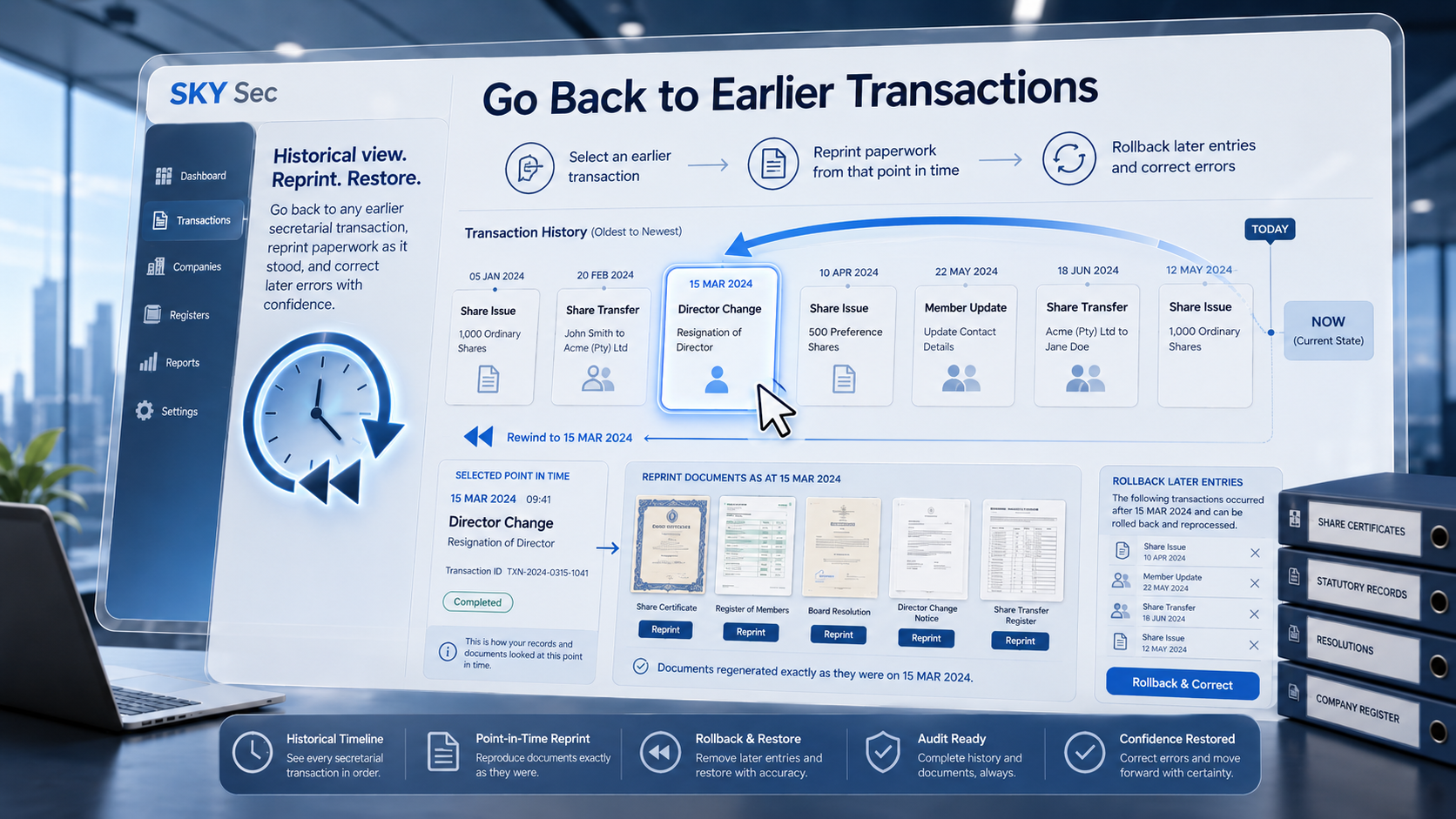
A proper company secretarial system must do more than record transactions. It must allow the practitioner to understand what happened, when it happened, who dealt with it, and what the company records looked like at a particular point in time.
This is especially important in share transactions, director changes, member updates and other statutory records where the historical position matters. A company register is not simply a current list of names and numbers. It is a permanent record of movements over time.
One of the most useful features in SKY Sec is the ability to go back to earlier secretarial transactions and reproduce the paperwork as it would have appeared at that stage of the transaction history.
Real-Time Transactions with Proper Control
SKY Sec is designed to work in real time. Transactions are captured as they happen, rather than being treated as something that only becomes effective at month-end or after a later batch process.
However, real-time processing does not mean a loss of control. Each transaction is managed through a proper workflow and status system. A transaction can move through stages such as:
- Gone for signature
- Signed
- Registered
- CIPC
- Finalised
These statuses allow the firm to see exactly where the transaction is in the process. Staff, managers and reviewers can identify whether a transaction is still waiting for signature, has been signed, has been registered, has gone to CIPC, or has been fully finalised.
Once a transaction is marked as finalised, it is locked. This is important because it protects the integrity of the record. A finalised transaction should represent a completed piece of work, supported by the correct documentation and evidence.
Reprinting Earlier Transaction Paperwork
In practice, a practitioner will often need to go back to an earlier transaction.
For example, a share transaction may have been processed months or years ago, and the firm may need to confirm exactly what certificate, register, resolution or supporting document was produced at that time. In a high-volume share environment, this can be extremely difficult if the system only shows the current position.
SKY Sec allows the user to click on an earlier transaction and reprint the paperwork linked to that transaction. This means the firm can reproduce the documents as they were generated at that point in the transaction history.
This is particularly useful when checking:
- Share certificates
- Share registers
- Director or member changes
- Resolutions and supporting documents
- Historical ownership positions
- The sequence of transactions leading to the current position
The ability to reprint earlier paperwork gives the practitioner a clear audit trail and helps ensure that the records can be explained long after the transaction was originally processed.
Correcting Later Errors Without Losing the Past
Another important benefit is the ability to correct later errors.
Sometimes an error is discovered after a later transaction has already been processed. In that case, the later transactions may need to be removed and reprocessed correctly. SKY Sec supports this type of correction by allowing later entries to be rolled back and then redone in the correct sequence.
This is not the same as simply overwriting the current record. It is a controlled way of restoring the transaction trail so that the company records remain consistent.
The principle is important: the historical transactions that were correct should not be lost simply because a later error occurred. The system allows the firm to go back to the relevant point, correct the sequence, and then rebuild the records properly.
Why This Matters for Share Registers
The "go back in time" feature is particularly valuable in share register work.
Share transactions build on each other. A later transfer, allotment, buy-back or reclassification may depend on what happened before it. If one step is wrong, the later register may also be wrong.
In a manual system, or in a system that only reflects the current position, it can be very difficult to reconstruct what happened. The practitioner may have to search through old documents, certificates, registers, emails and resolutions to work out the correct sequence.
SKY Sec helps by keeping the transaction history in the system. Users can go back to earlier transactions, view the position at that stage, and reprint the paperwork that supports the transaction.
This gives the firm better control over the permanent company record.
Finalisation Protects the Record
Finalising transactions is a key part of the control process.
When a transaction has been completed, signed and properly supported, it should be marked as finalised. This locks the transaction and prevents accidental changes. It also gives the firm a clear indication that the work has been completed and reviewed.
Finalisation therefore supports both workflow control and data integrity.
A transaction that is still in progress can continue through the status process. A transaction that is complete should be finalised and preserved as part of the permanent record.
A Practical Secretarial Control Tool
The ability to go back in time in SKY Sec gives practitioners two major advantages.
First, they can reprint the paperwork for an earlier transaction and see what the records looked like at that point.
Second, where later errors have occurred, they can roll back those later transactions and reprocess them correctly.
This gives the firm a practical way to manage historical records, correct mistakes, and maintain a reliable transaction trail.
For company secretarial practitioners, this is not simply a convenience feature. It is an important control tool. It helps ensure that the company records remain accurate, explainable and properly supported by documentation.
In a modern secretarial practice, the ability to reproduce the historical position is essential. SKY Sec gives users that ability directly inside the transaction system.