
Secretarial Practice Centre
Section 48(8) and Share Buybacks: The New Rules Practitioners Must Understand
By Mark Silberman B.Acc CA(SA), SAICA Tax Technology Committee
Introduction
Share buybacks are a common commercial tool. They are used to restructure ownership, return capital to shareholders, settle disputes between shareholders, facilitate exits, simplify a shareholding structure, or acquire shares held by a departing shareholder.
However, a share buyback is not merely an accounting transaction or a commercial agreement between the company and the selling shareholder. It is a transaction regulated by the Companies Act 71 of 2008, and it affects capital maintenance, creditor protection, shareholder equality, board responsibility, and in some cases takeover regulation.
The amendment to section 48(8) has materially changed the way practitioners must approach share buybacks. The old "5% rule" has been removed. This is an important simplification, but it does not mean that buybacks are now informal or free of shareholder approval. In fact, the new section 48(8) creates a different and arguably broader approval test.
The practical message is this: under the new regime, the question is no longer simply whether the buyback exceeds 5% of a class of shares. The correct questions are now: who is selling, how is the offer made, whether the transaction is pro rata or selective, whether the shares are traded on a recognised exchange, whether the solvency and liquidity test is satisfied, and whether the transaction is in substance a scheme of arrangement.
The Old Section 48(8): The Former 5% Trigger
Before the amendment, section 48(8) created two important triggers.
First, if the company acquired shares from a director, prescribed officer, or a person related to a director or prescribed officer, the board decision had to be approved by special resolution of shareholders.
Secondly, if the buyback, considered alone or together with other transactions in an integrated series, involved the acquisition by the company of more than 5% of the issued shares of any particular class, the transaction was made subject to sections 114 and 115.
This created a major practical difficulty. A buyback exceeding the 5% threshold could be forced into the procedural framework normally associated with schemes of arrangement and fundamental transactions. This could involve additional procedural requirements, expert reports, shareholder approvals and potential appraisal rights.
For many private companies, this was cumbersome. A perfectly commercial buyback between a company and a willing shareholder could be treated procedurally as if it carried the same weight as a major corporate restructuring. The result was often delay, cost and uncertainty.
The New Section 48(8): The 5% Rule Falls Away
The new section 48(8) changes the approach. The previous automatic rule that linked a buyback of more than 5% of a class of shares to sections 114 and 115 has been removed.
This is the most important change. A buyback is no longer automatically pushed into the scheme of arrangement procedure simply because it exceeds 5% of a class of shares.
Instead, the new section 48(8) focuses on whether a special resolution is required.
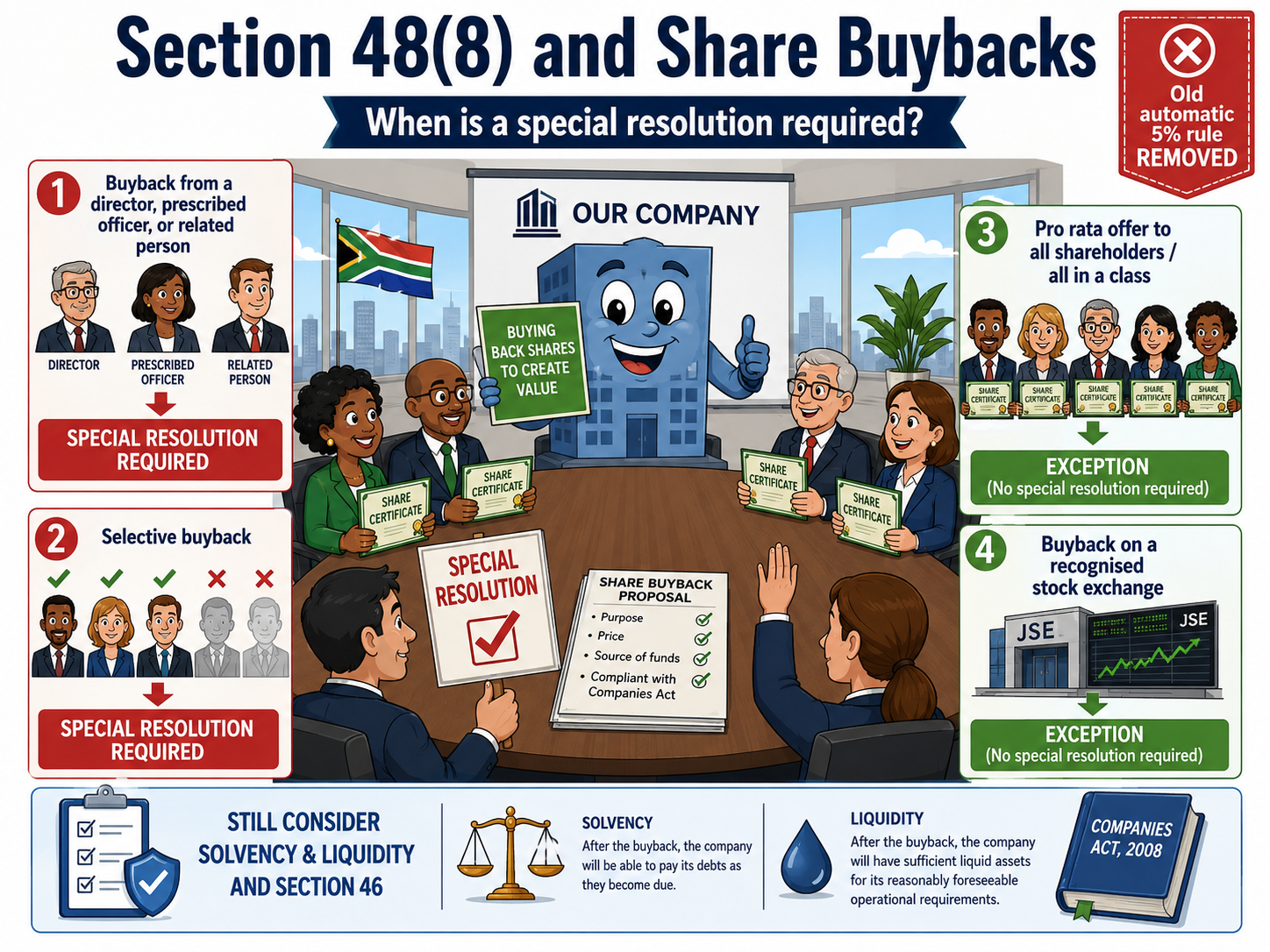
A decision by the board of a company to acquire its own shares must be approved by special resolution if the shares are acquired from a director, prescribed officer, or a person related to a director or prescribed officer.
In addition, a special resolution is required where the transaction entails the acquisition by the company of its own shares, unless the acquisition arises from one of two exceptions.
The first exception is a pro rata offer made by the company to all shareholders, or to all shareholders of a particular class. This remains so even if the pro rata offer includes shareholders who are directors, prescribed officers or persons related to them.
The second exception is a transaction effected on a recognised stock exchange on which the shares are traded, being a licensed exchange under the Financial Markets Act.
The effect is that selective buybacks will usually require a special resolution. Pro rata buybacks and exchange-traded buybacks may fall outside the special resolution requirement in section 48(8), although other legal, MOI, listing, tax and regulatory requirements must still be considered.
The New Practical Test
Practitioners should no longer start with the old 5% question. The better approach is to apply a practical decision tree.
- Is the company acquiring its own shares? If yes, section 48 is engaged.
- Is the selling shareholder a director, prescribed officer, or related person? If yes, a special resolution is required unless the transaction falls within the pro rata offer wording.
- Is the buyback pro rata to all shareholders or to all shareholders of a particular class? If yes, the transaction may fall within the statutory exception.
- Is the transaction effected through a recognised stock exchange? If yes, the second exception may apply.
- If neither exception applies, the transaction is a selective repurchase and a special resolution will be required.
- Even if section 48(8) does not require sections 114 and 115 merely because of size, the practitioner must still consider whether the transaction is in substance a scheme of arrangement.
Sections 114 and 115: Not Gone, But No Longer Automatic
It would be wrong to conclude that sections 114 and 115 are irrelevant after the amendment. What has been removed is the automatic 5% gateway.
A buyback may still be structured in a way that amounts to a scheme of arrangement. This will depend on the facts. Where the transaction is simply a consensual agreement between the company and a willing selling shareholder, and it does not bind non-consenting shareholders or alter their rights, it is less likely to be a true scheme of arrangement.
However, where the transaction forms part of a broader arrangement between the company and holders of a class of securities, and shareholders are bound through a statutory approval mechanism, sections 114 and 115 may still need to be considered.
The distinction is important. The practitioner must examine the substance of the transaction, not merely the percentage of shares being repurchased.
Solvency and Liquidity Remain Central
The removal of the 5% rule does not dilute the capital maintenance protections in the Act.
A share buyback remains subject to the solvency and liquidity requirements. The board must consider whether the company will satisfy the solvency and liquidity test immediately after completing the transaction. This is not a box-ticking exercise.
The board should record the financial information considered, the basis of the valuation, the effect of the payment on creditors, cash flow forecasts, liabilities, contingent liabilities and whether the company will be able to pay its debts as they become due in the ordinary course of business.
The buyback should also be considered as a distribution for purposes of the Act. This means that section 46 must be dealt with properly, including the board resolution and the reasonable conclusion that the company will satisfy the solvency and liquidity test.
A failure to document this properly may expose directors to personal risk, especially if the company later experiences financial difficulty.
MOI and Template Risk
One of the most practical dangers is that many companies still have memoranda of incorporation, precedent resolutions and secretarial checklists based on the old section 48(8).
A company's MOI may repeat the old 5% rule or impose stricter approval requirements than the Act. If so, the MOI must still be followed unless and until it is amended.
This creates a practical trap. The Act may have been simplified, but the company's own constitutional document may preserve the old approach. Practitioners should therefore never assume that the statutory amendment automatically changes the company's internal approval requirements.
Every buyback should begin with a review of the MOI.
Private Companies and Shareholder Exits
The amendment is particularly important for private companies.
In many private companies, a buyback is used when one shareholder exits and the remaining shareholders do not want to buy the shares personally. The company buys back the shares, cancels or holds them as permitted, and the ownership percentages of the remaining shareholders effectively increase.
Under the old regime, if the buyback exceeded 5% of a class, there was a risk that the transaction would be pushed into the procedural world of sections 114 and 115. Under the new regime, the practitioner must rather determine whether the transaction is a selective buyback requiring a special resolution, and whether it is in substance a scheme.
In most private company exit transactions, the buyback will be selective and will therefore require shareholder approval by special resolution. That is simpler than the old automatic sections 114 and 115 trigger, but it is still a formal process.
Regulated Companies and TRP Considerations
The buyback analysis should not stop at section 48.
Where the company is a regulated company, the takeover provisions and Takeover Regulation Panel requirements must also be considered. This is particularly relevant where the buyback changes control percentages or forms part of an affected transaction.
The amendment to section 48(8) does not eliminate the need to consider Chapter 5 of the Act. A private company may also be a regulated company in certain circumstances. Practitioners should therefore consider whether the company falls within the regulated company provisions before treating the buyback as a purely internal matter.
Tax and Accounting Considerations
A share buyback also has tax and accounting consequences.
For tax purposes, the treatment of the payment must be considered carefully. The transaction may involve dividend tax consequences, capital gains tax implications, contributed tax capital considerations, and possible anti-avoidance concerns depending on how the transaction is structured.
From an accounting perspective, the company must account properly for the repurchase, the reduction in equity, and any related disclosures. The board should ensure that the accounting treatment aligns with the legal form and commercial substance of the transaction.
The company secretary, accountant and tax practitioner should therefore work together. A buyback should not be processed only as a secretarial event.
Practical Documentation Checklist
A proper buyback file should include at least the following:
- The signed buyback agreement or offer documentation.
- The current MOI and confirmation that its requirements were checked.
- A board memorandum explaining the commercial rationale.
- A board resolution approving the transaction.
- A solvency and liquidity assessment.
- Management accounts or financial information relied upon by the board.
- The special resolution, where required.
- Confirmation whether the transaction is pro rata, selective, or exchange-traded.
- Confirmation whether the seller is a director, prescribed officer or related person.
- Confirmation whether sections 114 and 115 were considered.
- Confirmation whether the company is a regulated company.
- Tax advice or tax working papers.
- Updated securities register and beneficial ownership records.
- Proof of payment and accounting entries.
- Any CIPC or regulatory filings required by the transaction.
This documentation is not merely administrative. It is the evidence that the board applied its mind and that the transaction was lawfully implemented.
Conclusion
The amendment to section 48(8) is a welcome change. It removes the mechanical and often burdensome rule that treated a buyback of more than 5% of a class as automatically subject to the procedural requirements of sections 114 and 115.
However, the amendment does not make buybacks informal. It changes the compliance question.
Practitioners must now focus on whether the buyback is selective, whether the seller is connected to management, whether the transaction is pro rata or exchange-traded, whether the solvency and liquidity test is satisfied, whether the MOI imposes additional requirements, and whether the transaction is in substance a scheme of arrangement.
The old 5% shortcut is gone. The need for careful professional judgement remains.